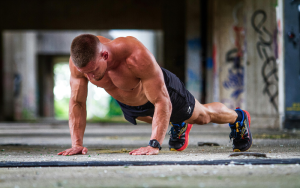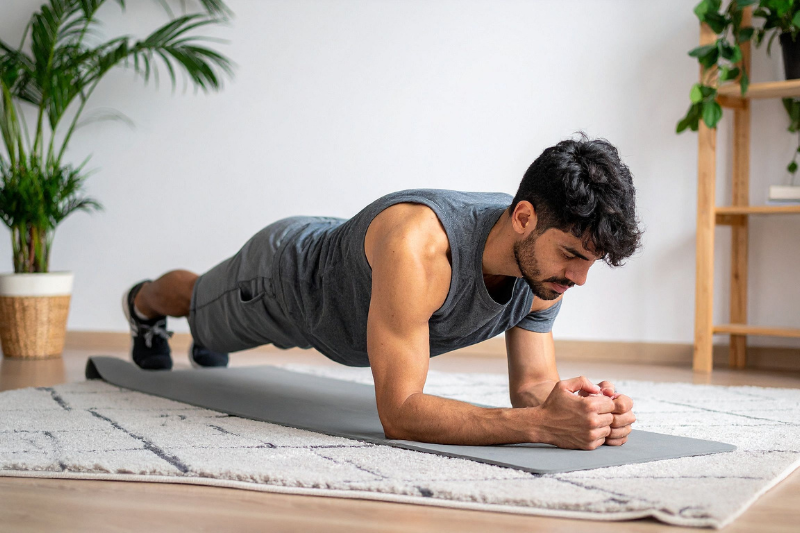
A plank works your entire trunk — mainly the rectus abdominis, the obliques, and the deep transversus abdominis — but its real job is to stop your hips from sagging, not to flex your spine the way a crunch does.
Keep reading to understand exactly which muscles are doing what, why your body position matters more than how long you hold, and how to get far more out of the exercise than most people do.
The Plank Is an Anti-Extension Exercise, Not a Crunch
Most people think of the plank as a core exercise in the same category as a crunch or sit-up. It's not. A crunch works by shortening the rectus abdominis through spinal flexion — your spine rounds, the muscle contracts, job done.
A plank does the opposite. Your spine stays neutral, and your muscles fire continuously just to keep it that way.
That continuous firing is what “anti-extension” means. Gravity is constantly pulling your hips toward the floor, which would arch your lower back if your trunk muscles let it happen.
They don't — or at least, they shouldn't. The whole point of the exercise is that your abs, obliques, and deep core generate enough tension to resist that pull and hold the line.
This distinction matters more than it might seem, for two reasons:
- What you should feel: If a plank is working correctly, you feel it in the front of your trunk — your abs and sides — not your lower back. Lower back discomfort is a signal that your hips have dropped and load has shifted away from the muscles and onto the passive structures of the lumbar spine.
- How you should set up: Because the goal is resisting extension, your starting position determines almost everything. A slight posterior pelvic tilt (tucking the tailbone toward your ribs) puts your trunk muscles in the best position to do that job before you even start the clock.
Think of it less as “holding a position” and more as “actively bracing against a force.” That mental shift alone tends to improve both form and muscle engagement immediately.
The Primary Muscles Doing the Heavy Lifting
Four muscles carry most of the load in a standard plank, and understanding what each one actually does changes how you think about the exercise.
Rectus abdominis — This is the superficial “six-pack” muscle running vertically along the front of your abdomen. In a plank, it contracts isometrically, meaning it generates force without changing length. It's not shortening to flex your spine; it's bracing to prevent your spine from extending. That's a fundamentally different demand than what a crunch places on it.
External and internal obliques — These run diagonally along the sides of your trunk, connecting your ribs to your pelvis. Beyond supporting anti-extension, they handle anti-rotation — resisting any tendency for your hips or shoulders to twist out of alignment. In a standard two-point plank, you might not notice them working, but they're on the whole time.
Transversus abdominis (TrA) — The deepest abdominal layer, wrapping your trunk horizontally like a built-in weight belt. Its primary role is generating intra-abdominal pressure, which stiffens the spine from the inside. It doesn't produce visible movement, which is partly why it's underappreciated — and also why it's hard to measure accurately in research.
Here's where the data gets interesting. EMG studies consistently show that the external oblique, not the rectus abdominis, tends to be the hardest-working muscle in a standard plank.
In one well-cited study, the external oblique hit 52.2% of maximum voluntary contraction compared to just 27.3% in the upper rectus abdominis — nearly double. That pattern holds across multiple studies.
The practical takeaway: if you've been thinking of the plank purely as an “ab exercise” targeting your six-pack, the obliques are doing at least as much work, if not more.
The Supporting Cast — Secondary Muscles Involved
The plank is often sold as a core exercise, but your body doesn't really work in isolation like that. From your shoulders to your feet, several other muscle groups are contributing to the hold — some more than you'd expect, and one far less.
Glutes and quads keep your hips extended and your knees straight throughout the hold. Actively squeezing your glutes isn't just a coaching cue for appearance — it directly reduces the anterior pelvic tilt that lets your hips sag, which in turn keeps the load where it belongs: on your abs, not your lower back.
Serratus anterior is the muscle that pins your shoulder blades flat against your ribcage. Without it doing its job, the scapulae lift away from the ribs — a fault called scapular winging — which destabilizes the entire shoulder girdle.
It's easy to overlook because you can't see it working, but a collapsing upper back between the shoulder blades is a sign it's not engaged.
The broader shoulder girdle — trapezius, rhomboids, rotator cuff, deltoids, and lats — all contribute as stabilizers, keeping the shoulders packed and the upper body from shifting or rotating. How much they work depends partly on which plank variation you're doing, which is covered in the next section.
The one that might surprise you: the spinal erectors. Despite what some fitness content suggests, the plank does not meaningfully train your lower back. EMG data puts erector spinae activation at around 5% of maximum voluntary contraction during a standard plank — low enough that it's essentially just along for the ride. The plank is an anterior-dominant exercise. If lower back strength is your goal, you need different tools.
Forearm Plank vs. High Plank — What Actually Changes
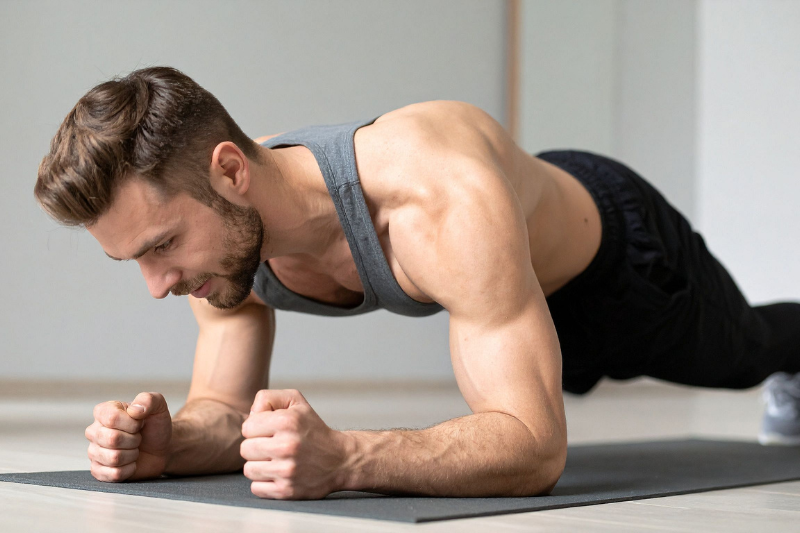
The short answer: your core works roughly the same in both. The meaningful differences are almost entirely in the upper body, which makes the choice between them straightforward once you know what you're training for.
In the forearm plank, the arms and shoulders contribute less to supporting your bodyweight, which puts a slightly greater relative demand on the anterior core.
It's also easier on the wrists, making it the better default for anyone with wrist discomfort or those focused purely on trunk training.
The high plank shifts a meaningful amount of work onto the shoulder girdle and arms.
Research comparing the two found that the straight-arm position produced significantly greater lower trapezius and triceps activation than the forearm version — and those differences were statistically robust, not marginal.
If you're building toward push-up strength or shoulder stability work, the high plank has a clear edge.
The serratus anterior deserves a specific mention here. In the high plank, your hands are flat on the floor and your scapulae need to be actively protracted — pushed forward and flat against the ribcage — to keep the position stable.
That active protraction demand makes the serratus anterior work harder than it does in the forearm version, where the scapular load is lower.
In practical terms, the choice comes down to goal:
- Forearm plank — maximum core emphasis, wrist-friendly, good default for most people
- High plank — adds lower trapezius, triceps, and serratus demand; better carryover to pressing movements
There's no reason to pick one permanently. Both have a place depending on what you're working on that day.
How Your Body Position Changes Everything
Of all the variables in a plank, body position has the biggest impact on what actually gets trained. Two people can hold a plank for the same duration and get completely different results based on alignment alone.
Posterior pelvic tilt — tucking your tailbone toward your ribs rather than letting it point upward — is the single most effective positional adjustment you can make. Research shows it produces the largest increase in abdominal muscle activation of any positional change, and combining it with scapular adduction raises the EMG response even further. It's a small adjustment that makes a significant difference.
Lever arm length is where the numbers get dramatic. Moving your elbows forward of your shoulders (the “long-lever” position) while maintaining a posterior pelvic tilt produces some of the highest abdominal activation values recorded in plank research:
- Upper rectus abdominis: 27.3% → 109.7% MVC
- External oblique: 52.2% → 148.7% MVC
That's not a modest improvement — it's a fundamentally harder exercise. If you've plateaued on standard plank variations, shifting your elbows a few inches forward is one of the most efficient progressions available.
The two positions that quietly undermine the exercise:
- Hips too low (sagging): The abs disengage, the ribs flare, and load transfers to the ligaments and discs of the lumbar spine. This is the most common plank fault, and it's counterproductive — you're no longer training the muscles the exercise is designed for.
- Hips too high (piking): This reduces the anti-extension demand on the abdominals, making the hold easier in a way that defeats the purpose. The core simply does less work.
One detail that often gets overlooked: neck position. Flexing the neck — tucking the chin rather than holding it neutral or extended — has been shown to increase total core activation.
It's a minor variable compared to hip position or lever length, but it's worth knowing if you're optimizing.
The bottom line is that a plank's effectiveness isn't really about duration. It's about maintaining the specific alignment that keeps maximum tension on the right muscles throughout the hold.
Common Plank Mistakes and How to Fix Them
Most plank errors fall into one of two categories: form breakdowns that shift load away from the target muscles, and programming habits that limit progress over time.
The three most common mistakes:
- Holding longer instead of progressing difficulty. A 3-minute plank with mediocre form trains endurance, not strength. Once you can hold a clean plank for 30–60 seconds, adding more time produces diminishing returns. The stimulus your muscles need to adapt comes from increased intensity, not increased duration.
- Feeling it in the lower back and thinking that's normal. Lower back discomfort during a plank is not a sign the exercise is working — it's a sign your hips have dropped and load has moved onto the passive structures of the lumbar spine. The plank should be felt in the front and sides of your trunk. Full stop.
- Assuming the six-pack is the main event. As covered earlier, the obliques frequently outwork the rectus abdominis in EMG measurements. If you're only cueing “squeeze your abs,” you're likely underengaging the muscles doing the most work.
How to set up correctly — in order:
- Get into position with elbows or hands under shoulders, body in a straight line from head to heels
- Squeeze your glutes
- Tuck into a slight posterior pelvic tilt
- Draw your belly button up and in
- Then start the timer
That sequence — glutes, tilt, brace — maximizes abdominal engagement and protects the lumbar spine before the hold even begins.
When and how to progress: Once 30–60 seconds feels manageable with clean form, the right move is to increase difficulty rather than time. Move your elbows forward to lengthen the lever, add a posterior pelvic tilt if you haven't already, or lift one foot or one arm to remove a point of contact. Any of these options raises muscle activation substantially more than simply holding longer.
Conclusion
The plank is a more complex exercise than it looks, and most of the common assumptions about it — that it's mainly an ab exercise, that longer is better, that your lower back should feel it — don't hold up against the evidence.
What actually matters is understanding which muscles are working, why position determines everything, and how to progress intelligently rather than just adding time.
Get those three things right and you'll get far more out of every second you spend in the hold.