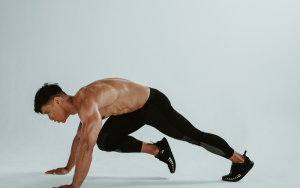
If you want one move to build serious triceps size without touching a single weight, it's the diamond push-up—research shows it consistently ranks as the top triceps activator among common bodyweight and weighted exercises alike.
Keep reading for the exact form cues, progressions, and a full arm day workout built around it.
Why the Diamond Push-Up Is the Best Bodyweight Move for Your Triceps
Your triceps take up roughly two-thirds of your upper arm's total volume, which means they matter far more for arm size than your biceps do. The muscle has three separate heads working together every time you straighten your elbow:
- Long head – the largest of the three, crosses the shoulder joint, responds especially well to overhead and stretched positions
- Lateral head – gives you that outer “horseshoe” shape when developed
- Medial head – sits deeper and stays active through basically every pressing and extension movement
Given how much real estate the triceps take up, picking the right exercise isn't a minor detail—it's the difference between arms that look proportionate and arms that don't.
That's where the research gets interesting. A study measuring muscle activation across eight common triceps exercises found the diamond (or triangle) push-up produced the highest activity of the bunch, with dips and kickbacks trailing close behind.
Movements like overhead extensions, pushdowns, close-grip bench, and lying extensions all came in noticeably lower. So if you're choosing one move to build your arm day around, the diamond push-up earns its reputation.
A newer study added some nuance worth knowing. It confirmed the diamond push-up still activates the triceps more than a wide push-up, but the gap between it and a standard push-up was much smaller than expected—not enough to call one definitively superior to the other.
Here's what that actually means for your training: the exact exercise matters less than how you position your hands and elbows.
Narrow hand placement combined with elbows tucked tight to your body is what drives higher triceps activation, whether you're doing a diamond, close-grip, or standard push-up. Get that positioning right, and you're already doing the most important part correctly.
How to Grow Triceps Without Adding Weight
With barbells and dumbbells, progression is simple: add more weight over time. Bodyweight training takes that lever away, so you need other ways to keep making a set harder than it was last week. Four tools do the job well.
Change your leverage. This is your main substitute for adding plates. As you get stronger, shift your body position so more of your weight loads onto your arms:
- Elevate your feet on a bench or step to increase the load on your upper body
- Add a deficit by placing your hands on blocks or parallettes, which increases your range of motion
- Lean into a pseudo-planche position, shifting your shoulders further past your hands
- Progress to an archer push-up, shifting your weight almost entirely onto one arm at a time
Train close to failure. Since you can't just add 5 pounds to the bar, effort has to make up the difference. Aim to stop each set somewhere between 0 and 3 reps before failure. This is arguably the single biggest factor in whether bodyweight training builds muscle at all—research shows that light-load, high-rep work matches heavy training for growth, but only when you're actually pushing sets hard.
Slow down your reps. A controlled 2-3 second lowering phase keeps tension on the triceps and prevents you from using momentum to cheat the movement. Bouncing at the bottom of a push-up shifts work away from the muscle and onto your joints and connective tissue—exactly what you don't want.
Use intensity techniques to extend a set. Once a variation gets too easy to challenge you within a reasonable rep range, these methods let you keep pushing:
- Drop sets – move from a harder variation to an easier one the moment you hit failure (feet-elevated diamond push-ups into standard diamonds into knee push-ups, for example)
- Rest-pause – take 10-15 seconds after reaching failure, then squeeze out a few more reps
- Mechanical drop sets – shift hand position instead of body position, moving from archer to wide to standard push-ups as fatigue builds
Put these four elements together, and bodyweight training builds muscle just as effectively as lifting weights. The mechanism driving growth isn't the barbell itself—it's mechanical tension and effort, and you can generate both without any equipment at all.
The Long Head Needs Overhead Work — Here's Why
Most push-up variations and dips train your triceps with your arms down by your sides. That's a problem for one specific part of the muscle.
The long head is the only one of the three triceps heads that crosses the shoulder joint, which means its involvement changes depending on where your arm is positioned—not just how much you bend your elbow. Train exclusively with your arms at your sides, and you're neglecting the exact position that stretches this head the most.
A 12-week study on cable elbow extensions made this gap obvious. Researchers compared two arm positions: one with the arm held overhead, and one with the arm held in a neutral position at the side.
The overhead position grew the long head 1.5 times more than the neutral position—despite using 34-39% less load.
Less weight, more growth, simply because of arm position. The lateral and medial heads showed a similar advantage from the overhead angle, just to a slightly smaller degree.
That finding matters for anyone training triceps without weights, because it points to a specific gap in a typical bodyweight routine.
Diamond push-ups, dips, and close-grip work are excellent, but none of them place your arms overhead. Two bodyweight moves fill that gap:
- Pike push-ups – hips lifted, arms overhead in a downward-dog position, closely mimicking the overhead angle from the cable study
- Bodyweight bar skull-crushers – hands on a waist-height bar, body angled into a plank, elbows bending to lower the head toward the bar and stretch the long head under load
Skip these movements entirely, and you're not doing anything wrong—you're just leaving a specific type of growth on the table. The long head responds to a stimulus that flat-arm pressing and dipping simply can't provide.
Adding one overhead-pattern move to your routine closes that gap without requiring any equipment beyond a sturdy bar or elevated surface.
Your Full Bodyweight Triceps Exercise Toolkit

Here's the complete set of movements to build your arm day around, from your primary builder to advanced overload work.
Diamond / Triangle Push-Up (Primary Builder)
Place your hands under your chest with index fingers and thumbs touching to form a triangle shape. Keep your body in a rigid plank from head to heels, elbows tucked close to your ribs rather than flared out, and lower until your chest nears your hands before pressing back to full lockout. You should feel this in your triceps, not the front of your shoulders.
- Too hard? Drop to your knees, or elevate your hands on a bench or counter
- Too easy? Elevate your feet, then progress to a deficit using parallettes or books, then add tempo, pauses, or a weighted pack
Close-Grip Push-Up
Set your hands just inside shoulder width with elbows tucked tight throughout the movement. This variation is gentler on your wrists than the diamond position, which makes it useful when you want to grind out more reps without wrist discomfort. Use the same plank and lockout cues as the diamond push-up.
Parallel-Bar Dip
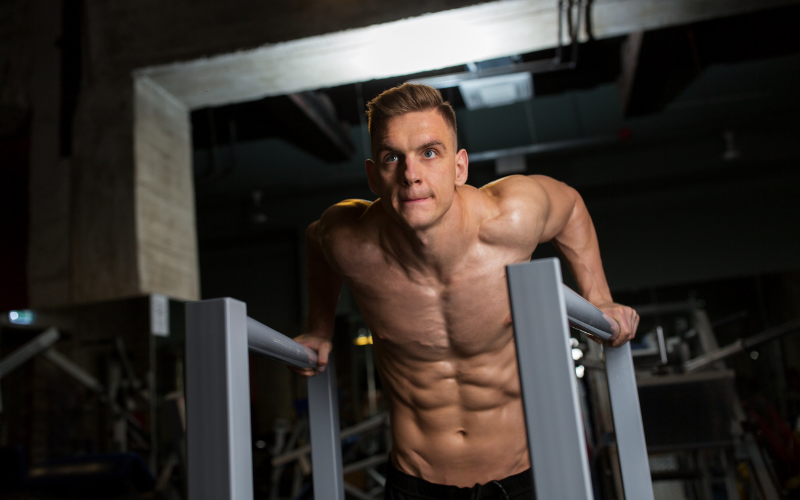
Stay as upright as possible—leaning forward shifts the emphasis toward your chest instead of your triceps. Pack your shoulders down and away from your ears, lower until your shoulder is roughly at elbow height (or as deep as feels comfortable), then drive back up to a strong lockout. Once bodyweight reps become easy, add load with a backpack or dip belt.
Bench Dip
This one works, but it comes with a real shoulder risk worth respecting. The internally rotated arm position behind your body can cause impingement if you're not careful.
- Keep your back grazing the bench throughout
- Squeeze your shoulder blades together before each rep
- Lower only until your upper arms are roughly parallel to the ground
- Stop the instant you feel shoulder pinching, not muscle fatigue
Regress: bend your knees and keep feet close to your body
Progress: straighten your legs, then elevate your feet on a second bench, then add a plate to your lap
Bodyweight Skull-Crusher
Set your hands on a bar or sturdy table at waist-to-hip height, then walk your feet back into a plank angle with elbows pointed slightly forward.
Bend only at the elbows to lower your forehead toward (or just past) the bar, feel the stretch, then extend back to lockout without letting your elbows flare. This is the closest bodyweight equivalent to an overhead cable extension, and it directly targets the long head.
Regress: raise the bar higher for a more upright body position
Progress: lower the bar, walk your feet farther back, or slow the eccentric
Pike Push-Up
Start in a downward-dog position with your hips lifted high, lower the crown of your head toward the floor between your hands with elbows at roughly 45 degrees from your torso, then press back to lockout.
This move leans on the shoulders more than the others here, but your triceps finish every single rep, and the overhead arm angle is exactly what drives long-head growth.
Regress: elevate your hands on a bench
Progress: elevate your feet, then work toward wall handstand push-ups
Archer Push-Up
This is your advanced unilateral overload option. Set your hands wider than shoulder width with fingers angled about 45 degrees outward, then shift your weight toward one hand while bending that elbow—the other arm stays nearly straight, acting like a kickstand. Lower your chest toward your working hand, then press back up.
This shifts the vast majority of the load onto a single arm without any equipment, and it serves as a natural bridge toward eventually training one-arm push-ups.
If you can't keep your non-working arm straight throughout the movement, drop back to wide or standard push-ups until you build the strength to control it.
The Complete Torch-Your-Triceps Arm Day Workout
Here's how to put everything together into one session, ordered from hardest leverage work to burnout finisher.
Warm-Up
Spend a few minutes preparing your shoulders and elbows before loading them:
- Arm circles, forward and backward
- Light scapular work (band pull-aparts or wall slides)
- 1-2 easy sets of standard push-ups
- An overhead triceps stretch to open up the shoulder joint
The Workout
- Feet-elevated diamond push-ups — 4 sets x 8-12 reps, 2-second descent, 1-second press, 90 seconds rest. This is your primary builder. If it's too easy even with feet elevated, add a deficit; if it's too hard, drop to the floor or your knees.
- Parallel-bar dips — 3 sets x 8-12 reps, 90-120 seconds rest. Stay upright to keep the emphasis on triceps rather than chest. If dips bother your shoulders, substitute close-grip push-ups instead.
- Bodyweight bar skull-crushers — 3 sets x 10-15 reps, controlled 3-second eccentric, 60-90 seconds rest. This is your long-head, overhead-pattern move. Adjust the bar height to dial in difficulty.
- Pike push-ups — 3 sets x 8-12 reps, 90 seconds rest. Keeps your arms working in that overhead position. Scale with hand or foot elevation depending on your strength level.
- Close-grip push-up drop set (finisher) — 1-2 rounds to failure: max reps with feet elevated, immediately followed by max reps on the floor, immediately followed by max reps on your knees. Rest 2 minutes between rounds. This is where you drive metabolic stress and end the session completely spent.
That's roughly 13-15 direct triceps sets in one session.
Weekly Structure
Run this workout once or twice per week. If you're training triceps twice weekly, vary the emphasis between sessions rather than repeating the exact same session twice:
- Session A: lean on diamonds and dips for heavier mechanical tension
- Session B: emphasize skull-crushers and pike push-ups with higher-rep burnout work
Progress week to week the same way you'd add plates to a bar—just through different means. Add reps, elevate your feet higher, move toward deficit or archer variations, or slow your tempo down. Any of these keeps the stimulus increasing even though the exercises themselves stay the same.
How to Progress, Troubleshoot, and Support Growth
Weeks 1-4: Build the Foundation
Anchor every session around diamond push-ups, using whichever variation lets you hit 8-12 hard reps with 1-2 reps left in reserve—knees, floor, or feet-elevated, depending on your current strength.
Add dips or close-grip push-ups alongside one long-head move (bar skull-crushers or pike push-ups). Keep total weekly triceps volume around 10-12 sets across two sessions while your joints and connective tissue adapt to the new demand.
Weeks 5-8: Increase the Demand
Once the basics feel manageable, push most sets closer to failure—0-2 reps in reserve rather than 1-2. Add the drop-set finisher to your routine and start climbing the leverage ladder: feet-elevated into deficit, then eventually into archer variations. If recovery is holding up well, nudge weekly volume up toward 14-18 sets.
When to Progress to Harder Variations
Use concrete performance benchmarks rather than guessing:
- Once you can complete 3 clean sets of 15 feet-elevated diamond push-ups, move to deficit or archer variations
- If a variation stops challenging you within your target rep range, that's your signal to increase leverage difficulty rather than just adding more sets
When to Back Off
Joint pain is a different signal than muscle fatigue, and it means something needs to change immediately:
- If your elbows or shoulders start feeling achy, cut back on dip or skull-crusher volume right away
- Swap bench dips for close-grip push-ups if you notice any shoulder pinching—the risk isn't worth pushing through
- Always prioritize pain-free range of motion over hitting a specific rep count
If Growth Stalls
Two to three weeks of hitting your reps without visible progress calls for a specific adjustment, not just more volume for its own sake:
- Add a third weekly training session if you're currently only training twice
- Introduce a second intensity technique, such as rest-pause, rather than simply adding more sets to your existing routine
Supporting Growth Outside the Gym
Training stimulates growth, but recovery and nutrition are what actually let it happen:
- Protein intake: aim for roughly 1.6 grams per kilogram of bodyweight daily, which research points to as the practical optimum for muscle growth
- Recovery time: space hard triceps sessions about 48 hours apart to allow the muscle to repair and grow between workouts
Stick with this approach consistently, and the diamond push-up along with its supporting movements will do exactly what the research suggests they can—build triceps size without a single plate added to a bar.
Conclusion
The diamond push-up stands out as your most reliable bodyweight triceps builder, but real growth comes from combining it with overhead-pattern moves, smart progression through leverage, and training close to failure.
Follow the workout and progression plan outlined here, and you'll have everything you need to build noticeably bigger, stronger triceps without ever touching a weight.
Stay consistent, listen to your joints, and give your arms 48 hours to recover between sessions—the results will follow.