Most lifters pick deadlift accessories out of habit, and that rarely fixes the actual weak spot in the lift. The five exercises that best support a stronger deadlift are the Romanian deadlift, deficit deadlift, rack or block pull, barbell bent-over row, and barbell hip thrust, and you'll get the most from one or two that match where your pull breaks down. Keep reading for a more detailed explanation of how each one works and how to program it.
Why Accessory Lifts Help Your Deadlift (and What the Research Does and Doesn't Show)
The deadlift is mostly a hip extension lift. Hip demand peaks in roughly the first third of the pull and fades as the bar rises, while your quads play a small role and your spinal erectors work hard to resist a large flexion force. That's why accessories for the glutes, hamstrings, and back make sense.
You also can't change where your muscles attach. What you can change is your skill and your muscle mass, and hypertrophy-style accessories go after the second one.
Keep two limits in mind:
- Specificity caps carryover. Gains show up most in the exercise you train, so the floor deadlift stays your main lift and accessories sit on top of it.
- Muscle activation data is a weak guide. In a trial comparing hip thrusts with squats, thrusts produced higher glute activation but no extra glute growth.
Only the hip thrust has a randomized trial that measured deadlift strength as the outcome. The case for the other four rests on biomechanics and coaching experience, so treat them as well-reasoned bets rather than proven fixes.
Find Your Weak Point Before You Pick Exercises
Coaches usually sort deadlift failures into three zones: off the floor, at the knees, and at lockout. Figure out which one stops you, and the choice of accessory gets much easier.
- Slow or failing off the floor: deficit deadlift plus Romanian deadlift (RDL).
- Failing at or just above the knee, or your back rounds: barbell row, a block pull from mid-shin, and the RDL.
- Failing at lockout: hip thrust plus a block pull from just below the knee.
- No clear weak point: RDL, row, and hip thrust for general posterior-chain growth.
Pick one or two that fit your weak point rather than piling on all five. More exercises won't fix a specific problem any faster, and they eat into your recovery.
For a sense of what others do, a survey of 548 powerlifters (401 of whom finished every question) found that over 97.5% trained lift variations alongside the competition lifts. On average, they did about 1.26 barbell deadlift variation sessions and 1.72 accessory sessions per week. Romanian or stiff-leg deadlifts were the most common variation, which fits with the RDL showing up in three of the four match-ups above.
Fix Your Start: Romanian Deadlift and Deficit Deadlift
If you're slow off the floor, these two lifts give you the most direct way to work on it. The Romanian deadlift builds the hinge and the muscles behind it, while the deficit deadlift makes the first few inches of the pull harder.
Romanian Deadlift
Stand with the bar in your hands and your knees slightly bent and fixed. Push your hips back, let the bar slide down your thighs, and lower it to mid-shin or just below the knee while your spine stays neutral. Then stand up by driving your hips forward. Unlike a regular deadlift, the bar never returns to the floor between reps.
The long, loaded lowering phase works your hamstrings, glutes, adductor magnus, and spinal erectors. It's a good fit if your hips shoot up at the start of the pull.
What the research shows:
- In 12 trained men lifting at 85% of 1RM, the RDL produced more hamstring activation than the good morning or the leg curl.
- A review of deadlift muscle activation found the RDL produces much less quad activity than glute or hamstring activity.
- In a 10-week trial, 36 trained men did RDLs once a week. Their RDL 1RM rose from 143.3 kg to 166.3 kg, about 16%, from a single set per week. Their isolated lumbar extension strength didn't improve, though.
How to program it: Do 3–4 sets of 6–10 reps at RPE 7–9, once or twice a week. Start at roughly 50–70% of your deadlift 1RM, and keep it 48–72 hours away from heavy deadlifts. Add reps first, then add 2.5–5 kg once you've reached the top of the range.
Deficit Deadlift
Stand on a plate or platform so the bar starts lower relative to your feet. A deficit of 1–3 inches (2.5–7.5 cm) works well. Use the same setup you use from the floor and reset on the floor each rep. If your back rounds to reach the bar, the deficit is too deep.
This lift loads the start of the pull, where your hip extensors are at their longest, and it brings in more quad involvement.
What the research shows:
- In a 20-person study of men and women lifting at 70% of 1RM, a 4-inch deficit produced greater joint angles and range of motion than the floor deadlift. Glute max and vastus lateralis activation were higher, while erector activation didn't differ.
- A pilot study found a 2-inch deficit 1RM averaged 88.4 ± 5.2% of floor 1RM, which helps you pick a starting load.
- No controlled trial has tested whether deficit deadlifts raise your floor 1RM, so the case rests on biomechanics and coaching experience.
How to program it: Do 2–4 sets of 3–5 reps, leaving 1–2 reps in reserve, with 2–3 minutes of rest. Start near 65–75% of your floor max and adjust by feel. Stick with one deficit height for a whole block, about 12 weeks if it's your main hinge.
Fix Your Mid-Range and Lockout: Rack Pulls, Rows, and Hip Thrusts
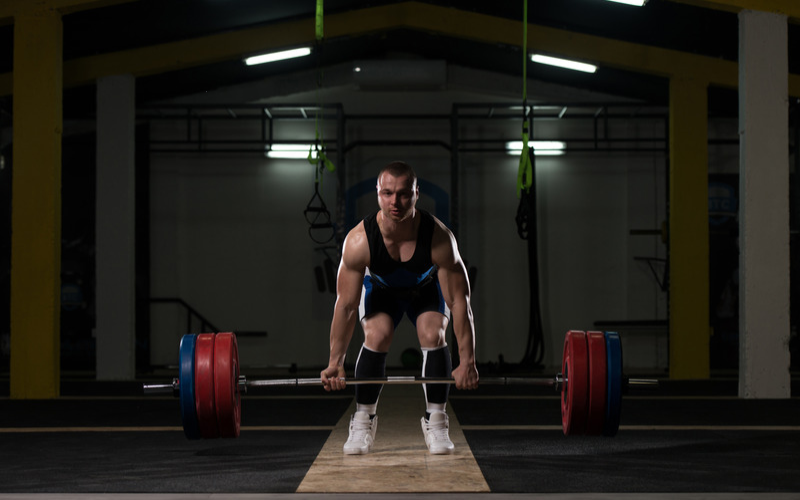
These three lifts cover the parts of the pull that happen after the bar leaves the floor. Rack pulls let you train the knee-to-lockout range with heavier loads, rows build the upper back that keeps the bar close, and hip thrusts target the glutes at full hip extension.
Block Pull / Rack Pull
Raise the bar on blocks or safety pins and pull to lockout. Set the height just below your sticking point, so if you slow down at the upper shin, pull from mid-shin. This suits lifters who leave the floor fast but grind at or above the knee, and it works the glutes, upper back, traps, and grip.
What the research shows:
- Pulling from 2–8 inches off the floor tends to carry over best to the full lift.
- Rack pulls from about 2.54 cm above the kneecap allowed 226.0 ± 40.6 kg, compared with 191.7 ± 37.2 kg from the floor.
- A 6-week pilot of 18 wrestlers found no significant gain in the full deadlift, with a non-significant 2.3% improvement in the combined group. The study was small, overlapped with weight cutting, and appeared in a low-tier journal.
- Experts disagree on heavy rack pulls. One well-known coach says he pulled over 900 lb from a rack but barely locked out 700 in the full deadlift. He prefers moderate reps, such as 4 sets of 6–8 at 80% of your rack pull max.
How to program it: You have two options. Do 3 sets of 1–3 reps at about 100–110% of your floor 1RM from above the knee, but only occasionally and in 3–6 week blocks. Or do 3–4 sets of 5–8 reps at 70–80% of your block pull max. Either way, once a week is the ceiling, and rack pulls should supplement full-range pulls, never replace them.
Barbell Bent-Over Row
Hinge to a torso angle between 45° and parallel, keep a neutral spine, and use a double-overhand grip. Row the bar to your lower chest or upper abs without jerking your torso. In the Pendlay version, each rep starts dead from the floor.
Rows train the lats, mid-traps, rhomboids, rear delts, and grip, and they load the erectors isometrically. The lats aren't prime movers in the deadlift, but they keep the bar close, which eases the load on your hip, lumbar, and thoracic extensors.
What the research shows:
- The standing bent-over row produced large, symmetrical activation of the upper and lower back. It also produced the highest lumbar compression of the rows tested, at 3,576 N versus 2,339 N for the inverted row.
- In a pilot study, row 1RM tracked deadlift strength better than it tracked bench press. That hints at shared back strength but doesn't prove rows build a bigger deadlift.
How to program it: Do 3–4 sets of 6–10 reps at RPE 7–9, one to three times a week. For Pendlay rows, use 4–5 sets of 3–6 reps. If spinal fatigue is a concern, switch to chest-supported rows after deadlifts.
Barbell Hip Thrust
Rest your upper back on a bench at the bottom of your shoulder blades, with a padded bar across your hips and your feet about hip-width apart. Drive up until your torso is parallel to the floor, keep your ribs down, and pause briefly at the top.
This targets the glute max at full hip extension, which matches the lockout position, and it adds little spinal load.
What the research shows:
- In a randomized trial, 34 untrained adults aged 18–30 did 9 weeks of volume-equated hip thrusts or squats. Glute growth on MRI was similar, and so were deadlift 3RM gains: a difference of 0 ± 2 kg, or about 15% for thrusts and 16% for squats.
- A 6-week trial in adolescent males found thrusts “likely superior” to front squats for mid-thigh pull strength.
- Hip thrusts and band-resisted kneeling squats are two of the best fixes for lockout weakness.
- Whether this applies to trained lifters is unknown. The researchers included the person who popularized the exercise, though the MRI measurement was independent.
How to program it: Do 3–4 sets of 6–12 reps at RPE 7–9, or 5–8 reps if you want to go heavier. Train it one to two times a week. It fits fine on deadlift days because of the low spinal load.
How to Program These Exercises Into Your Week
Start small. Use one to three accessories per deadlift session at RPE 7–9, mostly in the 6–10 rep range, and place them after your main lift. A sensible weekly total is 6–12 hard sets for the deadlift muscles, spread over one to three sessions.
Within a session, go from most to least specific and from most to least spinally loaded:
- Main deadlift or a heavy variation (deficit or block pull)
- RDL or good morning
- Rows
- Hip thrusts
Sample Week for an Intermediate Lifter
- Day 1: Deadlift for 3–5 sets of 2–5 reps, then RDL for 3×8 at RPE 7–8, then barbell row for 3×8.
- Day 2 (upper body): Chest-supported or Pendlay row for 4×6.
- Day 3: 2-inch deficit deadlift for 3×4 at RPE 7–8, or block pull for 3×3, then hip thrust for 3×8–10.
Treat this as a template and swap in the exercises that match your weak point.
Rotating, Peaking, and Checking Results
Run a variation for 4–12 weeks before you judge it, then rotate. Within that block, add reps first and then add load.
As a meet gets closer, cut accessory volume before you cut the competition lift. In the powerlifter survey, 62.3% changed how they programmed accessories near competition, while 49.0–58.7% kept the same exercises throughout, so there's no single right approach.
Judge every variation by results. If its 1RM climbs for 8–12 weeks but your deadlift doesn't move, stop assuming it transfers to you and switch to something else.
It also helps to remember that some modern coaches argue general hypertrophy and deadlifting more often may matter more than finding the perfect accessory. Don't let exercise selection become a reason to skip the basics.
Safety, Common Mistakes, and the Good Morning Swap
The biggest mistake is stacking several hinge accessories on top of heavy deadlifts. Every exercise here except the hip thrust loads the spinal erectors, so count them all toward your total pulling volume.
Exercise-Specific Cautions
- Deficit deadlift: Too deep a deficit forces your lower back to round, especially if your hip mobility is limited.
- Rack or block pulls: Spinal and grip demands are high. Blocks are kinder to the bar than pins. Don't hyperextend at lockout, and keep heavy singles occasional.
- RDL: Control the lowering phase and stop before your lower back rounds.
- Rows: If back fatigue limits your deadlift training, switch to chest-supported or inverted versions.
- Hip thrust: Use a bar pad, keep your ribs down, and finish the rep by squeezing your glutes rather than arching your lower back.
If your lower back is what holds you back, add direct back-extension work. The RDL trial showed little gain in isolated lumbar extension strength.
The Good Morning Swap
The good morning is a fair substitute for the RDL, but swap it in rather than adding it on top. The bar sits on your upper back, which puts more stress on the erectors and removes any grip demand. That makes it useful if you have weak grip or an upper-limb injury.
It produced less hamstring activity than the RDL in research, and coaches disagree on how much it helps. The long lever from bar to hip also raises spinal shear, so stick to moderate loads for 3–4 sets of 6–10 reps and skip max attempts.
Conclusion
A stronger deadlift starts with knowing where yours breaks down. Pick one or two accessories that match that spot, and keep the floor deadlift as your main lift.
Here's the quick version: if you stall off the floor, reach for the deficit deadlift and RDL. At the knees, use rows and mid-shin block pulls. At lockout, go with hip thrusts and block pulls from just below the knee.
Run one variation for a full block, track your results, and adjust from there. And if you're a decision maker looking to build custom software for fitness tracking or training programs, we'd be glad to talk.