The three rowing workouts that build a faster 2k are 8×500m with 3:30 rest for speed, 4×1000m with 5:00 rest for race pace, and 4×2000m with 5:00 rest for threshold, each paced from your current 2k split.
Keep reading to learn how to set your targets, run each session, and fit them into your week without burning out.
Why These Three Workouts Work
A hard 2k feels anaerobic, but it mostly isn’t. A maximal 2000m effort runs on about 80–82% aerobic energy and 18–20% anaerobic, within a wider range of 77–88% and 12–23%.
Faster rowers sit toward the anaerobic end, and oxygen use can top 97% of VO2max. To get faster, you need to load VO2max and threshold heavily, not just chase the burn.
Each session covers part of that:
- 8×500m: VO2max and power at 95–105% of 2k speed
- 4×1000m: race-pace endurance, with each rep about half a 2k
- 4×2000m: threshold and aerobic power at 90–95% of 2k intensity, plus a real test of grit
Controlled intervals also outperform Tabata-style or “to failure” work.
- Rowers, four weeks: 8×2.5-minute intervals cut 2k time by 1.9% (about 8 seconds). They also raised power 5.8% and VO2peak 7.0%.
- National-level rowers: eight sessions at 95% of 2k watts brought about a 2% gain in three weeks. Eight more sessions added little, for 2.5% (about 10.6 seconds) total.
- Trained cyclists, seven weeks: 4×8 minutes at 90% of peak heart rate beat 4×4 minutes at 94%. That supports keeping a long-interval day.
The long rests are deliberate. Work plus recovery adds up to about 5 minutes per 500m of work, which puts rest at roughly twice the work time.
That extra recovery lets you hold a faster pace, and pace is the stimulus. Cutting rest for “lactate tolerance” only slows you down.
Set Your Targets Before You Row
Every target comes from your current 2k split. If you don’t have a recent one, you can estimate it two ways. A 4×1000m with 3:00 rest at race effort usually lands within 1–2 seconds of your 2k average.
You can also add about 5 seconds per 500m each time the distance doubles, which puts 5k pace near 2k + 6–7 seconds. Treat that second method as a rough guide only.
From there, each session has its own pace:
| Session | Target pace | 7:00 2k example (1:45.0/500m, ~302 W) |
|---|---|---|
| 8×500m | 2k − 0–3 s | Start at 1:45, ceiling near 1:42 (~330 W) |
| 4×1000m | 2k + 0–2 s | About 1:46 |
| 4×2000m | ~5k pace (2k + 6–8 s) | 1:52–1:53 (2k × 1.08 ≈ 1:53.4) |
Watts come from the formula watts = 2.80/pace³. Because of that cube, power doesn’t rise in a straight line with split.
Going from 2:05 to 2:00 takes you from 179 to 202 W, a 23 W gain. Going from 1:45 to 1:42 alone is a 28 W jump. So you should track progress in tenths of a second.
On your first attempt at any session:
- Row every rep except the last at the pace you could hold for the total distance. For the 4000m sessions, that means 5k pace.
- Go all out on the final rep.
- Use that session’s average as next time’s target.
Set the damper between 3 and 5 and don’t push it higher. Note your drag factor and use the same one every time so your results stay comparable.
Workout 1: 8×500m for Speed
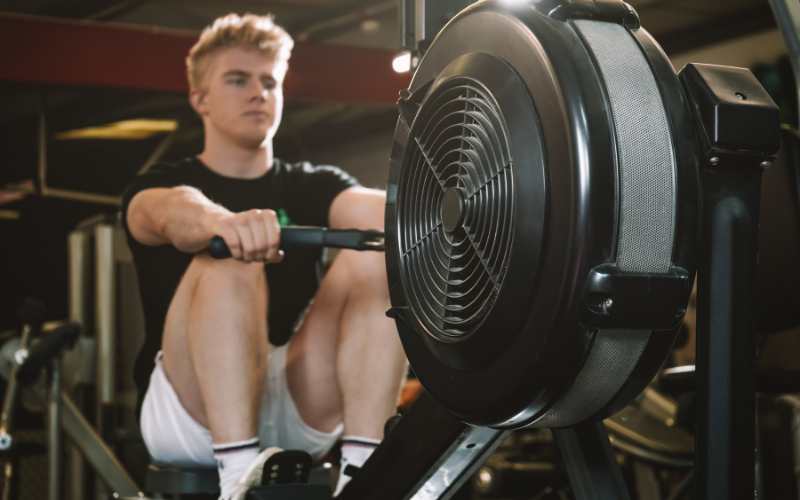
This session gives you about 14 minutes at or faster than 2k speed, roughly double what a single 2k allows. It also teaches you to hold long, connected strokes at high rates.
Set your PM5 to Intervals: Distance (500m, 3:30 rest, 8 reps). You can row it on the water too, but holding pace is harder there.
Warm-up (15–20 minutes)
- 8–10 minutes easy at 18–22 spm
- 3–4 minutes firmer at 22–26 spm
- 3–4 bursts of 10–15 strokes at race rate and target split
- 2–3 minutes easy
You should be sweating before rep 1.
Main set
Start at your 2k split. Over time, bring it down to 2k − 2–3 seconds. Hold reps 1–7 even, then go all out on rep 8. Your stroke rate should fall between 30 and 36 spm, and you should use the lowest rate that still holds your target. Row lightly at 16–18 spm during rest and keep drinking.
Expect RPE 9/10 by the final reps. Heart rate lags on 500s, so pace by split instead.
Cool down for 10–15 minutes easy. The intervals take about 38–40 minutes from first rep to last, and the whole session runs 65–75 minutes.
Progression and scaling
Aim to cut 0.2–0.3 seconds off your average each time. When that stalls, keep the pace and shorten the rest from 3:30 to 2:00, then to 1:00. You can also rotate in a 250-500-750-1000-750-500-250m pyramid. It totals 4000m, with 1:30 of rest for every 250m of the previous rep.
- Beginners: 6×500m with 2:00 rest at RPE 7–8, or start with 4–6 reps
- Advanced: 2k − 3 s or faster, 10 reps, or 2:00 rest. If you’re racing 1000m, try 10×400m or 12×300m.
Workout 2: 4×1000m for Race Pace
Here you hold about 2k speed for half the race distance, four times over. That trains the “middle 1000” that decides most 2k results, which is why your average here is a reliable predictor of 2k ability.
Set the PM5 to Intervals: Distance (1000m, 5:00 rest, 4 reps). Use the same warm-up as Workout 1, then add a 250–500m piece at target split about 5 minutes before you start.
Main set
Pick the pace that matches your experience:
| Version | Pace | Rest |
|---|---|---|
| First attempt | 2k + 3 s | 5:00 |
| Good benchmark | 2k + 1 s | 5:00 |
| Lighter club version | 2k + 5–7 s | 3:00 |
If you’d rather start a new rep every 10 minutes, that gives you 6–7 minutes of rest. Keep your stroke rate around 28–30 spm early on and let it rise toward 34 on rep 4.
Open each rep with a few quick strokes, then settle right away. Starting at 1:39 and fading to 1:50 to “average” 1:45 is poor training. You should hit RPE 9/10, with your heart rate above 90% of max by reps 3–4.
Cool down for 10–15 minutes. The intervals take 28–32 minutes, and the full session runs 60–70.
Progression and scaling
Lower your average a little each session. Because the two averages land close together, you can use this result to plan your 2k pace. For test-specific practice, try a “broken 2k”: 1000m at 2k pace, 1:00 rest, 500m at 2k − 2 s, 1:00 rest, then 500m all out.
- Beginners: 3×1000m with 4–5:00 rest at RPE 8, or a 500-1000-1500-1000-500m pyramid with 2:00 rest
- Advanced: 2k pace or faster, 5 reps, or 3:00 rest at 2k + 2 s
Workout 3: 4×2000m for Threshold
This is the session that tests your patience. It builds lactate threshold and aerobic power, and it teaches you to pace evenly when you’re tired.
Each rep lasts 7–8 minutes, close to the 8-minute bouts that gave the largest gains in interval-duration research. Set the PM5 to Intervals: Distance (2000m, 5:00 rest, 4 reps).
Warm up for 10–15 minutes. Row 1–2k steady, spend 2–3 minutes near target pace, then ease off briefly before rep 1.
Main set at a glance
- Pace: 2k split × 1.08 (about 1:53.4 for a 7:00 2k). A good benchmark is your 5k PB + 0.5 s.
- Stroke rate: 26–32 spm, though most rowers settle at 26–28
- Rest: 5:00, or 6–7 minutes, or 1500m of easy rowing
- Effort: RPE 8 rising to 9, with heart rate at 85–92% of max
Keep reps 1–3 even and go all out on rep 4. On reps this long, heart rate finally becomes a useful guide.
Cool down for 10–15 minutes. For a 7:00 2k rower, the 8000m of work comes to about 30 minutes of hard rowing. Expect 45–50 minutes from first rep to last and 70–80 minutes in total.
Progression and scaling
Bring your average down a little each time. To keep things fresh, rotate in 5×1500m at about 5k pace or a 3000/2500/2000m set at about 5k + 1 s. Both use 5:00 rest.
If you’re newer, start with 2×2000m at a steady-hard pace with 3–5 minutes of rest and build to three reps before you try four. Advanced rowers can hold 5k pace or better, drop rest to 4:00, or stretch pieces up to 3000m for 7.5–8k in total.
Fit Them Into Your Week and Track Progress
Plan your week
Limit yourself to two hard sessions a week. Make one of them short and fast (8×500m, 4×1000m or the pyramid) and the other a long-interval day (4×2000m or one of its rotations). The short, fast work should come to just 3–4% of your total meters. Early in the season, do it only every other week.
Keep about 80% of your training easy. Low-rate steady rowing at 16–22 spm can make up 65–70% of your meters, with other steady rows at 22–25 spm, and you should take a full rest day each week.
Leave at least one easy day between hard sessions, too. Putting 4×1k and 4×2k in the same week tends to backfire.
Avoid these mistakes
- Going out too fast. Compare a disciplined 8×500m (1:47.2, 1:47.0 … 1:45.1, avg 1:46.6) with a “fly and die” one (1:44.5 … 1:52.4, avg 1:49.5). Make rep 1 your slowest.
- Sprinting the opening strokes. Settle into pace by 150–200m.
- Leaning on stroke rate. If you can hit your target at a lower rate, you have room to grow. Needing a high rate early in the season points to a strength or length issue.
- Cutting rest to make it “harder.” Keep rest the same each time so your gains are real.
- Letting easy days creep up. Steady rows should be at least 10 seconds per 500m slower than endurance-interval pace. When in doubt, go slower.
Expect a plateau
Most of your gains come in roughly the first eight hard sessions. After that, you’ll improve more by rotating formats and protecting your aerobic volume than by adding intensity.
If the load feels like too much, cycle easy, medium and hard weeks at 2 seconds slower, 1 second slower, then normal targets. After time off, drop your targets 1 second for each week you missed.
Track the right numbers
For each session, log your average split, drag factor, stroke rate per rep and the spread between your fastest and slowest reps. Over time, you want a faster average and a tighter spread. Retest your 2k every 8–12 weeks.
These typical relationships can show you where you’re strong. They’re guides, not targets:
| Session | Typical result |
|---|---|
| 8×500m | 2k − 3 s |
| Pyramid | 2k pace |
| 4×1000m | 2k + 1 s |
| 5×1500m | 5k pace |
| 4×2000m | 5k + 0.5 s |
If your 500s run well ahead of these ratios while your 2000s lag, give aerobic and threshold work more priority. If the reverse is true, shift toward speed.
Keep in mind that much of this guidance comes from coaching experience rather than direct trials of these exact sessions, and gains may differ for beginners and masters rowers. Above all, hard sessions only pay off when you build them on a solid steady-state base.
Conclusion
Pick one short, fast session and one long-interval session each week, pace them from your current 2k, and let each session’s average set the next target.
Keep rest consistent, start every set under control, and surround the hard days with plenty of easy rowing. Stick with that pattern, retest every 8–12 weeks, and the gains will show up in your 2k time.