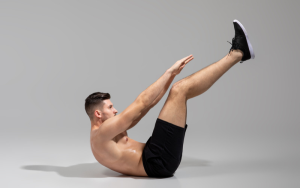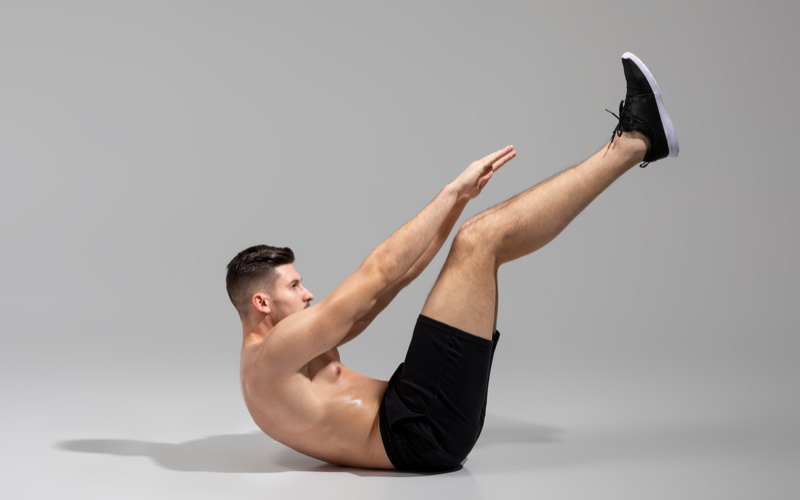
The three hollow hold variations that work best for runners are the Tipping Hollow Rock, the Hollow Rock, and the Anti-Rotation Hollow Rock, which you can do for 40 seconds on and 20 seconds off, for two to three rounds, once you can hold a clean static hollow hold for about a minute.
Keep reading for a more detailed explanation of how to do each one and what to expect from them.
What a Hollow Hold Is and Why Runners Use It
A hollow hold is an isometric, supine, anti-extension position borrowed from gymnastics. You lie on your back while your abdominals hold the pelvis in a slight posterior tilt and keep your lower back pressed to the floor. Meanwhile, the long levers of your arms and legs try to pull your spine into an arch. The exercise is built around bracing, the core’s job of supporting the spine under load.
So why would a runner care? Running is a series of single-leg stances, which means your pelvis and trunk have to resist side-bending and twisting forces with every stride.
Your arms and upper trunk also counter-rotate against your pelvis and legs to cancel the angular momentum of the swinging legs. A trunk that stays stiff through all of that is the goal, and the hollow hold trains that kind of control.
Fatigue adds another reason. In one study, novice runners leaned their trunks further forward as they tired, which suggests trunk control fades late in a run.
Coaches argue that a stiffer trunk makes you sturdier and more resilient over those final miles. Keep in mind that this is a practitioner claim, not a measured outcome.
Master the Static Hollow Hold First
All three variations build on the static hold, so get it right before you add any movement. You’re ready to move on once you can hold the full position with solid form for about one minute. A good build-up target is 3 to 4 rounds of 45 to 60 seconds.
How to Set It Up
- Lie on your back and hug your knees to your chest in an “egg” shape, lifting your shoulders off the floor.
- Drive your lower back into the floor. This is the key point of the whole movement.
- Extend your legs with straight knees and your feet a few inches off the floor. Reach your arms behind your head, keeping your shoulders lifted.
- Squeeze your abs and glutes to create full-body tension, and hold.
Cues to Keep in Mind
- Pull your ribs down toward your hips.
- Lift your shoulder blades only slightly. This is not a crunch.
- Keep your neck in line with your upper back.
- Point your toes and squeeze your legs together.
- Breathe in small, steady breaths instead of holding your breath.
Regress When You Need To
If you can’t hold the full position yet, work up through these steps:
- Tuck hold, with your knees bent toward your chest and your arms by your sides
- Bent-knee or tabletop hold, with your arms reaching toward your heels
- One leg extended, switching legs halfway through
- Both legs extended, with your arms by your sides
- Full hold, with your arms overhead
Bending your knees and bringing your arms forward, which is essentially a dead bug, is also a solid fallback. A shorter lever is always easier, so raise your legs or bring your arms toward your hips the moment your lower back starts to lift.
Variation 1 and 2: The Tipping Hollow Rock and the Hollow Rock
Tipping Hollow Rock
This is a hollow hold that tips side to side, and it trains your core to resist being twisted.
- Get into a strong hollow hold.
- Without losing tension, shift your weight onto your right glute and right shoulder blade.
- Balance there for two seconds.
- Shift to the left side and hold for two seconds, then keep alternating.
Watch for these mistakes: rolling like a log instead of tipping as one rigid unit, letting an arm or leg drift, your lower back peeling off the floor, and holding your breath.
If it feels too hard, tip from a tuck or bent-knee version, or keep your arms by your sides. To make it harder, slow the tips down and make them larger.
Hollow Rock
This is the dynamic version. Your rigid “banana” shape rocks back and forth like a rocking chair, so your core has to hold its position while momentum keeps changing.
- From a strong hollow hold, lift your legs slightly to create momentum.
- Rock back and forth, keeping your lower back on the ground.
- Keep your abs and glutes tight the whole time.
A few cues help: move as one unit, rock from your upper glutes to your shoulder blades, and keep your heels and hands off the floor. Exhale at the end of each rock to maintain your brace.
Common mistakes include:
- Swinging your arms or legs to drive the rock instead of using a locked body shape
- Bending your knees or letting your limbs drop
- Letting your lower back arch at the leg end of the rock
- Rocking big and fast, which usually means your core has lost tension
To regress, bend your knees, keep your arms by your sides, or shrink the rock. To progress, hold your arms fully overhead, rock slower with a bigger range, or add light ankle weights. Only add load once the unloaded shape is consistently clean.
Why the Rocking Version May Suit Runners
When you rock, your trunk has to stay stiff while your limbs and center of mass move. That is closer to what happens during a run than a static hold is.
A running coach also recommends hollow work for runners with an arched lower back, or anterior pelvic tilt. That rationale is plausible, though it hasn’t been tested.
Variation 3: The Anti-Rotation Hollow Rock
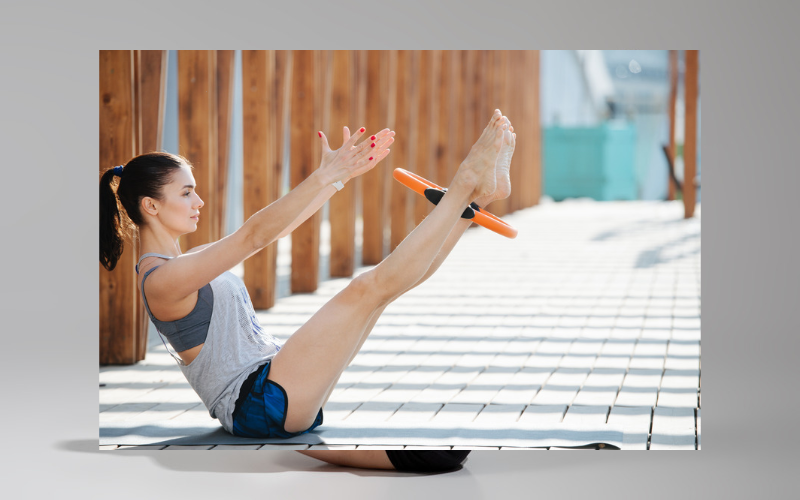
This is a hollow rock with an uneven arm position. Because the arms aren’t symmetrical, you have to fight against gravity to keep your body from shifting or twisting.
- Get into a strong hollow hold.
- Rotate one arm out to the side, so one arm is straight overhead and the other forms an “L.”
- Rock as you would in the standard Hollow Rock.
- On the next set, swap your arm positions.
Mistakes to Avoid
- Letting your torso rotate or tip toward the side arm instead of staying square
- Resting the side arm on the floor
- Rocking bigger and faster to make up for the extra challenge
- Using the same arm out every set, which leaves the challenge lopsided
If it’s too hard, hold the L-arm position as a static hollow hold first, or use a bent-knee version before adding the rock. To make it harder, rock slower, use a larger range, or hold a light weight in the overhead hand.
Why It May Help Runners
Every stride, your arms and legs swing in opposite directions, and your trunk has to resist the rotation that creates. This variation mimics that demand by adding a twisting force you have to hold against.
There is some supporting data here. In a study of 225 runners, 52% of whom were injured, less pelvic rotation toward the opposite side at toe-off was one of the factors linked to higher injury odds.
That link doesn’t show that anti-rotation drills change those movement patterns or reduce injury, though. Treat this variation as targeted trunk-control practice, not a fix.
How to Program the Three Variations
Run the three moves back to back as a mini-circuit: Tipping Hollow Rock, then Hollow Rock, then Anti-Rotation Hollow Rock. Work for 40 seconds and rest for 20 seconds on each, and repeat the circuit for 2 to 3 rounds.
That takes about 6 to 9 minutes. Switch your arm position between rounds of the third variation so both sides get equal work.
Where It Fits in Your Week
Coaches commonly suggest doing this circuit one to three times a week. You can slot it in after an easy run, use it as a short warm-up, or add it to a strength day. This frequency is practitioner advice, not something that’s been tested in trials, so adjust it to how your legs and back respond.
Stop When Form Breaks
End a set when your form goes, not when the timer runs out. Warning signs include your lower back lifting, your breath locking up, or your arms and legs dropping. A short, clean set builds more than a long, arched one.
Fill in the Gaps
Hollow work is mostly anti-extension, meaning it trains you to resist arching. It doesn’t cover everything a runner needs, so add anti-lateral-flexion work such as side planks to address pelvic drop.
Keep this circuit in perspective, too. It shouldn’t replace your running volume, your general strength training, or individual physical therapy if you’re dealing with an existing injury.
What the Research Says and Safety Notes
Performance
No study has tested hollow holds in runners, but research on core training in general shows modest gains in a few small trials:
- Six weeks of core training, done four times a week, produced faster 5000-m times in 20 runners (12 training, 8 control).
- Core training combined with inspiratory muscle training improved 1-hour running performance by 3.04%, versus 1.57% for interval training alone, in 16 recreational runners.
- Eight weeks of core work in 21 male college athletes raised plank endurance from 193.5 to 241.5 seconds. It also lowered oxygen cost at the highest treadmill stage from 52.4 to 50.0 ml/kg/min.
- Not every trial agrees. A six-week Swiss ball study of 18 athletes improved core stability but didn’t change running economy, VO2max, or running posture.
Injury Prevention
A 2024 meta-analysis of nine trials with 1,904 runners found that exercise-based programs did not significantly reduce injury risk or rate. So don’t count on hollow holds to keep you injury-free.
Limits of the Evidence
The trials are small and used mixed core programs, not hollow holds specifically. Better plank times also haven’t been shown to mean better running posture. Be wary of online claims such as “40% more activation than crunches,” since they trace back to references that couldn’t be verified.
Safety Notes
- Lower back: When your lumbar spine arches off the floor, the load shifts to your hip flexors and lower back. Stop at any sharp, shooting, or new pain, regress to a dead bug, and see a clinician if it persists.
- Hip flexors: If you feel the work mainly in the front of your hips, shorten the lever by raising your legs or bending your knees, then reset your posterior pelvic tilt.
- Neck: Keep your gaze toward your knees with a gentle chin position instead of forcing your chin to your chest.
- Pregnancy and postpartum: If you’re pregnant or postpartum, or you have diastasis recti or pelvic-floor symptoms, avoid any version that causes midline doming, leaking, or pelvic heaviness. Get individual guidance from a pelvic-health physical therapist.
Conclusion
Once you can hold a static hollow hold for about a minute, the Tipping Hollow Rock, Hollow Rock, and Anti-Rotation Hollow Rock give you a low-risk way to build trunk endurance and control alongside your running and strength work.
If you want a tailored running or fitness program built into a custom app or platform, get in touch.