Warm up for about 10–15 minutes with easy movement, dynamic drills and a few explosive jumps and sprints, and finish as close to tip-off as you can.
Skip long static stretching, and keep your body warm with a jacket or a quick re-warm-up if you have to wait. Keep reading for a more detailed explanation of each step.
What a Good Warm-Up Does for Your Game
A review of 32 high-quality studies found that warming up improved performance in 79% of the outcomes tested, with little evidence that it harms athletes.
Basketball data points the same way. In one study, two players did a 20-minute warm-up and saw their countermovement jump height rise by about 7%, their heart rate climb by about 100 bpm, and their core temperature go up by about 0.8 °C.
Your body also keeps heating up once the game starts. In a simulated game with 10 college-level men, core temperature reached 39.4 °C by the end of the fourth quarter. The warm-up had already improved their 10-m sprint time by 5.5% and their jump height by 3.8%.
Injury prevention is where you should keep your expectations in check. A generic warm-up has weaker evidence for preventing injuries than most people assume. Of five high-quality trials, three showed a significant drop in injury risk and two did not.
So the benefit is clear for performance, and less certain for injuries. What you do, how long you do it, and when you finish all shape the result, and the next sections cover each one.
How Long to Warm Up and When to Finish
Shorter beats longer here. Warm-ups of 10-15 minutes that build in intensity gave better explosive performance than the longer routines most team sports use.
Keep the active part under about 15 minutes, since field team sports only benefit when the warm-up runs about 16 minutes or less.
Timing matters as much as length. You want to finish as close to the start of the game as you can. If the gap runs past about 10 minutes, use passive heat maintenance, such as a warm-up jacket. Once the gap passes 15 minutes, short explosive re-warm-up tasks worked best.
Here is what waiting costs. In a study of basketball players who sat down after warming up:
- After 10 minutes: jump height fell 13% and 20-m sprint time slowed 3.9%.
- After 40 minutes: jump height fell 20% and sprint time slowed 6.3%. Body temperature dropped from 36.9 °C to 36.2 °C.
Pregame shootarounds and team rituals often take 20-30 minutes in total, and that’s fine. The physically demanding part just needs to be compact, build in intensity and end within a few minutes of tip-off. The worst setup is a front-loaded warm-up followed by a long, cold wait.
A Step-by-Step Pre-Game Warm-Up Sequence
The routine below moves through five phases: raise, mobilize, activate, practice basketball movements, then potentiate. It’s a synthesis of what the research supports, and it hasn’t been tested as a complete package, so treat it as a solid template rather than a proven protocol.
- Raise (about 3-4 minutes). Start with an easy jog, skipping, backpedaling and defensive slides along the lane lines. Pick up the pace gradually.
- Dynamic mobility (about 3-4 minutes). Run baseline-to-half-court drills, 1-2 lengths each, such as hip out, hip in, high knees, butt kicks, carioca or leg crossovers, and walking lunges. Add about 8-10 leg swings per leg, forward and sideways. Skip long static holds.
- Activation and landing control (about 2-3 minutes).
- Single-leg balance, 1 × 20-30 seconds per leg
- Glute bridges, or a 20-30 second plank and side plank
- 5-6 controlled double-leg jumps with soft, knee-aligned landings
- Basketball-specific work (about 5-10 minutes). Your team will often run this part. Layup lines, form shooting, passing, closeouts and defensive slides all fit, with the speed rising to game pace.
- Potentiate (about 2-3 minutes, ending close to tip-off).
- 3-5 accelerations of 10-15 m at near-maximal speed
- 2-3 sets of 3-5 explosive jumps, such as countermovement jumps, pogo jumps or approach jumps to the rim, with 30-60 seconds between sets
Why the Finisher Stays Small
Short-term boosts from high-intensity primers vary a lot between individuals and are typically small, so a few jumps and sprints are enough.
Heavy lifting can help in some cases. In a trial of 40 college players, moderate-load back squats at 70-90% 1RM worked best with a rest of about 8-12 minutes.
Results across studies are inconsistent, though, and heavy barbells are rarely available courtside. Don’t try heavy lifting on game day unless you’ve rehearsed it in practice.
Static vs. Dynamic Stretching Before a Game
When researchers tested performance right after stretching, the average change depended heavily on the type:
- Static stretching: −3.7%
- Dynamic stretching: +1.3%
- PNF stretching: −4.4%
Dose matters too. Static holds of 60 seconds or longer per muscle group cost 4.6% of performance, while shorter holds cost only 1.1%.
Stretching inside a full warm-up that ends with dynamic activity has an inconsequential effect on performance, and it can improve range of motion.
Basketball-specific findings line up with this. Dynamic stretching tends to maintain or improve vertical jump, while static stretching alone tends to reduce it.
In young players, a sport-specific warm-up after static stretching cancelled out the drop in jump height. The gap shows up in kids as well: children averaging 11.3 years old did significantly worse on jump and shuttle-run tests after 5 minutes of walking plus 5 minutes of static stretching than after 10 minutes of dynamic exercise.
Make dynamic stretching your default. If a player needs static work for a tight area, keep holds under about 60 seconds and follow them with explosive, basketball-specific work. Static stretching isn’t dangerous, it’s just not the best use of limited warm-up time.
Keeping Your Warm-Up Going: Bench, Halftime and Re-Warm-Ups

Stay Covered
Insulated jackets and heated garments worn between the warm-up and competition limited drops in core and muscle temperature and improved later power.
In rugby players, a survival jacket worn through a 15-minute simulated half-time reduced the fall in core temperature and improved peak power and repeated-sprint ability. Basketball-specific trials are lacking, but the principle transfers: cover up as soon as you stop moving.
Re-Warm-Ups for Non-Starters
In a study of 15 elite youth female non-starters, sitting for 15 minutes reduced countermovement and drop jump height and slowed change-of-direction times. Three approaches were compared against that drop:
- Plyometric re-warm-up: kept all three measures at warm-up levels. It used cycles of 2 minutes of exercise and 1 minute of rest, with low skipping-ladder work on one foot, multidirectional multi-jumps and arm-swing countermovement jumps.
- Dynamic re-warm-up (high knees, butt kicks, lunges, leg swings) or draping towels over the body: kept drop jump and change of direction steady, but countermovement jump height still fell.
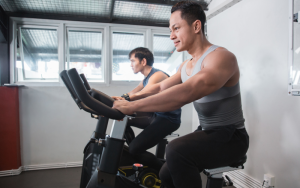
- Cycling: in 12 semi-professional players, 1 minute at 80% VO2max followed by 1 minute of rest attenuated some of the losses after 15 minutes of passive rest and improved agility.
Halftime
In 13 semi-professional players, 11 minutes of rest, 3 minutes of cycling at 40% VO2max and 1 minute of rest maintained jump, change-of-direction performance and body temperature.
Results aren’t uniform, though. Two studies of young female players found no significant jump benefit, including one that added single-leg bouncing (8 × 2 bounds per leg) to 2 minutes of shooting.
Keep the certainty in perspective. Pooling seven studies and 82 players, re-warm-ups preserved jumping (SMD 0.64) and change of direction (SMD −0.83). The certainty was low to very low, and removing one study erased statistical significance.
A Practical Protocol
- Put on warm-ups the moment you leave the floor, and stay covered during coach talks.
- In the last 2-4 minutes before play, do 1-3 minutes of explosive work: 2-3 sets of 3-5 jumps, a few short sprints or slide bursts, and some shooting.
- Use a stationary bike instead if one is available.
Injury Prevention, Age Differences and What to Practice
Structured neuromuscular programs combine running drills, strength, balance, plyometrics and landing technique. They have the best injury evidence in basketball, but only when players do them regularly through a season. The results so far:
- Elite men: in 121 players over 9 months, teams using FIFA 11+ had 0.95 injuries per 1,000 athlete-exposures, compared with 2.16 in control teams.
- Regional players: a roughly 20-minute multicomponent program in 112 players cut ankle-sprain incidence (IRR = 0.26), with a non-significant trend toward fewer knee injuries (IRR = 0.32).
- Pooled trials: across 10 randomized trials, the odds of lower-extremity injury dropped 31% (OR 0.69). There was no significant effect on ACL injuries.
- Caveats: one US high school trial found no reduction. Compliance matters too, since only 60.3% of players complied with one home program.
Using It Before Games
Only the running parts of FIFA 11+ (Parts 1 and 3) are meant for matches. Strength and balance work belongs in practice, so run the full program there and keep the pre-game version lighter.
Age and Level
Dynamic warm-ups suit children and adolescents. Standard FIFA 11+ is built for players about age 14 and up, and a Kids version exists for younger players.
No evidence supports setting different warm-up durations by competitive level, so adjust for skill, available time and supervision instead.
Conclusion
A good pre-game warm-up is progressive and dynamic, lasts about 10-15 minutes, and ends close to tip-off. Keep warm clothing on afterward and use quick re-warm-ups if you have to wait.
Many of the studies behind this are small, simulated or borrowed from other sports, so rehearse the routine in practice and see what works for your players.