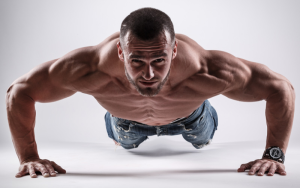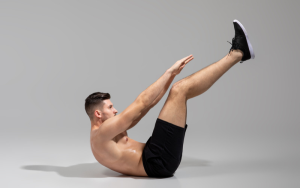
Strong abs take more than crunches, and five exercises cover the job: the bicycle crunch, ab wheel rollout, side plank, Pallof press and dead bug.
Together they work every major ab muscle and all four jobs your trunk does, so keep reading for a closer look at how to do each one and fit them into a simple routine.
What “All-Around” Ab Strength Really Means
Most people train their abs with one move, usually crunches, and call it done. That works one part of your trunk and leaves the rest alone. Your core does four different jobs, and a well-rounded routine trains all of them:
- Flexion and rotation: bending forward and twisting, like a crunch with a turn.
- Anti-extension: keeping your lower back from arching or sagging.
- Anti-lateral flexion: resisting a pull toward one side.
- Anti-rotation: resisting a twist.
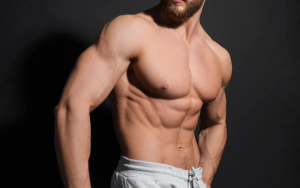
Four muscle groups handle those jobs. The rectus abdominis is the long muscle down the front of your stomach, the one people call the “six-pack.”
The external and internal obliques run along your sides and manage twisting and side-to-side control. The transversus abdominis is the deepest layer, and it wraps around your midsection like a belt.
Here's how the five exercises spread across them:
- Rectus abdominis: the bicycle crunch and ab wheel rollout do most of the work, and the dead bug and side plank chip in.
- Obliques: the side plank, Pallof press and bicycle crunch lead here. The rollout also hits them hard.
- Transversus abdominis: the dead bug is the main driver, while the side plank and Pallof press train it as a bracing muscle.
Put together, the five moves cover all four jobs and leave no major gap. One caveat: the research behind each exercise is uneven, and some picks have stronger data than others. We'll get to that later.
The Five Exercises, Step by Step
1. Bicycle Crunch (flexion plus rotation)
This move trains the rectus abdominis and both obliques, and your hip flexors help through the cycling motion.
- Lie on your back with your knees bent, hands lightly behind your head and abs braced.
- Lift your feet so your thighs are vertical and your knees sit at about 90 degrees, then curl your head and shoulders up.
- Drive one knee toward your chest, extend the other leg off the floor and rotate so the opposite shoulder moves toward the bent knee.
- Switch sides in a slow pedaling rhythm, keeping your lower back on the mat.
Common mistakes: pulling on your neck, moving only the elbow without turning the trunk, pedaling fast on momentum and letting your lower back arch as the straight leg drops.
Dose: 2–3 sets of 10–20 total reps (5–10 per side).
Easier or harder: keep the non-working foot down, or start with a basic crunch. To make it harder, lower the straight leg, pause 1–2 seconds at each twist or slow the tempo.
2. Ab Wheel Rollout (anti-extension)
The rollout works the upper and lower rectus abdominis, both obliques and the lats. Your abs lengthen under load here, which stops your lower back from sagging.
Kneel with the wheel under your shoulders and tilt your pelvis slightly backward. Roll forward slowly, with your hips and shoulders moving together, and stop just before your lower back arches. Pull back by driving your arms toward your hips.
- Common mistakes: lower back sagging (the most common one), hips lagging or piking, rolling farther than you can control and jumping to standing rollouts too soon.
- Dose: 2–3 sets of 5–10 controlled reps. End the set at the first sign your lower back loses position.
- Easier: roll toward a wall, use a shorter range, try a stability-ball rollout or build a base with a forearm plank.
- Harder: add range, pause 1–3 seconds at full extension and slow the roll-out. The standing version comes last, and it's a big jump in difficulty.
Don't confuse the wheel with the old-style “ab roller” crunch device. That gadget did no better than a regular crunch.
3. Side Plank (anti-lateral flexion)
The side plank works the external oblique and quadratus lumborum most, with the internal oblique, transversus abdominis, rectus abdominis and hip stabilizers helping. It loads the side of your trunk while keeping total spine load low.
Lie on your side with your forearm down and your elbow under your shoulder. Stack or stagger your feet, lift your hips into a straight line and breathe steadily, pushing your shoulder away from your ear.
- Common mistakes: sagging hips, a rotating torso, an elbow out of place, holding your breath and lengthening holds before your form is solid.
- Dose: start with 20–30 seconds and build toward 45–60 seconds, 2–3 times a week. Another option is repeated holds of about 8–10 seconds in a 6-4-2 pyramid, with roughly 20 seconds' rest.
- Easier: a knee-supported version with 10–20 second holds.
- Harder: straight legs, a raised top leg, a hand-balance version with the top arm reaching up, elevated feet or rolling from elbow to elbow.
Your two sides don't work equally, so train both and match the hold times.
4. Pallof Press (anti-rotation)
Your internal and external obliques resist the twisting pull here, while the transversus abdominis and rectus abdominis brace and the shoulders and glutes stabilize.
- Set a band or cable at chest height and stand side-on to it, feet shoulder-width apart, with the handle at mid-chest.
- Step away until you feel tension, then brace, squeeze your glutes and keep your ribs down.
- Press the handle straight out from your sternum and hold.
- Bring it back under control, then switch sides.
Common mistakes: your torso or hips turning toward the anchor, arching or shrugging, pressing off to one side, using a load so heavy you lean away and holding your breath.
Dose: 2–3 sets of 8–12 reps per side with a 2–5 second hold, or isometric holds of 10–15 seconds per side.
Progressions: an 11-level continuum runs from seated to half-kneeling, quarter squat and lunge, with dynamic presses coming before 3-second holds. Smartphone readings of pelvic movement in 12 adults back this up. They rose from 0.17 m/s² kneeling on foam to 0.22 standing feet together, 0.31 in tandem stance and 0.55–0.61 on a hemisphere ball. For a simpler start, use half- or tall-kneeling with a lighter band. To make it harder, narrow or split your stance, hold longer, add resistance or step farther from the anchor.
5. Dead Bug (deep-core control)
The dead bug trains the transversus abdominis, rectus abdominis and obliques. Moving an arm and a leg together recruited more rectus abdominis and oblique activity than moving arms alone or legs alone.
- Lie on your back with your knees bent. Tighten your lower abdomen as if zipping up tight jeans, and keep breathing.
- Lift your feet to 90 degrees at the hips and knees, with your arms reaching toward the ceiling.
- Slowly extend one leg to just above the floor while the opposite arm lowers overhead, without letting your back arch.
- Return and switch. Both sides together count as one rep.
Common mistakes: your lower back lifting, moving fast, holding your breath and letting tension drop between reps.
Dose: 8–12 reps for 1–3 sets, 3–4 times a week, at roughly 3 seconds out and 3 seconds back. Your last rep should look as good as your first.
Easier or harder: keep your feet on the floor and move only your arms, try heel taps or use a seated version in a supported chair. To make it harder, add light ankle or hand weights, a band pulling your arms overhead, longer holds or a stability ball pressed between your hands and knees.
Putting the Five Into One Routine
How Often to Train
Aim for 2–4 non-consecutive days a week. Three days, such as Monday, Wednesday and Friday, works well because it fits the side plank guideline of 2–3 times a week and the dead bug guideline of 3–4 times a week.
It also leaves rest between your flexion sessions. You can do the routine on its own or tack it onto the end of a strength session.
The Order and Why It Works
- Dead bug: 2 sets of 8–10 reps per side. It primes your deep core and your motor control before the harder work.
- Ab wheel rollout: 3 sets of 5–10 reps. It's the most demanding move, so do it while you're fresh.
- Pallof press: 2–3 sets of 8–12 reps per side with a 3–5 second hold.
- Side plank: 2–3 holds per side of 20–45 seconds, or the 10-second pyramid (6, 4, then 2 reps per side).
- Bicycle crunch: 2–3 sets of 10–20 total reps. It goes last because it's the least technically risky when you're tired.
Rest Between Sets
- 30–60 seconds after the lighter moves: the dead bug, side plank and bicycle crunch.
- 60–90 seconds after rollouts and Pallof presses, especially if you're using heavier resistance.
- About 20 seconds between pyramid sets.
Expect the whole session to take about 15–20 minutes.
Sample Weekly Layout
| Day | Plan |
|---|---|
| Monday | Full routine, in the order above |
| Tuesday | Rest from direct ab work |
| Wednesday | Full routine |
| Thursday | Rest from direct ab work |
| Friday | Full routine |
| Weekend | Rest |
Quick Tracking Checklist
Jot these down after each session so you know when to move up:
- Sets, reps and hold times for each exercise
- Which version you used (for example, knee-supported side plank or standing Pallof press)
- Whether every rep stayed clean, with no back arching or sagging, no rotation and no breath-holding
- Anything that felt off, so you can adjust next time
How to Progress (and Back Off) Without Getting Hurt
The One-Change Rule
When an exercise starts to feel easy, change only one thing at a time: reps, hold time, range, lever length or position. If you add a longer hold and a harder variation in the same week, you won't know which one made your form fall apart.
The Clean Rep Test
Move to a harder version only when every rep of your current version stays clean. That means:
- No back arching or sagging
- No rotation
- No breath-holding
Stop each set when your form breaks down, not when you hit a target number. A set of 6 good rollouts beats 10 where your lower back sags on the last four.
A Beginner Version of the Whole Routine
If the full routine feels like too much, start here and work up:
- Dead bug: arms only, with your feet on the floor
- Rollout: toward a wall, or on a stability ball
- Pallof press: half-kneeling with a light band
- Side plank: knee-supported
- Crunch: a basic crunch or curl-up in place of the bicycle crunch
Troubleshooting Common Problems
Your lower back sags in the rollout. You're rolling past what you can control. Shorten your range, roll toward a wall or switch to a stability-ball rollout. Keep your pelvis tilted slightly back, and stop just before your lower back starts to arch.
Your hips rotate in the Pallof press. The load is too heavy or the setup is too hard. Use a lighter band, step closer to the anchor or go back to half-kneeling. Keep your ribs down and press straight out from your sternum.
Your neck aches in crunches. You're probably pulling on your head. Rest your hands lightly behind it and curl through your trunk instead. If it persists, slow the tempo or drop to a basic crunch, keeping your low back and tailbone on the mat.
What the Research Does (and Doesn't) Tell You
Most of what we know about these exercises comes from muscle-activity studies, which measure how hard a muscle works during a single exercise. That's useful for picking moves, but it doesn't prove better strength gains over time. Here's what each exercise has behind it.
Exercise by Exercise
- Bicycle crunch: A 2001 study of 30 adults aged 20–45 tested 13 exercises. It ranked the bicycle crunch first for the rectus abdominis and second for the obliques, at 248% of a regular crunch for the rectus abdominis and 290% for the obliques. The catch is that the study was industry-funded and released as a press release. It also didn't measure the transversus abdominis or include planks.
- Ab wheel rollout: A 2006 study put the wheel exercises among the highest for abdominal activity, with low lower-back muscle activity. A 2010 stability-ball version measured 63% of maximum for the upper rectus abdominis, 53% for the lower rectus abdominis and 46% for each oblique.
- Side plank: A 2007 study found it produced the highest external oblique activity of nine exercises, at 69% ± 26% of maximum, with the rectus abdominis at 34% ± 13%. A 2010 study of 9 men found about 80% for the supporting-side external oblique. It also showed side-to-side differences in the deep abs, at about 30% on the right versus 15% on the left.
- Dead bug: A 2023 ultrasound study of 44 women aged 25–55 found it thickened the transversus abdominis more than four other exercises. Other studies disagree, and thickness is only an indirect measure of how hard a muscle works.
- Pallof press: This has the thinnest evidence of the five. No full study reports muscle-activity percentages for it. What exists is a 4-person pilot and a 12-person smartphone study of pelvic movement. Ignore any blog that quotes specific percentages. It earns its spot because no other simple exercise trains anti-rotation as directly.
The Bigger Picture
A 2013 review of core-muscle research called for better-quality studies before anyone draws firm conclusions. Treat activity rankings as guidance, not proof.
Experts also disagree on two points: how long to hold a side plank (45–60 seconds versus repeated 10-second holds) and how much spinal flexion is safe. Quality beats duration either way, so pick the approach you can do with clean form.
Who Should Modify, Swap or Skip
Most healthy people can run this routine as written, but a few situations call for changes.
- Disc herniation or flexion intolerance: Swap the bicycle crunch for a curl-up, or skip it. Get guidance from a clinician before adding any flexion work back in.
- Back problems, osteoporosis or other health concerns: Check with a clinician before you start, and stop any exercise that causes pain.
Your Action Plan
- Pick a start day, such as the next Monday, and plan on three non-consecutive days that week.
- Begin with the beginner versions of each exercise, even if you think you could handle more.
- Track your sets, reps and holds, and add one change at a time once every rep stays clean.
If you're building a fitness product or running a training business, this routine is a good example of what a custom app can handle. Logging sets, spotting when a user has earned a harder variation and adjusting the next session automatically are all tasks software does well, and they're what keep clients progressing without a coach checking every workout.
Conclusion
Strong abs come from training all four jobs of your trunk, and the bicycle crunch, ab wheel rollout, side plank, Pallof press and dead bug cover each one in about 15–20 minutes.
Three non-consecutive days a week is enough, as long as you stop each set when your form slips and change only one thing at a time.
Start with the beginner versions this week, and you'll have a routine you can build on for months.