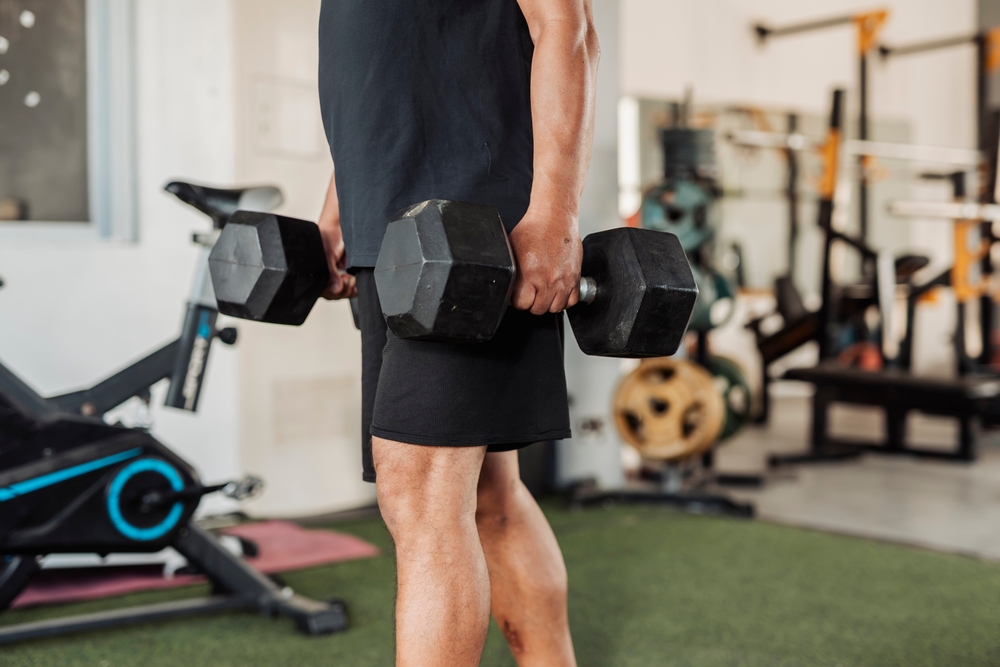
Farmer's walks—carrying heavy weights in each hand while walking—build the exact type of strength men over 40 need most: grip strength that predicts how long you'll live, functional muscle that prevents falls and maintains independence, and real-world capability for daily tasks like carrying groceries or luggage.
This single exercise addresses multiple age-related concerns simultaneously, from bone density and cardiovascular health to posture and mental toughness, without the joint-pounding impact of running or complex technique requirements of other lifts.
Keep reading to learn proper form, starting weights, programming guidelines, and how to progress safely for long-term results.
Why Farmer's Walks Matter More After 40
Your grip strength reveals more about your future health than your blood pressure does.
Research published in Clinical Interventions in Aging found that grip strength directly predicts disability prevention, mental well-being, and survival rates as you age.
More surprisingly, it forecasts mortality risk, cardiovascular health, and cognitive decline with greater accuracy than traditional health markers doctors typically monitor.
This matters because farmer's walks build grip strength while simultaneously addressing the health challenges that accelerate after 40:
- Sarcopenia: The muscle loss that starts around age 30 and accelerates each decade
- Insulin resistance: A growing risk that increases vulnerability to type 2 diabetes and metabolic dysfunction
- Cardiovascular decline: Reduced heart health and aerobic capacity
- Metabolic slowdown: The gradual decrease in how efficiently your body processes nutrients and burns fat
Dr. Gabrielle Lyon emphasizes that functional, load-bearing movements like farmer's walks provide direct protection against these aging markers.
For men facing elevated risks of insulin resistance and cardiovascular disease after 40, this type of movement isn't just exercise—it's preventive medicine.
The exercise activates nearly every muscle group, with particular effectiveness in areas that decline fastest with age.
Your forearms, traps, and upper back work to prevent shoulder rounding.
Your core muscles—abs, obliques, and spinal erectors—engage to prevent bending or twisting under load.
Your glutes, quadriceps, hamstrings, and calves all activate to maintain stability and forward movement.
Beyond raw strength, farmer's walks improve your gait patterns and stride efficiency.
Walking mechanics naturally deteriorate as you age, but this exercise forces intentional core engagement and shoulder blade retraction while teaching proper posture.
If you spend hours at a desk, this movement directly counters the forward-slumped position your body adapts to over years.
The functional benefits translate immediately to daily life: carrying groceries without multiple trips, lifting luggage without strain, moving furniture when needed, and maintaining the independence that defines quality of life after 40.
The exercise strengthens stabilizing muscles throughout your body, improving balance and reducing fall risk—a genuine concern as coordination declines.
The weight-bearing nature promotes bone density, crucial for preventing osteoporosis.
And unlike running or other high-impact cardio, farmer's walks elevate your heart rate and improve both aerobic capacity and anaerobic threshold without punishing your joints.
Dr. Peter Attia, a longevity expert, includes farmer's walks in his training protocols and sets a clear benchmark: you should be able to carry your total body weight split between both hands for a meaningful distance.
For a 180-pound man, that means working toward 90 pounds in each hand.
This isn't about gym performance—it's about maintaining the physical capability to live independently and handle whatever life requires.
The mental component shouldn't be overlooked either.
Fighting to maintain your grip and posture when your body screams to quit builds genuine toughness that carries beyond the gym into every challenging situation you face.
How to Perform Farmer's Walks With Perfect Form
The setup determines everything that follows. Poor positioning at the start creates form breakdown during the walk, so treat these first steps as non-negotiable.
Setting Up and Lifting the Weights:
- Stand between your weights with feet hip-width apart, positioned slightly behind the center of the handles
- Bend at your hips and knees exactly like you're initiating a deadlift, keeping your back flat
- Before you touch the weights, create full-body tension: squeeze your glutes to shift your pelvis to neutral, tighten your abs, and retract your shoulder blades
- Grip the handles as tightly as possible—you're actively crushing them, not just holding on
- Pull the weights slightly upward to create tension in your body before they leave the ground
- Push through your heels and deadlift the weights up until you're standing completely upright
Stand tall with your shoulders packed down and back, chest proud, and eyes looking straight ahead.
This isn't a casual stance—you should feel rigid and locked in.
The Walk Itself:
Strike the ground with your midfoot, not your heel. Heel-striking increases joint stress and disrupts the stability you've built.
Keep your feet pointing straight ahead with each deliberate, controlled step.
Your posture stays identical to your standing position: spine straight, shoulders back, core braced, glutes squeezed.
Nothing changes as you move.
Breathe steadily and rhythmically throughout the entire walk.
Holding your breath spikes blood pressure unnecessarily—a particular concern for men over 40.
Find a breathing pattern that feels natural and stick with it.
Lowering the Weights:
When you're finished, reverse the deadlift movement.
Push your hips back first, then bend your knees to lower the weights to the ground.
Don't just drop them—controlled lowering reinforces the same movement pattern you used to lift them and prevents injury.
The entire movement should feel deliberate and powerful, not rushed.
You're building strength through intentional control, not speed.
Starting Weights and How to Progress Safely
Start conservatively at 20-25 pounds per hand—roughly 25-30% of your total body weight.
If you weigh 180 pounds, begin with 20-25 pounds in each hand rather than jumping to heavier loads.
Your first priority is perfecting your stride and posture, not testing your maximum capacity.
Form matters more than ego at this stage.
Spend several sessions getting comfortable with the movement pattern, walking mechanics, and how to maintain tension throughout your body.
Once your form stays solid for multiple sets without breakdown, you're ready to add weight.
The Progression Pathway:
Your progression follows a clear trajectory based on experience and capability.
Once your form is locked in, move to 25-50% of your body weight per hand.
For that same 180-pound man, this means 45-90 pounds per hand.
Experienced lifters eventually work toward 50-75% of body weight per hand, while elite performance sits at 100% of body weight per hand.
Dr. Peter Attia's longevity benchmark provides a concrete target: you should be able to carry your total body weight split between both hands for a meaningful distance.
A 180-pound man works toward carrying 90 pounds in each hand—not for a few steps, but for 40-50 yards or more.
How to Progress:
You can manipulate multiple variables to drive progress without always adding weight.
Increase the distance you walk, extend time under tension, reduce rest periods between sets, or add more total sets to your workout.
This flexibility lets you progress even when weight increases aren't appropriate yet.
Here's a sample 12-week progression: Start with a weight you can carry 100 feet for 4-6 sets.
Each week, gradually decrease the distance while increasing the weight.
After several weeks of heavier, shorter carries, cycle back to longer distances with your new, heavier baseline.
This wave-like approach builds both strength and endurance without plateauing.
The real key is adopting a long-term mindset.
Adding just 5 pounds every few weeks doesn't sound impressive, but it accumulates to significant strength gains over a year.
Men over 40 benefit from this patient approach far more than aggressive loading that leads to injury.
Recovery Matters More After 40:
Listen to your body's recovery signals.
Grip fatigue that lingers for days, persistent forearm exhaustion, or upper back soreness that doesn't resolve indicates you need additional rest.
Your body requires more recovery time than it did at 25 or 30.
This isn't weakness—it's physiology.
Respect it, and you'll build sustainable strength. Ignore it, and you'll end up injured and set back weeks or months.
Common Mistakes That Will Sabotage Your Progress
Most form breakdowns stem from the same root cause: using too much weight before you're ready.
When the load exceeds what you can control, your body compensates with poor mechanics that negate the exercise's benefits and increase injury risk.
Posture Collapses:
Allowing your shoulders to round forward is the most common error.
This completely negates trap and core activation while putting dangerous stress on your spine.
The opposite problem—overarching your back—compromises spine safety just as badly.
Your solution is constant self-cueing throughout every set: “Shoulders back, abs tight, glutes squeezed.” Repeat this mentally with each step.
If you can't maintain upright posture, can't walk at least 20-40 yards, or your grip fails prematurely, the weight is too heavy.
Form breakdown tells you exactly when you've exceeded appropriate load—listen to that signal.
Positioning and Movement Errors:
Hitting your thighs with the dumbbells impairs your performance and causes bruising that'll remind you of your mistake for days.
Keep your arms slightly out to provide clearance, or switch to thinner weight plates instead of thick dumbbells if this keeps happening.
Shuffling with short steps and bent knees puts excessive strain on your quadriceps and accelerates fatigue.
Lift your feet fully off the ground with each purposeful step while maintaining tall posture.
This isn't a trudge—it's a deliberate walk with intention behind every movement.
Creating Tension in the Wrong Places:
Scrunching your neck, locking out your knees completely, or creating excessive back arch all indicate you're struggling with too much weight.
These compensations create tension in areas that should stay relaxed while robbing tension from areas that need it.
Check your form before each walk. If you notice these patterns emerging, drop the weight and reset.
The Breathing Mistake:
Holding your breath throughout the carry is dangerous, particularly for men over 40 who need to be mindful of blood pressure.
Breath-holding spikes blood pressure unnecessarily and can cause dizziness or worse.
Breathe steadily and rhythmically from start to finish. Find a pattern that works and stick with it.
Every mistake listed here disappears when you start lighter than you think necessary and progress slowly.
Your ego might prefer heavier weights now, but your body will thank you for patience when you're still training injury-free a year from now.
How to Program Farmer's Walks Into Your Weekly Routine
Plan for 2-3 sessions per week with at least two days of rest between each session.
Your grip, forearms, and upper back need adequate recovery time, and men over 40 particularly need this spacing to avoid overuse injuries.
Rushing the frequency only leads to diminished performance and potential setbacks.
Training Protocols Based on Your Goals:
Your programming depends entirely on what you're trying to accomplish.
Different goals require different approaches to sets, distance, weight, and rest periods.
For general strength and conditioning, perform 3-5 sets of 30-60 seconds or roughly 40 yards.
Use 25-50% of your body weight per hand and rest 60-90 seconds between sets.
This builds well-rounded capability without specializing in any single quality.
For maximum strength development, stick to 3-5 sets of 40 yards with heavier loads at 50-75% of body weight per hand.
Rest longer between sets—90-120 seconds—to allow fuller recovery so you can maintain intensity.
For muscular endurance and fat burning, reduce the weight to 25-40% of body weight per hand but extend the distance to 80-100 yards or up to two minutes of continuous walking.
Complete 2-3 sets with this lighter load and longer duration.
For muscle building (hypertrophy), perform 3-6 sets of 40-60 yards carrying your total body weight split between both hands (80-100% total).
This higher volume with moderate-heavy loads creates the stimulus your muscles need to grow.
How to Fit Them Into Your Workouts:
Farmer's walks work effectively in multiple positions within your training session.
Use them as a warm-up with lighter weights—30 seconds on, 30 seconds off for 2-3 minutes gets your entire body activated.
Place them mid-workout as your main strength movement when you're fresh enough to handle heavier loads.
Or deploy them as a brutal finisher after completing your other exercises—4 rounds of 40 seconds on, 20 seconds off with challenging weight will leave you depleted in the best way.
A Practical Starting Point:
Kirk Charles, a certified trainer specializing in men over 40, recommends this straightforward approach: Start with 100 paces, rest 1-2 minutes, and complete 4 sets.
Perform this three times per week.
Begin light at 20 pounds per hand to master your stride, then increase to whatever weight your grip strength can handle while maintaining form.
Prioritize movement quality over load, especially in your first month.
Focus on midfoot striking rather than heel striking—this simple adjustment reduces stress on your joints and improves your overall gait efficiency, which matters more as you age.
If you have arthritis, joint issues, or other physical limitations, consult a physical therapist to adapt the exercise appropriately.
The movement can still benefit you when modified correctly, but professional guidance ensures you're not aggravating existing problems.
Variations and Safety Guidelines for Long-Term Success
Once you've mastered the standard farmer's walk, variations add new challenges and address specific weaknesses.
Each variation serves a distinct purpose beyond simple novelty.
Single-Arm (Suitcase) Carry:
Hold weight in only one hand, creating an asymmetric load that forces your obliques and core to work overtime preventing lateral flexion.
This variation directly addresses muscle imbalances between your left and right sides while providing an intense core challenge.
Walk 40-60 feet, then switch hands. Start with just 15-20% of your body weight—this is significantly harder than it looks.
Uneven Farmer's Walk:
Carry different weights in each hand, such as 30 pounds in your right hand and 20 pounds in your left.
This mimics real-life scenarios like carrying uneven grocery bags and forces your stabilizing muscles to adapt to imbalance.
Switch which side carries the heavier load between sets.
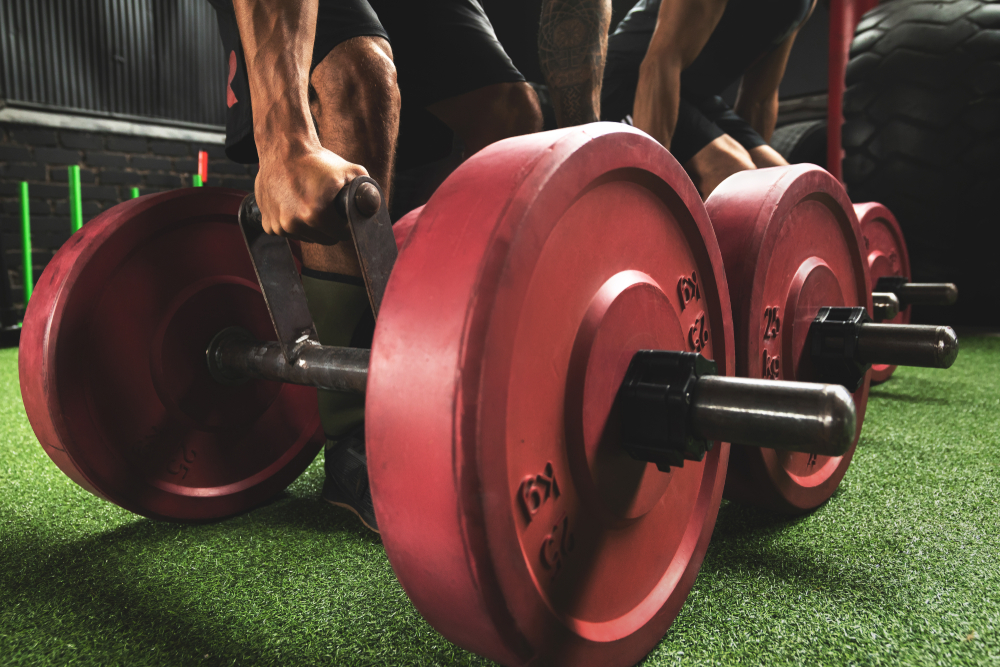
Trap Bar Carry:
Stand inside a loaded trap bar and carry it while walking.
The neutral grip and centered load reduce strain on your hands and back while allowing you to progress to 100-200+ pounds.
The better biomechanics make this ideal for men with grip limitations or those ready to handle serious weight.
Overhead Carry:
Hold dumbbells or kettlebells overhead while walking.
This dramatically increases shoulder stability demands and core engagement.
Start very light—this variation is exponentially more challenging than standard carries and requires exceptional shoulder mobility.
Timed Static Holds:>
Instead of walking, simply hold heavy weights at your sides for 30-60 seconds.
This builds pure grip endurance and postural strength without the added complexity of movement.
Use this when space is limited or when isolating grip strength is the priority.
Non-Negotiable Safety Guidelines:
Always perform a dynamic warm-up before touching any weights: arm circles, leg swings, torso rotations, and light movement to prepare your muscles and joints.
Men over 40 require more thorough warm-ups than younger athletes to prevent injury—never skip this.
Maintain a neutral spine throughout every rep of every set.
Never allow rounding or excessive arching.
If your posture breaks down, the set is over regardless of how much distance or time remains.
No exceptions.
Clear your walking path completely before you begin.
Tripping hazards are unacceptable when you're carrying heavy weights, especially when fall prevention is one of the exercise's primary benefits.
Use flat, stable shoes without excessive cushioning—running shoes compress under heavy loads and destabilize you.
If you have cardiovascular concerns, blood pressure issues, or previous injuries, consult your physician before beginning heavy loaded carries.
The exercise does elevate blood pressure temporarily, and you need medical clearance if you have any history of heart problems.
Stop immediately if you experience sharp pain, dizziness, or unusual symptoms. Muscle burn and grip fatigue are normal—joint pain or cardiovascular symptoms are not. Learn to distinguish between productive discomfort and warning signs your body is in distress.
Why This Matters Beyond the Gym:
The strength and stability you build directly improve your functional capacity for the daily activities that define independence after 40: carrying children or grandchildren, moving furniture when needed, traveling with luggage, outdoor work, and maintaining your home and property.
These aren't abstract fitness goals—they're the capabilities that let you live life on your terms.
The mental component deserves final emphasis.
Fighting to maintain your grip and posture when every muscle screams to quit builds genuine resilience that transfers to every challenging situation you face.
This psychological fortitude matters as much as the physical strength you're developing, perhaps more.
Conclusion
Farmer's walks deliver exactly what men over 40 need: functional strength that translates to real life, injury prevention that maintains independence, and measurable health improvements that predict longevity.
Start with 20-25 pounds per hand, focus relentlessly on form, and progress slowly over months rather than weeks.
The strength you build now determines the life you're capable of living at 50, 60, and beyond.