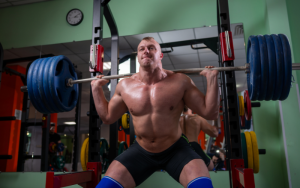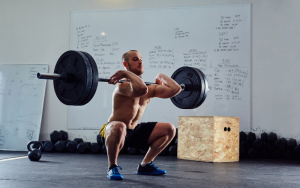
If your lower back, shoulders, or knees can't handle a heavy back squat anymore, the belt squat and safety squat bar are your best direct replacements, while the trap bar deadlift and Bulgarian split squat work best if you're training for athletic performance.
Keep reading to see exactly which alternative fits your situation and why the research backs each one up.
Why You Might Need a Back Squat Alternative
The back squat rests the bar high on your upper back, which creates a long lever between the load and your hips and lower spine.
That distance is exactly why the lift works so well for building total-body strength, and also why it wears down certain joints faster than other exercises. Once you understand where the stress actually goes, it's easier to see which alternative solves your specific problem.
Spinal loading is the biggest driver. As the weight on the bar climbs toward your one-rep max, your torso naturally leans forward to keep the bar over your midfoot.
That forward lean is not a technique flaw — it's a mechanical necessity — but it does raise the compressive load on your lower spine. Researchers modeling barbell half squats have estimated L3-L4 compressive forces reaching 6 to 10 times body weight with 0.8 to 1.6 times body weight loaded on the bar.
Studies on maximal-effort squats confirm the pattern: the closer you get to your 1RM, the more your trunk leans forward, and the more your lumbar spine has to resist that shear and compressive force.
Shoulder and elbow mobility set a hard ceiling. Getting the bar into position, especially in a low-bar setup, demands a good amount of shoulder external rotation.
If that range of motion isn't there, your body finds it somewhere else, usually at the inner elbow or the wrist. This shows up commonly enough that it has its own nickname among lifters and physical therapists: squatter's elbow.
A high-bar position and a wider grip ease some of this demand, but for lifters with genuinely limited shoulder mobility, the discomfort often persists regardless of bar placement.
Knee mechanics differ from what most people expect. You'd think shifting the load forward, as in a front squat, would punish the knees more. The opposite tends to be true.
Trained lifters produce significantly higher knee compressive forces and knee extensor moments in the back squat than in the front squat. So if your knees are the limiting factor, the back squat isn't necessarily the gentler option it might seem.
Beyond the biomechanics, a few practical and philosophical issues push lifters toward alternatives:
- No rack, no problem — except there is one. A heavy back squat needs a squat rack and ideally a spotter or safety pins. Home gym owners without that setup are effectively locked out of heavy back squatting and need exercises loaded from the floor or held in the hands instead.
- The bilateral debate. Some coaches argue single-leg training carries over better to sprinting, cutting, and jumping than two-legged squatting does. This isn't a fringe opinion — prominent strength coaches have dropped back and front squats from their programming entirely, citing both this reasoning and the frequency of low back pain among their athletes. It's a genuinely contested position, not a settled one, but it's common enough that you'll run into it if you coach or train athletes.
- Training frequency and recovery. Heavy back squats create systemic fatigue that limits how often you can train legs hard. Alternatives that reduce spinal and central nervous system demand let you hit your legs more frequently without digging as deep a recovery hole.
None of this means the back squat is a bad exercise. It means the demands it places on your body are specific, and when one of those demands doesn't fit your joints, your equipment, or your goals, there's usually a more targeted tool for the job.
What the Research Actually Shows Before You Pick a Replacement
Before you swap in a new exercise, it helps to know what the evidence actually supports and where it's thinner than most fitness content lets on.
Training specificity is real, and it's stubborn. If your goal is a bigger back squat number, squatting beats every alternative for building that specific number. Trials comparing squat-only training against leg-press-only training show squatting produces greater carryover to maximal squat strength, even when the leg press group builds comparable muscle.
The same pattern holds for half squats versus trap bar deadlifts: each exercise gets you better at itself first. This isn't a knock on alternatives — it just means you should pick a replacement based on what you actually need, not assume any single exercise will preserve your squat number while you're away from it.
Muscle growth cares less about the exercise than you'd think. A 2023 meta-analysis pooling 13 studies and over 1,000 participants found no meaningful difference between free-weight and machine training for strength, hypertrophy, or jump performance when tested on neutral measures.
Each training style still wins on the specific skill it practices — free weights on free-weight lifts, machines on machine lifts — but for raw muscle size, effort and proximity to failure matter more than whether you're under a barbell or locked into a machine.
Where the evidence is genuinely solid:
- Reducing spinal load is the best-supported claim in this entire topic. Belt squats, safety squat bars, and machine-based squats all measurably cut lumbar extensor activity or low-back moments compared to the back squat.
- These reductions aren't small or marginal — some approaches cut peak lumbar activation by roughly half, which is a meaningful difference for anyone managing back pain.
Where the evidence gets shaky or outright contested:
- Zercher squat claims about superior muscle activation and reduced spinal compression are mostly extrapolated from front squat data, not measured directly. Treat these claims as plausible, not proven.
- Calling the trap bar deadlift a squat substitute is common in marketing but disputed by biomechanics researchers, who point out it remains a hip-dominant hinge pattern rather than a true knee-dominant squat replacement.
- The unilateral-versus-bilateral debate remains unsettled. Trials show single-leg and two-leg training producing statistically equal outcomes, yet even the strongest advocates for single-leg-only programming have revised their own approach over time — which tells you the science hasn't caught up to a firm answer.
A few caveats worth keeping in mind as you read further: most of the underlying studies involve small groups, often 10 to 20 participants, run over just 5 to 10 weeks, and drawn almost entirely from young, healthy, already-trained men.
Few studies include injured populations, which limits how confidently you can apply these findings if you're choosing an alternative specifically because of an injury.
And a lot of the muscle activation data comes from EMG readings or inverse dynamics modeling — useful tools, but ones that estimate muscle demand and joint moments rather than directly measuring tissue stress or growth.
None of this invalidates the findings. It just means you should treat the recommendations ahead as strong starting points, not absolute rules.
Barbell and Specialty Bar Alternatives
If you still want the loading pattern and skill carryover of a barbell squat but need to change where the stress lands, these three variations keep you under a bar while solving different problems.
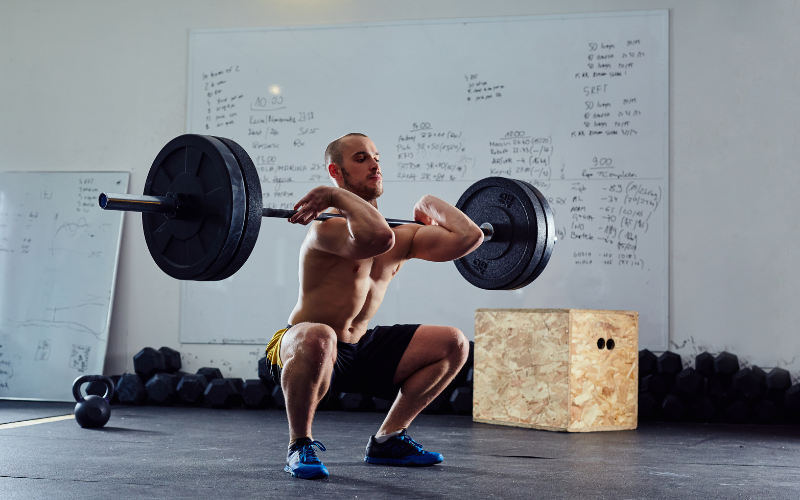
Front squat. Moving the bar to the front of your shoulders forces your torso into a more upright position, which changes the entire loading picture.
Trained lifters produce lower knee compressive forces and knee extensor moments in the front squat than the back squat, and the more upright torso means less forward lean and less lumbar stress at heavy loads.
The tradeoff is real: expect your front squat max to run about 20% lower than your back squat, since the lift is now limited by how much weight your upper back and core can support in that rack position.
You'll also need decent wrist, lat, and thoracic mobility to hold the front rack — so if shoulder mobility was your original problem, you're trading one mobility demand for another.
This one's best suited to lifters managing knee or lower back sensitivity who still want a heavy bilateral squat, plus anyone doing Olympic weightlifting, where the front squat position is already part of the sport.
Program it with heavy sets of 3 to 6 reps, based on a front squat-specific max rather than a percentage of your back squat number, since high-rep sets tend to fail at the upper back long before your legs give out.
Safety squat bar squat. The cambered bar design and forward handles let you keep your hands out in front of your body instead of pinned behind your shoulders, which dramatically cuts the shoulder and elbow mobility this lift usually demands.
That's the whole appeal: it lets lifters with shoulder or elbow pain keep squatting heavy without forcing a joint position they can't access. The bar also encourages a more upright torso and increases lower trapezius activity, though don't expect to match your back squat numbers — competitive powerlifters have shown roughly an 11% lower 3RM with the safety bar.
It requires specialty equipment, so this only works if your gym has one. Treat it as a near-direct back squat replacement: program it the same way you'd program a back squat, just with about 10% less load, and consider rotating it in as either your primary or secondary squat if you're managing an upper-body injury long-term.
Zercher squat. Holding the bar in the crooks of your elbows eliminates the shoulder mobility requirement almost entirely, which makes it a genuinely useful option if a rack-mounted bar position isn't accessible to you.
It also demands significant work from your abs and upper back to keep the bar from pulling you forward, which is part of why some coaches use it specifically as a bracing and technique teaching tool.
Here's the honest caveat: there's almost no direct research on this lift's biomechanics. Most claims about reduced spinal compression are borrowed from front squat data, not measured in Zerchers themselves — plausible, but not proven.
It's genuinely uncomfortable on the forearms and elbows, and your upper body strength will cap the load well before your legs are challenged. This makes it a better fit for lifters without a shoulder-friendly bar option, strongman athletes, and home gym setups where the bar can be lifted from pins or blocks.
Keep reps moderate, in the 3 to 8 range, use padding or sleeves to protect your forearms, and consider adding pauses or slow tempo work to reinforce the bracing position, since that's really what this lift is teaching you.
Hinge-Based and Unilateral Alternatives
These options move away from the bilateral squat pattern entirely, either shifting the movement to a hip hinge or splitting the load between one leg at a time. Both approaches change the demands on your body enough to be worth understanding before you pick one.
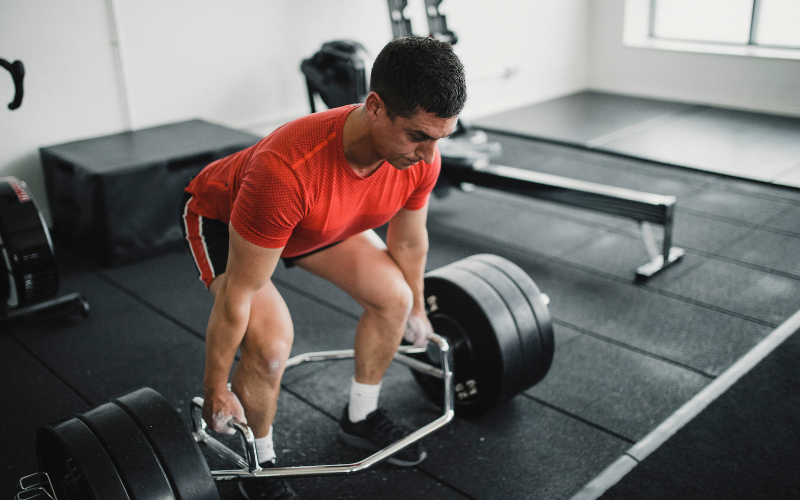
Trap bar deadlift. Standing inside the bar with the load at your sides makes this exercise look like a squat, but don't be fooled — joint-moment data shows the hip moment runs about 1.78 times higher than the knee moment, which means this is still mostly a hip hinge wearing a squat costume.
That matters for programming: if you're relying on the trap bar deadlift to cover your quad training, you're leaving a gap. What it does offer is genuinely valuable. You get higher peak power and peak velocity than a conventional deadlift across a range of loads, no shoulder mobility demand since your arms hang naturally at your sides, and no rack requirement at all.
Trials comparing barbell half squats against trap bar deadlifts over eight weeks found each exercise improved its own specific strength measure more than the other did — further confirmation that this isn't a true squat substitute, just a strong, accessible complement to one.
Use it for heavy sets of 3 to 6 when building strength, lighter and faster sets when chasing power output, and always pair it with a knee-dominant unilateral movement to cover what it doesn't train.
Rear-foot-elevated (Bulgarian) split squat. This is one of the better-supported alternatives on this list. Research comparing back squats at 85% of 1RM against rear-foot-elevated split squats at roughly half that load found peak vertical force was similar between the two — meaning you can generate comparable leg force at a fraction of the spinal loading.
A five-week trial with academy rugby players backs this up at the performance level: athletes training exclusively with this exercise matched athletes doing only back squats on squat 1RM, split squat 1RM, 40-meter sprint time, and change-of-direction speed, with no significant differences between the groups.
It's not without controversy, though. Critics have raised concerns about pelvic torsion and SI-joint stress from the elevated rear foot position, and while this criticism comes more from opinion than controlled data, it's worth taking seriously if you have a history of hip or SI-joint issues.
To keep quad emphasis high, stay upright through the movement — leaning forward shifts work toward the glutes and hamstrings instead. And keep the back foot functioning purely as a stabilizer, since letting it push turns this into a diluted two-leg exercise and defeats the purpose entirely.
Walking lunges and forward or reverse lunges. Step length changes the knee stress profile more than most lifters realize. Research on lunge mechanics found that a short step produces greater patellofemoral force and stress than a long step at higher knee flexion angles, which means if you're managing knee sensitivity, your stride length is a bigger lever than the exercise choice itself.
For rehab purposes, a sensible progression moves from partial range of motion — roughly 0 to 50 degrees of knee flexion — toward deeper ranges, eventually working up to a long step at ground level once tolerance improves.
These lunges need minimal equipment and add a locomotor, balance-driven component that static exercises don't offer, though loading is inherently capped by grip strength and stability, and walking variations need enough open floor space to be practical.
Step-ups. This exercise consistently shows strong glute medius and hamstring activation, often outperforming standard squats on those measures.
It's also one of the easiest exercises on this list to scale precisely — raise or lower the box height and you immediately adjust difficulty, which makes it well-suited to beginners, older adults, and anyone working through knee rehab with a low box.
The main technical flaw to watch for is cheating: it's easy to let the trailing leg push off the ground and quietly turn a unilateral exercise into a bilateral one, which defeats the purpose.
Keep the trailing foot passive and choose a box height that puts your working thigh near parallel to the floor for a real strength stimulus, working in the 6 to 10 rep range per leg.
Single-leg squats, skater squats, and pistols. These represent the far end of unilateral loading — bodyweight alone on one leg can load that leg comparably to a bilateral squat with meaningful barbell weight, and adding load, such as 50% of bodyweight, can approach the per-leg demand of a heavy double-bodyweight back squat.
Those loading equivalencies come from force plate data reported by prominent strength coaches, though some researchers dispute how precisely those numbers translate across different lifters and setups.
What's not in dispute is the difficulty: these movements have a steep learning curve, demand real balance and ankle or hip mobility, and often require awkward external loading methods like weighted vests, chains, or sandbags held in a Zercher position to keep progressing.
They need almost no equipment beyond that, which makes them a strong option for advanced athletes training at home or on the road, but they're not a beginner-friendly entry point the way step-ups or split squats are.
Machine-Based and Bodyweight-Friendly Options
Machines and bodyweight movements sit at opposite ends of the equipment spectrum, but they share a common thread: both remove variables that make a free-weight barbell squat demanding, which is exactly what makes them useful when injury, access, or experience level rules out the back squat.
Belt squat. Of every alternative covered so far, this one cuts spinal loading the most. Lifters experienced in both movements showed a 45% drop in lumbar erector impulse and a 52% drop in peak lumbar activation compared to the back squat, using matched loads.
The mechanism is simple: the load hangs from a belt around your hips instead of resting on your spine, so your upper body carries none of it. That makes it a strong option for lifters with disc issues, general lower back pain, or upper-body injuries that make holding a bar impossible.
Research also found that lifters with the highest back squat spinal moments saw the biggest reductions when they switched to the belt squat, suggesting the people who need this option most benefit from it the most.
The catch is access — belt squat machines aren't standard equipment in most commercial gyms, so this alternative often depends entirely on whether your facility has one.
Where it's available, program it in standard squat rep ranges of 5 to 12, and use back squat load as a rough starting reference, then adjust by feel from there.
Hack squat. This machine lets you load significantly heavier than a back squat — strength-trained lifters have posted 1RMs roughly 18% higher on the hack squat than the back squat — while trunk muscle activation drops sharply at matched relative loads.
Your lumbar erectors and obliques simply don't have to work as hard when the machine's fixed path and back pad handle stabilization for you.
That's a genuine advantage for pure quad hypertrophy work or for training around lower back fatigue. The tradeoff is transfer: despite the heavier numbers, hack squat training carries over less to actual free-weight squat strength than squat-specific training does, because the stabilization demands that build real squat strength are largely engineered out of the machine.
Use it in moderate-to-high rep ranges of 6 to 15, go to full depth, and place your feet lower on the platform if you want to bias the quads even further.
Leg press. With your back fully supported against a pad, this machine removes axial spinal loading almost entirely, which makes very heavy loading possible without putting your torso at risk. It's a legitimately effective hypertrophy tool for exactly that reason.
Where it falls short is athletic transfer — squat training produces greater carryover to jump performance and maximal squat strength than leg press training does, even when both build comparable muscle mass.
One detail worth flagging: knee forces at 90 degrees of flexion remain high on the leg press, with patellofemoral force running similar to a full squat, so it's not automatically the safer choice for knee-sensitive lifters that people often assume it is.
It works best as hypertrophy volume, injury-period training for lifters managing a back or upper-body issue, or supplemental work alongside a primary squat pattern. Standard programming runs 8 to 15 reps, with the hips kept flat on the pad and depth stopped right before the pelvis starts to lift off it.
Smith machine squat. The fixed bar path changes the whole exercise: lifters typically post roughly an 11% higher 1RM on the Smith machine than the free-weight back squat, paired with lower erector spinae activity.
That combination — more weight, less stabilizer demand — makes it appealing for lifters who want barbell-style loading with built-in safety and less technical risk, since the machine catches the bar if a rep fails.
The lower muscle activation at a given load is the direct cost of that fixed path; your stabilizers simply don't have to work as hard when the bar can't drift forward or back.
It's a solid choice for lifters who want a squat pattern with training wheels, particularly those newer to heavy lifting or working without a spotter.
Goblet squat and double-kettlebell front squat progression. Holding a single dumbbell or kettlebell against your chest counterbalances your body weight, which naturally keeps your torso upright and puts minimal load on your spine.
This is arguably the easiest squat variation to teach — the loaded position essentially cues correct depth and posture on its own, which is why it's commonly used to teach large groups of beginners to squat properly in a single session.
The obvious limitation is load: your arms and upper back will cap out well before your legs get a meaningful strength stimulus, so for anyone already reasonably strong, this becomes a high-rep or technique-focused tool rather than a true strength builder.
The natural progression is moving to double-kettlebell front squats once a single goblet load stops being challenging, which raises the ceiling somewhat while keeping the same upright, spine-friendly mechanics.
This one's best reserved for beginners, warm-ups, and home gyms without heavier equipment — work in higher rep ranges of 8 to 20 and treat it as a foundation rather than an endpoint.
Matching the Right Alternative to Your Situation
With the mechanics and evidence covered, here's how to translate that into an actual decision based on what's limiting you.
Lower back pain or disc sensitivity. Start with the belt squat if you have access to one — it produces the largest measured reduction in lumbar erector activity of any alternative, which makes it the most direct answer to a spine-related problem.
Without belt squat access, the hack squat and leg press both support the spine against a pad and let you train heavy without axial loading.
Bulgarian split squats round this out well, since comparable leg loading at roughly half the absolute weight means less total stress moving through your spine on each rep. Get clearance from a physical therapist first if you're dealing with active pain rather than general sensitivity.
Shoulder, elbow or wrist limitations. The safety squat bar is your best bet for a heavy bilateral option, since the forward handles let your hands stay out in front of your body instead of forcing the external rotation a standard bar demands.
Use the belt squat or leg press for additional volume work that requires zero shoulder involvement. If your goals lean athletic rather than purely strength-focused, the trap bar deadlift is worth adding too — arms hang naturally at your sides, so there's no mobility requirement at all. In the short term, switching to a high-bar position or widening your grip can sometimes reduce discomfort enough to keep back squatting through minor issues.
Knee sensitivity. Front squats and goblet squats both keep your torso upright and reduce knee compressive force compared to a back squat, making them logical first choices.
Long-step lunges matter more than most people realize here — a longer stride specifically reduces patellofemoral stress compared to a short step, so stride length is a lever worth adjusting regardless of which lunge variation you choose.
Low step-ups round out the list well, since box height gives you precise control over how much knee flexion you're working through. Progress range of motion gradually: start with a partial range and only move toward full depth as your knees adapt.
No rack or home gym setup. The trap bar deadlift solves this cleanly, since it loads from the floor and needs no rack or spotter. Heavy Bulgarian split squats with dumbbells are equally practical and only require a bench.
Goblet squats or Zercher squats worked from the floor or blocks fill out a complete lower-body session without a single piece of rack-dependent equipment.
Athletes chasing sprint and change-of-direction performance. Rotate the trap bar deadlift for strength and power development with heavy rear-foot-elevated split squats or single-leg work for unilateral strength — this combination has research backing it, since trials show matched improvements in squat strength, sprint time, and change-of-direction speed when comparing unilateral-only training against back squat-only training.
If you still want a bilateral squat pattern in the mix, add a front squat or safety bar squat alongside this rotation rather than replacing it entirely.
Hypertrophy-focused training. Anchor your program around the hack squat, leg press, and belt squat, since meta-analysis data shows machines and free weights build comparable muscle when training effort is matched.
The real variable that matters here isn't which of these three you pick — it's how close to failure you actually train. Add Bulgarian split squats for additional volume and to address any side-to-side strength differences that bilateral machine work won't reveal.
Injured powerlifters. Use the safety bar or belt squat to preserve the squat pattern and leg strength while you're sidelined, then return to back squatting as soon as your injury tolerates it.
Neither option fully replicates back squat specificity, so don't expect your competition numbers to transfer perfectly — but both keep you close enough to the movement pattern that the transition back will be far shorter than if you'd trained something unrelated during your time off.
Conclusion
The back squat puts unique demands on your spine, shoulders, elbows, and knees, but every one of those demands has a well-supported alternative once you know which problem you're actually solving.
Match your choice to your specific limitation — belt squat for back pain, safety bar for upper-body issues, front squat or lunges for knee sensitivity, trap bar and split squats for athletic carryover — rather than picking whatever's trending.
None of these fully replace the back squat's specificity, so treat them as smart substitutes while you address the underlying issue, not permanent replacements if a return to back squatting is realistic.