If you want bigger biceps without spending an hour in the gym, the best dropset routine pairs EZ-bar straight sets with dropsets on cable and dumbbell curls, using 1-3 drops of about 20-25% each with zero rest between them.
Keep reading for the full breakdown, including exact sets, reps, and how often to train this way.
What Is a Dropset (And Why It Works for Biceps)
A dropset means taking a set to muscle failure, then immediately cutting the weight and continuing to failure again, with no real rest in between.
Most lifters do one to three drops per set, reducing the load by 20-25% each time. That range hits the sweet spot: enough to keep you moving through fatigued fibers, not so much that the set feels like it's starting over.
The “near-zero rest” part isn't optional — it's what makes a dropset a dropset. You get the few seconds it takes to move a pin or grab lighter dumbbells, and that's it.
Set the weight down and rest for even 15 seconds, and you've essentially turned it into a new set with a lighter load, losing the fatigue carryover that makes the technique work.
Two mechanisms explain why this drives bicep growth:
- Metabolic stress. Stringing sets together with minimal rest floods the muscle with lactate and hydrogen ions, creating the deep burn and pump lifters chase. This buildup is one of the proposed drivers of hypertrophy, and it's noticeably higher after dropsets than after traditional training.
- Motor-unit recruitment. Failure at a heavy load doesn't mean every fiber is spent — plenty are still fresh. As you drop the weight and keep pushing, your nervous system recruits progressively more (and larger) motor units to keep the movement going, reaching fibers the first set alone wouldn't touch.
Time under tension plays a smaller supporting role here too. Chaining sets together with no rest extends how long your biceps stay under load in a single stretch, adding to the overall stimulus.
Here's the part worth setting straight before you get excited: dropsets don't beat straight sets for muscle growth.
Across multiple meta-analyses, the difference in hypertrophy between the two approaches is trivial — close enough to call it a tie.
What dropsets actually deliver is time efficiency, cutting total training time by roughly 30-70% for a comparable growth stimulus.
That efficiency comes at a cost, though. Dropsets consistently produce higher perceived exertion and higher lactate levels than straight sets. In plain terms: they feel harder, because they are.
What the Research Actually Shows on Biceps Growth
The most direct evidence on dropsets and bicep growth comes from a study that compared three approaches: three sets at 80% of 1RM, three sets at 30% of 1RM, and a single dropset starting at 80% and descending through 65%, 50%, 40%, and down to 30% of 1RM, all to failure.
The result: the single dropset grew the elbow flexors just as much as three full traditional sets.
The catch is how little time it took to get there — about 2.1 minutes for the dropset group, compared to 6.8 minutes for the high-load group and 11.6 minutes for the low-load group. Same growth, a fraction of the time investment.
Strength and endurance didn't follow the same pattern, though:
- Strength improved in both the high-load and dropset groups, but not in the low-load group. The high-load group still came out ahead on raw strength gains.
- Endurance improved in the dropset and low-load groups, but not in the high-load group.
That split matters. If your main goal is maximum strength, straight heavy sets still have an edge. If you want a blend of size and muscular endurance without spending as much time under the bar, dropsets check both boxes at once.
Findings outside this one study point the same direction. A separate study on triceps found dropsets and traditional sets produced similar increases in muscle size, with the dropset group's numbers running slightly higher, though the difference wasn't large enough to call statistically meaningful in that sample.
A study on women performing dropset bicep training saw comparable growth to a traditional group doing twice as many total sets.
Put together, the research tells a consistent story: dropsets aren't a shortcut to bigger gains than straight sets can produce. They're a shortcut to the same gains, reached in less time.
The Best Bicep Exercises for Dropsets (And Why)
The exercise you pick matters less for muscle recruitment and more for logistics: can you actually change the load fast enough to keep the set going?
Since dropsets depend on near-zero rest, anything that takes more than a second or two to adjust breaks the whole technique. That single rule narrows the field considerably.
- Cable curls are the top pick. Moving the pin up the weight stack takes about a second, so you can chain two or three drops with almost no interruption. Cables also keep tension on the biceps through the entire range of motion, including the bottom of the curl where free weights tend to go slack.
- Machine curls come in a close second. Pin adjustments are just as fast as cables, and the fixed movement path helps keep your form locked in as fatigue builds — a real advantage when you're pushing through multiple failure points in a row.
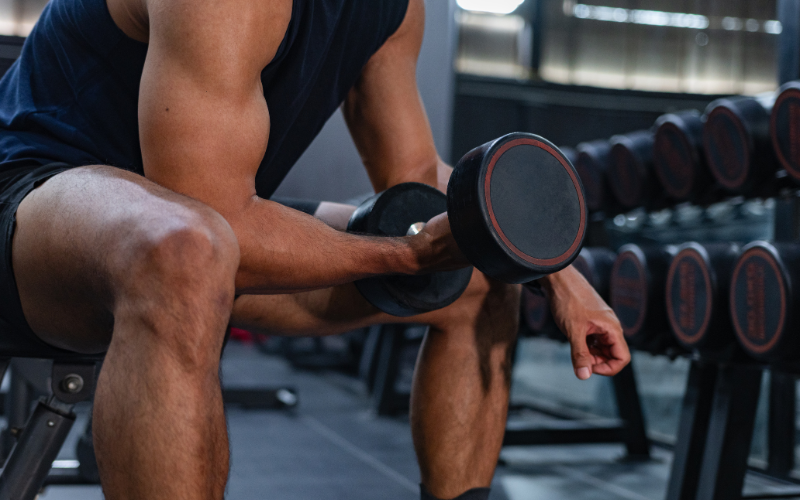
- Dumbbell curls work well too, but only with a bit of prep. Set out two or three pairs of dumbbells in descending weight before you start the set, and you can grab the next pair in seconds. Skip the setup and you'll waste time hunting for weights mid-set, which defeats the purpose.
- EZ-bar and barbell curls are the least practical option. Stripping plates off a bar takes too long to do alone without losing the intensity that makes a dropset effective. If you want to use one anyway, you have a few workarounds: have a training partner strip plates for you, use a rack of pre-loaded bars at different weights, or switch the approach entirely with a mechanical dropset.
A mechanical dropset solves the load-change problem a different way: instead of reducing the weight, you shift to an easier joint angle using the same dumbbells.
A typical sequence runs from incline curls (hardest position, deepest stretch) to standing curls (moderate difficulty) to hammer curls (easiest grip), all with one pair of dumbbells and no equipment changes.
It's a practical option when you're limited on equipment or want to hit the biceps through multiple angles in one set.
The Ready-to-Use Dropset Bicep Workout
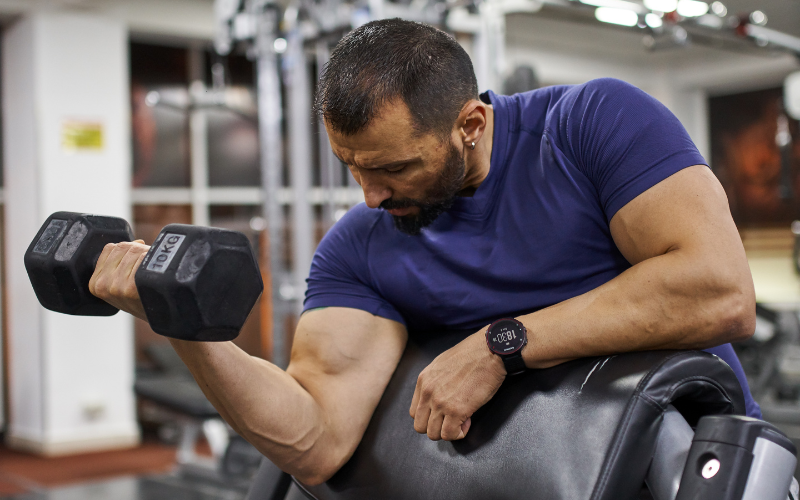
This session is built for intermediate to advanced lifters who already have solid curl technique. It takes about 30-35 minutes and delivers roughly 9-12 hard sets to the biceps, counting each dropset as a single intensified set.
Warm-up: Start with two light, non-failure sets of curls to get blood into the elbows and biceps tendons before you push toward failure. This isn't optional — cold tendons and repeated failure sets are a bad combination.
Exercise 1: EZ-bar curls
Three straight sets of 8-10 reps, no drops, with 90 seconds rest between sets. This exercise goes first while you're fresh, since stripping plates mid-set isn't practical and straight sets let you load up heavier for a strong opening stimulus.
Exercise 2: Seated dumbbell curls
Two straight sets, followed by a dropset on the third and final set. Pre-arrange your dumbbell pairs before you start — you'll need your working weight plus two lighter pairs, each roughly 20-25% below the previous one, so you can move from one to the next without hunting for weights mid-set.
Exercise 3: Cable curls
This is the centerpiece of the workout. Run two straight sets, then finish with a multi-drop set on the cable machine, using the pin to make each load change nearly instant. Because the adjustment takes about a second, this is where you can push the most drops without losing set-to-set intensity.
Optional finisher: Incline dumbbell mechanical dropset
One set, using a single pair of dumbbells. Start with incline curls to failure, sit up to standing or seated curls and continue to failure, then switch to a hammer grip and finish to failure. No weight changes needed — just a shift in joint angle each time your arms give out.
Self-check for dropset accuracy: After failing on your top set, you should be able to complete roughly 60-80% of that rep count on your first drop. If you're only getting one or two reps, you didn't cut enough weight. If you're matching or beating your top-set reps, you cut too much.
How Often to Train Biceps With Dropsets (Volume & Recovery)
Dropsets are far more fatiguing than they look on paper, which means the usual rules about training frequency need to be more conservative, not less.
Cap dropset sessions at one to two per week, with 48-72 hours between hard bicep sessions to let the tissue recover.
Total weekly volume matters just as much as frequency. Most lifters do well landing somewhere in the range of 10-20 hard sets for biceps per week — and dropsets should count toward that total, not stack on top of it.
A dropset already delivers the fatigue of multiple straight sets in one shot, so treat each one as several sets' worth of work when you're tallying your weekly numbers.
Add dropsets on top of an already full program, and you're setting yourself up for more soreness than growth.
Structure matters too. Run dropsets in focused blocks of four to eight weeks, then step back to straight sets for a stretch before bringing dropsets back into the mix.
This cycling keeps the technique effective instead of letting your body adapt to the point where it stops delivering a meaningful stimulus.
A few signs tell you it's time to pull back:
- Strength that declines from session to session instead of holding steady or improving — a sign you're not recovering between sessions.
- Achy sensations at the elbow or shoulder, as opposed to the normal muscle soreness you'd expect after a hard workout. This kind of ache can point to tendon irritation, which needs rest rather than more training.
Recovery outside the gym plays its part as well. Adequate protein intake and consistent sleep both support the repair process that dropset training demands — skimp on either, and even a well-structured program will underdeliver.
Common Mistakes to Avoid With Dropset Bicep Training
Most dropset mistakes come down to small execution errors that quietly cancel out the benefit of the technique. Here's what to watch for:
- Resting too long between drops. Any pause beyond the couple of seconds it takes to change the load lets fatigue fade and turns your dropset into just another straight set. The whole point is continuous, uninterrupted failure.
- Applying dropsets to every set instead of just the last one. Doing this on your first or second set forces you to reduce weight before you've built any real mechanical tension, and it tanks your performance on everything that follows. Save the drops for the final set of each exercise.
- Cutting the weight by the wrong amount. Drop too little and you'll barely squeeze out a rep or two, which isn't enough to matter. Drop too much and you'll match or beat your top-set rep count, meaning you didn't push the muscle hard enough at that first weight. Aim for the 20-25% range and check that you land around 60-80% of your top-set reps on the first drop.
- Letting form break down as fatigue builds. A little body English on a final rep or two is normal, but full-on swinging from the start shifts the work off your biceps and onto your shoulders and lower back — and raises your injury risk in the process.
- Choosing unstable or unfamiliar exercises. Dropsets push you to repeated failure, which is the wrong time to be testing a new movement or balancing on an unstable setup. Stick to exercises you've already mastered.
- Picking exercises where the load can't change fast enough, like a barbell curl you're stripping down solo. If you can't adjust the weight in a second or two, switch to cables, machines, or pre-arranged dumbbells — or use a mechanical dropset instead.
- Skipping the warm-up. Going straight to failure on cold elbow tendons is one of the more avoidable ways to end up with an overuse injury. A couple of light, non-failure sets first solves this.
- Stacking dropsets on top of an already high-volume program. Dropsets should replace some of your straight sets, not pile on top of them. Adding them to a full workload is a fast route to overtraining a muscle that's already small and easy to overwork.
Conclusion
Dropsets won't build bigger biceps than straight sets, but they'll get you there in a fraction of the time, provided you keep the rest between drops close to zero and reserve the technique for your last set on cable, machine, or dumbbell curls.
Stick to one or two sessions a week, cycle them in four-to-eight-week blocks, and pay attention to your elbows so intensity doesn't turn into injury.
Follow the routine above consistently, and you'll know within a few weeks whether dropsets earn a permanent spot in your training.