To correctly perform the triceps pushdown, stand close to a high cable pulley with your chest out and shoulder blades back, keep your elbows pinned to your sides throughout the movement, bring the handle all the way up to your chest, then press down with explosive force until your arms fully lock out, and control the weight slowly on the way back up.
This complete range of motion with proper elbow positioning is what separates arm-building pushdowns from wasted effort.
Keep reading for a detailed breakdown of setup, form cues, attachment selection, and programming strategies that will help you maximize triceps growth.
Why the Triceps Pushdown Deserves Your Attention
If you want bigger arms, you need to focus on your triceps.
They make up roughly two-thirds of your upper arm mass, which means they're the primary driver of arm size—not your biceps.
Most people overlook this and wonder why their arms stay small despite endless curls.
The triceps consists of three distinct heads working together.
The lateral head creates that coveted horseshoe shape on the outer arm.
The medial head handles the inner portion. The long head is the largest, running down the back of your arm.
The pushdown primarily targets the lateral and medial heads while also activating the long head, making it an efficient movement for overall triceps development.
Here's what many lifters get wrong: they assume heavy pressing movements alone will build their triceps. Research shows otherwise.
Your triceps grow significantly more when you supplement pressing with isolation exercises.
While bench presses and overhead presses involve the triceps, they don't provide the focused tension needed for maximum growth.
The cable mechanism is what makes pushdowns particularly effective.
Unlike free weights that vary in resistance due to leverage and gravity, cables provide consistent resistance throughout the entire range of motion.
This maintains constant tension on the muscle from start to finish, which is superior for triggering growth.
When you're using dumbbells or barbells, certain portions of the movement become easier due to mechanical advantages—the cable eliminates this inconsistency.
Setting Up Your Station for Maximum Results
Start by attaching your chosen handle to the cable machine at the highest pulley position.
Stand facing the machine with your feet shoulder-width apart, grip the attachment, and take a step back to pull the weight taut.
The handle should sit at roughly chest to eye level in your starting position—this ensures you're working through a full range of motion rather than starting from a shortened position.
Your body positioning determines how effectively you'll load the triceps.
Stick your chest out while retracting your shoulder blades.
This creates the most advantageous pressing position and prevents your shoulders from rolling forward, which would shift tension away from the triceps.
Think of this as creating a stable platform for your arms to work from.
Distance from the machine matters more than most people realize.
Stand close to the cable machine so the cable stays as vertical as possible.
Standing further back requires more forward lean and places less stress on the triceps in the stretched position, which is where you build the most muscle.
You want maximal tension when your triceps are lengthened at the top of the movement.
A slight forward lean from your hips is acceptable and often necessary depending on your height and the machine setup.
Just avoid arching your back, which turns the exercise into a pressing movement that recruits your chest and shoulders.
Keep your torso relatively upright and stable.
Before you start your first rep, pull the weight taut to eliminate any slack in the cable.
This small detail ensures you're creating tension immediately rather than wasting the first few inches of movement taking up slack.
Executing Perfect Form from Start to Finish
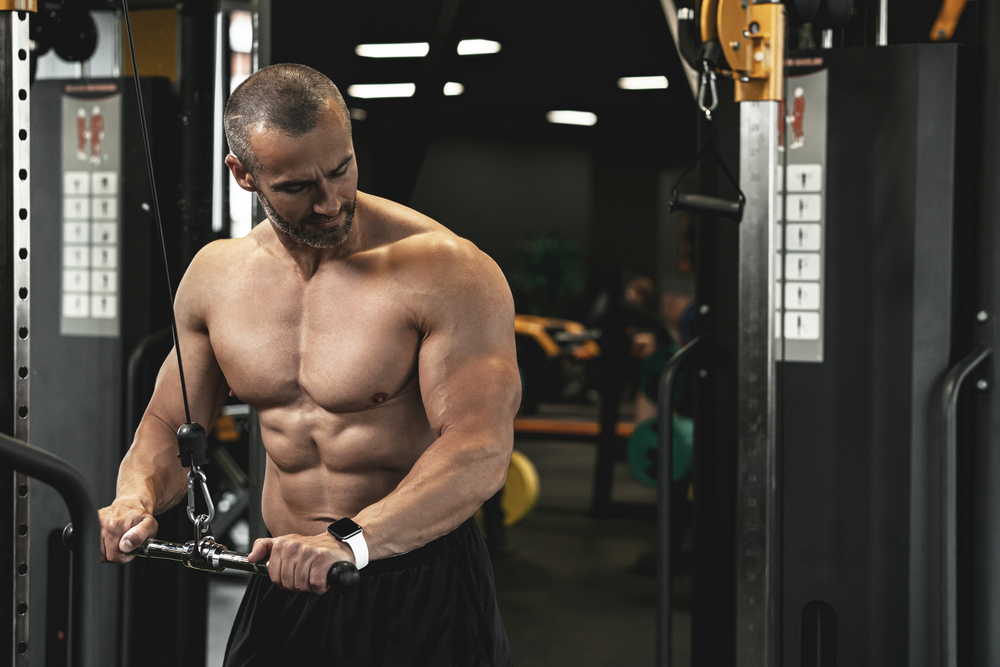
Your elbows should be the only joints moving during this exercise.
Everything else stays locked in position.
Keep your elbows tucked close to your sides, positioned in front of your hips throughout the entire movement.
This isn't just a preference—it's what keeps tension on the triceps instead of recruiting other muscles.
The moment your elbows drift forward or flare outward, tension shifts from your triceps to your lats and shoulders.
You'll feel this immediately if you pay attention.
Your arms should move like hinges, pivoting only at the elbow joint while your upper arms remain stationary against your torso.
Range of motion separates effective pushdowns from wasted sets.
Bring the bar all the way up to your chest at the top position.
Many lifters stop halfway, never letting their hands rise above their elbows.
This robs you of gains because the stretched position at the top is where you build the most muscle.
At the bottom, fully extend your elbows until they lock out, then hold that contraction for a moment. Squeeze hard.
This peak contraction reinforces the mind-muscle connection and maximizes fiber recruitment.
Keep your wrists in line with your forearms throughout the movement.
Extending your wrists outward only adds strain to your joints without activating more muscle.
Your wrists should remain neutral, as if you're punching straight down.
Tempo determines results.
Create an explosive and quick tempo on the pushdown phase—drive that weight down with force.
Pause briefly at the bottom while squeezing your triceps.
Then use a very slow tempo during the eccentric portion, taking three full seconds to fully bend your arm.
This controlled eccentric phase is vital for muscle growth.
Your muscles can handle more load during the lengthening phase, and this is where you create the most mechanical tension and metabolic stress.
Choosing the Right Attachment for Your Goals
The rope attachment allows for greater range of motion and increased muscle activation, particularly in the lateral head of your triceps.
The neutral grip position puts less stress on your wrists, and you can split the rope at the bottom to enhance activation.
Start with your hands together at the top, then spread them out gradually as you extend your elbows.
This spreading motion makes each rep slightly more difficult as you progress through the range, forcing your triceps to work harder at the bottom where they're strongest.
The straight bar enables you to lift heavier weights because bars are easier to stabilize than rope attachments.
You'll notice you can load more weight immediately when switching from rope to bar.
However, the fixed position may be less comfortable for some wrists, especially if you have limited wrist mobility or previous injuries.
The pronated grip forces your wrists into a position that some people find awkward.
The V-bar provides a middle ground between rope and straight bar.
It offers wrist-friendly hand placement through its angled grip while still providing more stability than a rope.
If you find the straight bar uncomfortable but want to lift heavier than you can with a rope, the V-bar is your solution.
Here's what matters most: when tempo, grip width, and elbow positioning are controlled, research shows no significant difference in muscle activation near failure between different attachments.
Technique matters more than the specific tool you choose.
Your ability to maintain proper elbow position, achieve full range of motion, and control the eccentric phase will determine your results—not whether you're using rope, straight bar, or V-bar.
Experiment with different attachments to find what feels best for your wrists and allows the best form.
If one attachment causes discomfort or forces you to compromise your technique, switch to another.
Programming Pushdowns into Your Training Plan
Your rep range depends on your goal. For hypertrophy, perform 8-12 reps per set with moderate to heavy weight for 2-4 sets.
You can also work in the 10-20 rep range, going as heavy as possible until you finish at failure or 1-3 reps from failure.
For strength, lower your rep ranges to 6-8 reps for 1-2 sets.
For beginners, keep things simple with 3 sets of 10 reps—this provides enough volume to grow without overcomplicating your training.
Around ten sets per week for your triceps is a good starting point.
You can go higher once you're accustomed to the training volume, but remember that your triceps are also heavily involved in pressing exercises.
Every bench press, overhead press, and dip hits your triceps hard, so factor in this total weekly volume.
If you're doing five sets of bench press and four sets of overhead press, you're already giving your triceps significant work before you touch a single isolation exercise.
Allow 60-90 seconds of rest between sets for hypertrophy and endurance training.
This is enough time to recover partially while keeping metabolic stress elevated, which drives muscle growth.
If you're following a push/pull/legs split, perform the triceps pushdown on push day after your chest pressing movements.
This prevents your triceps from becoming the weak link when training chest.
You don't want fatigued triceps limiting your bench press performance.
Training the cable pushdown with three to four sets of eight to 12 reps late in your workouts is a classic muscle-building approach that's stood the test of time.
Training frequency can range from 2-6 times per week depending on your program and recovery capacity.
Use exercise variation between sessions to take repeated stress off specific parts of your muscles and connective tissues.
For instance, you might use a rope attachment on Monday and a straight bar on Thursday.
Avoiding Common Mistakes and Building Progressive Overload
Using too much weight forces you to shorten your range of motion and use momentum to complete each repetition.
This makes the exercise less effective overall.
You'll see people loading up the entire weight stack, then jerking their bodies backward to move the weight.
The triceps pushdown is not a bench press—limit momentum and don't sway back or heave your body to extend your arm.
Controlled movement and squeezing your triceps delivers better results than ego lifting weights you can't handle properly.
Stopping halfway and not letting your hands move above your elbows robs you of gains.
Full extension at the bottom is equally important for complete muscle development.
When your elbows lose control and move out of position, tension shifts from your triceps toward your chest and shoulders.
You're no longer training what you intended to train.
Three mistakes that kill your progress:
- Loading weight you can't control through a full range of motion
- Using body English and momentum instead of isolated triceps contraction
- Allowing your elbows to drift forward or flare out during the movement
Always use a weight that allows you to perform every rep with proper form.
If you can't bring the handle to your chest and fully extend at the bottom while keeping your elbows pinned, the weight is too heavy.
Drop it and focus on execution.
Progressive overload is how you turn good technique into actual growth.
Work to progressively increase the weight you're using over time.
Focus on adding weight or reps while maintaining strict form.
This might mean adding 5 pounds every two weeks, or getting an extra rep on each set before moving up in weight.
Small incremental increases compound into significant strength and size gains over months.
Track your workouts so you know exactly what you lifted last session, then aim to beat it.
Conclusion
The triceps pushdown builds serious arm size when you execute it correctly—elbows pinned, full range of motion, and controlled tempo matter more than the weight on the stack.
Start with a load you can handle properly, focus on feeling your triceps work through every inch of the movement, and progressively add weight as your strength improves.
Stick with these principles consistently, and you'll see your arms grow faster than they ever have from pressing movements alone.