A jump rope can burn serious fat and build real density in your calves, forearms, and shoulders — especially with a weighted rope — but it won't add the kind of size to your chest, back, or arms that the word “bulk” typically implies.
What it will do is strip fat, reveal and condition the muscle you already have, and leave you looking leaner and more athletic — and if that sounds like what you're actually after, keep reading.
What a Jump Rope Actually Does to Your Body
At a moderate-to-fast pace, a jump rope burns 10–17 calories per minute — putting a 30-minute session at 400–500 calories, roughly on par with running. That's not a small number, and it adds up fast across a weekly program.
The fat loss research backs this up consistently. Regular rope training produces measurable reductions in:
- Body fat percentage
- Waist circumference
- Fasting insulin levels
These aren't minor shifts — they're the markers that actually matter for body composition.
Where things get more nuanced is muscle growth. The rope does build muscle, but only in specific areas. Your calves absorb every single landing, and over time they respond. Your forearms and grip strengthen from controlling the rope.
That's where the hypertrophy story largely ends — your chest, back, and biceps simply don't receive enough mechanical tension from a standard rope to grow.
A weighted rope changes part of this equation. Add enough resistance and you start generating real stimulus for your rotator cuff, deltoids, and grip — meaningful strength gains, not just conditioning.
One thing worth clearing up: “toning” isn't a separate biological process. When people say a body part looks more toned, what's actually happening is fat loss uncovering the muscle that was already there. The rope excels at exactly that.
So the honest goal here isn't bulking — it's recomposition. You'll get leaner, denser, and more athletic, with the muscle you have made fully visible. That's a legitimate and worthwhile outcome; it just needs to be named correctly from the start.
The Techniques That Drive Each Training Effect
Not all rope movements do the same thing. Matching the right technique to the right goal is what separates a program that works from one that just leaves you tired.
For fat burn and aerobic base
The basic bounce and alternate-foot step are your workhorses. The alternate-foot step in particular allows the highest sustainable cadence — you can keep it going longer than almost any other variation, which means more total calories burned per session. These two movements form the foundation everything else is built on.
For power and lower-body density
Double-unders are the single best movement in the rope toolkit. The rope passes twice per jump, which forces a short ground contact time and maximum output from your calves and ankles on every rep. If you only master one advanced technique, make it this one.
Single-leg jumps take the calf stimulus even further. Doubling the load on one leg at a time is the closest a rope gets to a true hypertrophy movement for the lower leg — and it's more effective than most people realize.
For HIIT intensity
High knees and butt kicks are finishers, not foundations. Drop them into the end of an interval block when you want to push heart rate to its ceiling and recruit hip flexors and hamstrings in the process.
For upper-body engagement
Two options exist, and only one actually matters. The criss-cross adds roughly 20% more energy cost than a basic bounce and pulls in your pecs, anterior delts, and lats to a small degree. It's useful, but it's not a muscle-builder.
The heavy or weighted rope basic bounce is the only movement that generates real upper-body stimulus. Slowed to 60–100 RPM with a rope over half a pound, it shifts meaningful load onto your deltoids and forces your forearms and grip to work hard for the full duration. If building upper-body strength with a rope is part of your goal, this is the only technique that actually delivers it.
The 4-Week Jump Rope Recomposition Program
Every session starts with a 5-minute dynamic warm-up — jumping jacks, arm and hip circles, leg swings, ankle circles, 12 calf raises, and 30 seconds of light boxer skip.
Every session ends with a 5-minute static cool-down covering your calves, quads, hamstrings, hip flexors, and forearms. Skip either and you're accelerating toward the injury that ends the program early.
The weekly structure rotates five distinct training modes so no tissue gets hammered twice within 48 hours:
| Day | Focus | Main Work | Target Intensity |
|---|---|---|---|
| Mon | Tabata HIIT | 3 Tabata rounds (20s on/10s off ×8), 60s rest between: high knees, double-unders, scissors | 85–95% HRmax, RPE 9 |
| Tue | Heavy-rope strength | 1 lb rope, 12 rounds × 30s work/20s rest — slow basic bounce, alt-foot, boxer step at ~80 RPM | 70–80% HRmax, RPE 7–8 |
| Wed | Zone 2 recovery | 25–30 min continuous, style change every 2 min, walking breaks if HR climbs | 60–70% HRmax, RPE 4–5 |
| Thu | Power/plyometric EMOM | 15-min EMOM: 40 double-unders, 20 power skips, 30s single-leg L/R — repeat 5× | 80–90% HRmax during work |
| Fri | Pyramid endurance | 3min @60% → 2min @75% → 1min @90% → 30s all-out → back down, 30–60s rest between rungs | RPE 5 → 10 → 5 |
| Sat | Long steady + skill | 10-min skill block (alt-foot, criss-cross, double-unders) + 20–25 min continuous at 140 RPM | 65–75% HRmax, RPE 5–6 |
| Sun | Full rest | Walking, mobility, or yoga — no rope | — |
Weekly progression
Week 1 sets your baselines. From there, the adjustments are specific:
- Week 2: Add one round to Tuesday's heavy-rope block (13 rounds); extend Wednesday to 32 minutes
- Week 3: Tuesday shifts to 8 rounds × 45s/30s; Thursday EMOM increases to 50 double-unders per minute
- Week 4: Tuesday hits 10 rounds × 45s/20s; Saturday extends to 30 minutes continuous
After week 4, deload for one week at 50% volume, then restart with a heavier rope. Progress the weight from ½ lb to 1 lb to 1.5 lb to 2 lb across 16 weeks. For double-unders, chase these skill markers: 10 unbroken by week 2, 30 by week 6, 50 by week 10, 100 in a minute by week 16.
The three muscle-building levers
Within a rope-only program, three variables drive the muscle stimulus:
- Weighted rope on Tuesday — the single most important factor; progressive loading from ½ lb to 2 lb over 12–16 weeks is what creates adaptation
- Power and single-leg work on Thursday — keeps mechanical tension on calves and unilateral stabilizers consistently high
- Isometric holds during EMOM rest intervals — wall sit for one minute, plank for another, calf-raise hold for a third; this converts recovery time into accessory work without leaving the rope-only framework
Intensity and Frequency Targets
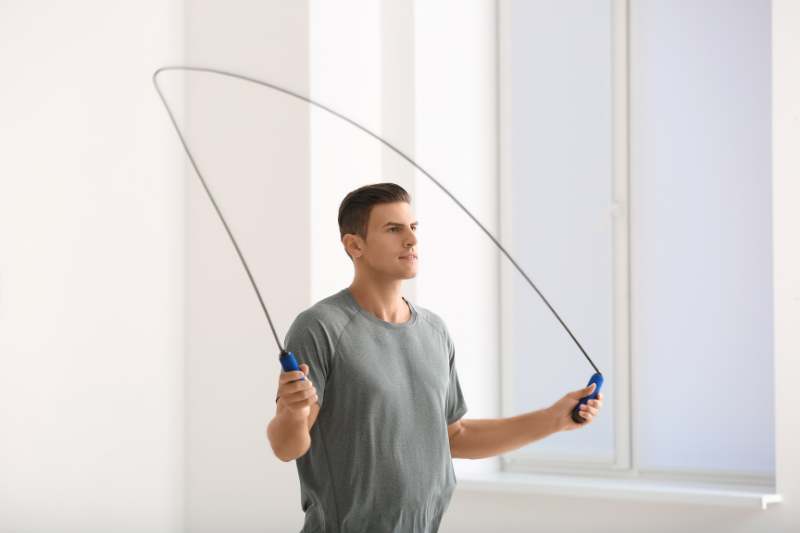
Five sessions per week with two rest days is the sweet spot this program runs on. If life gets in the way, three to four sessions still produces solid results — but fewer than three and the stimulus isn't consistent enough to drive meaningful recomposition.
At least one full rest day per week isn't optional; the rope's high-impact loading on calves and Achilles tendons requires it.
Keep sessions between 20 and 45 minutes including warm-up and cool-down. Longer isn't better here — the rope punishes excess volume, and consistency across weeks matters far more than grinding through marathon sessions.
If you're a beginner, don't jump straight into the structured program. Build to 10 continuous minutes at 120 RPM first. That's your entry ticket — once you're there, interval work becomes productive rather than just exhausting.
Intensity by session type
Each training day operates in a distinct heart rate zone, and staying in the right one is what makes the rotation work:
| Session Type | Target HR | Work-to-Rest | Notes |
|---|---|---|---|
| HIIT | 85–95% HRmax | 1:1 to 2:1 | 2:1 Tabata ratio drives the largest post-workout calorie burn |
| Heavy-rope strength | 70–80% HRmax | Longer intervals, slower cadence | Focus is load and time under tension, not speed |
| Zone 2 | 60–70% HRmax | Continuous, breaks as needed | Conversational pace — if you can't speak in short sentences, you're going too hard |
Zone 2 deserves a specific note: a 5-minute uninterrupted rope bout already pushes heart rate to around 81% HRmax. That means genuine Zone 2 rope work requires conscious pacing or short 30-second walking breaks to stay in range. Most people instinctively go too hard on recovery days and wonder why they're fatigued by Thursday.
Nutrition and Recovery
Eating for recomposition
A 250–500 calorie daily deficit is the target range — not deeper. Larger deficits do burn fat faster in the short term, but they also demonstrably impair muscle retention, which defeats the purpose of this program.
Protein is the single highest-leverage nutrition variable here. Aim for 1.6–2.2 g per kg of bodyweight per day, spread across three to five meals of 20–40 g each. If you're leaner and running a steeper deficit, push toward the higher end — up to 2.6 g/kg. The distribution across meals matters as much as the daily total.
Around training, the approach is straightforward:
- 2–4 hours before: A balanced meal with carbohydrates at 1–4 g/kg
- 15–30 min before high-intensity sessions: 20–30 g of fast carbs
- Within 30–60 min after: 20–40 g protein plus carbohydrates
One firm rule: don't train HIIT or double-under sessions fasted. Plyometric loading on cold, glycogen-depleted tissue is a direct path to calf and Achilles injury.
Hydration runs higher than most people expect with rope training because sweat rates are significant. Drink 16–20 oz of water two hours before training, replace fluids at more than 100% of sweat-weight lost, and add sodium if sessions run past 60 minutes — particularly if you're seeing white salt residue on your clothing.
Recovery and injury prevention
This is where most rope programs quietly fall apart. The calves and Achilles absorb every single rep, and without deliberate maintenance work they'll eventually give out.
Do this daily:
- Foam roll calves and shins, 30 seconds per area
- Eccentric calf raises — 3 sets of 15 reps in both straight-leg and bent-knee positions, twice a day
- Lacrosse ball under the plantar fascia
Beyond the soft tissue work, three surface and technique habits prevent the most common rope injuries:
- Land on the balls of your feet, only 1–2 inches off the ground
- Train on wood or a rubber mat — concrete accelerates joint wear and shin splints significantly
- Wear flat-soled cross-trainers, not running shoes with elevated heels
Sleep a minimum of 7–9 hours. Under seven hours raises cortisol and suppresses muscle protein synthesis — two things that work directly against recomposition. Deload every four to six weeks at 50% volume to let connective tissue catch up with the training load.
Mistakes That Kill Progress (and How to Avoid Them)
Most people who quit a jump rope program don't quit because the training doesn't work — they quit because a handful of avoidable errors compound into either injury or stalled results.
Form errors that lead to injury
The rope length is the first thing to check. When you stand on the midpoint, handles should reach your armpits — not your chest. Too long and the rope drags; too short and timing falls apart.
From there, two technique faults cause most of the overuse injuries: jumping 4–6 inches off the ground instead of 1–2, and driving the rope with your shoulders instead of flicking with your wrists. Both increase impact and fatigue far beyond what's necessary.
Footwear is underestimated. Running shoes with elevated, cushioned heels catch the cord on every rotation and place your ankle in a position it shouldn't be in during plyometric work. Flat-soled cross-trainers fix both problems immediately.
Programming errors that stall results
Two patterns consistently plateau progress. The first is doing only Tabata — it's effective early, but without varied stimulus across the week, adaptation stops. The second is never progressing rope weight or session duration. The body adapts to a fixed load quickly; if Tuesday's heavy-rope session stays at the same weight and same round count for weeks, it stops producing a training effect.
Nutrition errors that erase the deficit
Wearable fitness trackers overestimate calorie burn from rope training by 15–40%. Eating back those inflated numbers can eliminate your entire deficit — or tip you into a surplus — without you realising it. Track food independently of what your watch reports.
Dropping protein below 1.6 g/kg or pushing your deficit past 500 calories daily are the two fastest ways to lose muscle alongside fat. Both are common attempts to speed up results; both backfire.
The biggest expectation error
If your actual goal is building significant muscle mass, a jump rope is the wrong primary tool — and recognising that early saves weeks of frustration. The rope excels at recomposition: leaner, denser, more athletic. Treat it as that, run the program honestly, and it delivers. Treat it as a replacement for resistance training and you'll be disappointed by week eight.
Conclusion
Run this program honestly for 12–16 weeks — with the nutrition and recovery framework in place — and here's what you can realistically expect: a 4–10% reduction in body fat, visibly denser calves and forearms, a meaningful improvement in cardiovascular fitness, and preserved lean muscle mass throughout.
Your waist circumference will drop, your resting heart rate will improve, and the muscle you already have will be far more visible than when you started.
What you won't get is a bigger chest, wider back, or arms that fill out your sleeves. That's not a failure of the program — it's just outside what a rope can do.
Within its actual limits, though, the jump rope is one of the most time-efficient recomposition tools available. Leaner, denser, and more athletic is a legitimate outcome worth training for. This program gets you there.