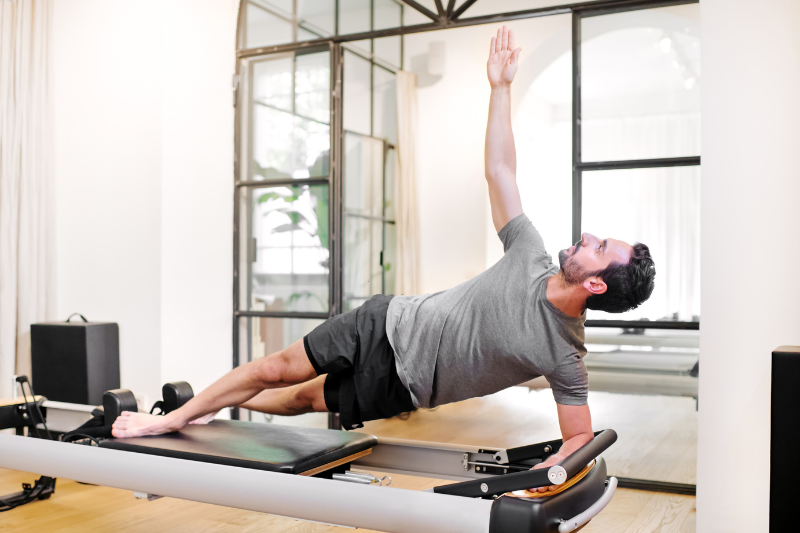
The five best Pilates exercises for men are the Hundred, the Shoulder Bridge, the Swan, the Side Bend or Side Plank, and the Leg Pull Front.
These five moves target the areas men most commonly neglect — deep core, glutes, posterior chain, and spinal mobility — so keep reading to find out exactly how to do each one and fit them into your routine.
Why Men Specifically Benefit from Pilates
Most men train what they can see in the mirror — chest, biceps, quads, and abs. The muscles you can't see, like the deep spinal stabilizers, glutes, and hip rotators, tend to get skipped.
Over time, that imbalance shows up as tight hips, nagging hamstrings, and lower-back pain that never quite goes away.
Pilates directly targets those neglected areas. It builds strength in the stabilizing muscles that hold your joints in place and keep your spine supported — the kind of strength that makes your gym work safer and more effective, not the kind that shows up in a selfie.
There's also the flexibility gap. Men are generally less flexible than women, particularly in the hips, hamstrings, and shoulders.
Pilates addresses this differently than static stretching — it strengthens muscles in a lengthened position, so you gain mobility without losing stability.
A few other reasons it works well for men specifically:
- It's low-impact, which means you can add it to an existing lifting or running schedule without digging into your recovery
- It improves posture, which counteracts the forward-rounded position that comes from too much benching, desk work, and driving
- It builds the kind of core strength that protects your spine under load — think deadlifts and squats, not just planks
If you still think of Pilates as a women's fitness trend, consider that LeBron James, Cristiano Ronaldo, Tiger Woods, and David Beckham have all made it part of their training. They're not doing it for the aesthetics — they're doing it because it works.
The 5 Best Pilates Exercises for Men
1. The Hundred
This is the classic Pilates warm-up, and it's a direct upgrade from the crunches most men have been doing since high school. Where crunches primarily work the surface-level rectus abdominis and strain the neck, the Hundred engages the deep core — transverse abdominis, obliques, and hip flexors — while also building breath control and circulation.
You hold a low curl position while pumping your arms and cycling through controlled inhales and exhales, which makes it as much about endurance and coordination as raw strength.
2. Shoulder Bridge
Most men are quad-dominant, meaning the quads and hip flexors do the heavy lifting while the glutes and hamstrings stay relatively passive.
The Shoulder Bridge corrects that. It targets the glutes, hamstrings, and posterior chain while simultaneously stretching the hip flexors — the muscles that get chronically tight from sitting.
The single-leg variation adds a stability challenge that exposes and addresses left-right imbalances most men don't know they have.
3. The Swan
If you bench press, sit at a desk, or spend time on a bike, your thoracic spine is probably stiff and your chest is rounded forward.
The Swan is spinal extension work — it strengthens the erector spinae, multifidus, and upper-back muscles while opening the chest and hip flexors. Most men never train this movement pattern at all, which is exactly why it belongs in the routine.
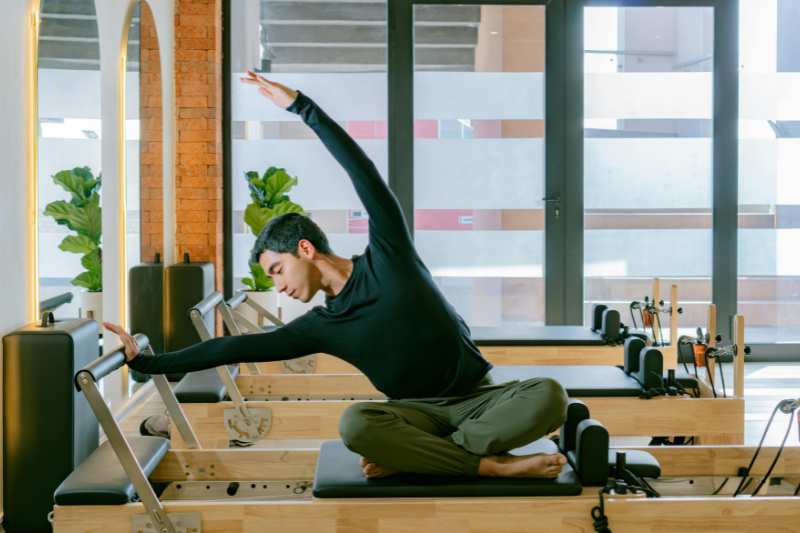
4. Side Bend / Side Plank
Lateral strength is the most overlooked plane of motion in most gym programs. The Side Bend and Side Plank both train the obliques, quadratus lumborum, and gluteus medius — muscles that stabilize the spine and pelvis during rotation and single-leg movement.
That translates directly to rotational sports like golf and tennis, and it also protects the lower back and knees in ways that standard core work simply doesn't cover.
5. Leg Pull Front
Think of this as a plank with a purpose. You start in a high plank and lift one leg at a time from the hip, which forces your shoulders, deep core, glutes, and hamstrings to work together to keep everything stable.
It builds the shoulder stability men need before pushing pressing volume higher, and the hip and ankle demands make it useful for runners and anyone dealing with recurring lower-body issues.
How to Do Each Exercise (Step-by-Step)
1. The Hundred
- Lie on your back, lift your head and shoulders, and draw your knees into your chest.
- Extend your legs to a high diagonal and reach your arms long by your sides, palms down.
- Pump your arms up and down — small, controlled movements no higher than hip level.
- Inhale for 5 pumps, exhale for 5 pumps. That's one cycle. Complete 10 cycles for 100 total counts.
Key form cues: Keep your chin gently tucked — imagine holding a small object between your chin and chest. Your gaze goes toward your legs, not the ceiling. Pelvis stays neutral; don't let your lower back arch off the mat.
Common mistakes: Straining the neck by lifting too aggressively, letting the lower back arch as the legs drop too low, and holding the breath instead of maintaining the inhale/exhale pattern.
Modification: Keep your knees bent in a tabletop position instead of extending the legs. If your neck strains at all, keep your head down — the core work still happens.
2. Shoulder Bridge
- Lie on your back with knees bent, feet hip-width apart, arms at your sides.
- Exhale and slowly peel your spine off the mat from the tailbone up until your hips form a diagonal line from knees to shoulders.
- Extend one leg straight, keeping your pelvis level.
- Lift and lower that leg three times, then switch sides. Aim for 5 reps per side.
Key form cues: The movement starts from the tailbone — articulate through each vertebra rather than just thrusting the hips up. Keep your pelvis even when one leg is extended; don't let the unsupported side drop.
Common mistakes: Clenching the glutes to initiate the lift instead of letting the spine lead, over-arching the lower back at the top, and letting the hips tilt when the leg extends.
Modification: Skip the leg lift and keep both feet on the floor. Focus entirely on the spinal articulation up and down before adding the single-leg challenge.
3. The Swan
- Lie face down with legs hip-distance apart and elbows bent, palms flat near your shoulders.
- Press lightly into your hands and use your upper-back muscles to lift your head, chest, and shoulders off the mat.
- Keep your abs gently engaged and your feet grounded.
- Lower slowly, vertebra by vertebra. Perform 5 reps.
Key form cues: The extension should feel distributed through your mid and upper back — not concentrated in the lower back. Think length through the spine, not just height. Abs stay lifted throughout.
Common mistakes: Hinging entirely from the lower back, letting the abs sag toward the floor, and pushing up with the arms like a push-up rather than leading with the back muscles.
Modification: Widen your legs and reduce your range of motion, keeping your lower ribs on the mat. This limits lower-back compression and is a good starting point if you feel any pinching.
4. Side Bend / Side Plank
Side Plank (recommended starting point):
- Prop yourself on one forearm with your elbow stacked directly under your shoulder.
- Stack your feet or stagger the top foot forward for stability, then lift your hips into a straight line from head to feet.
- Hold, or add a controlled hip dip — lower toward the mat and lift back up — for 8–10 reps per side.
Key form cues: Keep your shoulder actively pushing away from your ear — don't let it collapse. Your hips, shoulders, and head stay in one plane. Core stays braced throughout.
Common mistakes: Letting the bottom shoulder sag, allowing the hips to rotate forward or back, and resting the hip on the floor between dips rather than controlling the range.
Modification: Drop your bottom knee to the mat. This shortens the lever and reduces the load on your shoulder and obliques while you build strength.
5. Leg Pull Front
- Start in a high plank — hands under shoulders, abs lifted, body in a straight line from head to heels.
- Inhale and lift one leg from the hip, just a few inches off the floor. Keep your hips level.
- Point your foot and shift your weight slightly back, then flex and shift forward.
- Return the foot to the floor and alternate sides. Aim for 10 reps each side.
Key form cues: The lift comes from the hip, not the lower back. Your hips should stay square — no rotation, no tilting. The supporting leg stays strong and grounded.
Common mistakes: Letting the lower back sag, rotating the hips as the leg lifts, and distributing weight unevenly through the hands and feet.
Modification: Skip the leg lift entirely and hold a solid plank. If you can't maintain a neutral spine for at least 30 seconds, build that baseline before adding the leg movement.
How Often Should Men Do Pilates
The right frequency depends on what you're using Pilates for — and how it fits around the rest of your training.
As a standalone routine: Aim for 2–3 sessions per week on non-consecutive days. Do 6–8 slow, controlled reps per exercise, up to 3 rounds, with 30–60 seconds rest between moves. The non-consecutive days matter — your stabilizing muscles need recovery time just like any other muscle group, and the quality of each session drops fast when you're fatigued.
As a complement to lifting or running: One to two sessions per week is enough to see real benefit. The best placement is on a mobility or recovery day, not stacked onto a heavy training day. Pilates isn't particularly taxing on the cardiovascular system, but it does demand neuromuscular focus — you'll get more out of it when you're not already worn down.
What to Expect and When
Results don't follow a single timeline — they show up in layers:
- Within a few weeks: Better posture, less tension in the neck and lower back, improved awareness of how you're holding your body during other exercises
- After 6–8 weeks of consistency: Noticeable improvements in core strength, hip mobility, and stability under load
- Longer term: Reduced injury frequency, better movement quality in lifts, and more balanced muscular development overall
One important note on consistency: benefits have been observed even at once-weekly frequency, but the gains compound significantly with regular practice. Showing up twice a week for a month will teach you more about your body's imbalances than any single session ever could.
If Pilates eventually becomes your primary training modality rather than a supplement, you can push frequency to 3–4 sessions per week — but vary the intensity. Not every session needs to be a full three rounds at maximum effort.
How to Get Started Without Overcomplicating It
You don't need a reformer, a studio membership, or any equipment. A mat and enough floor space to lie down flat is all it takes.
Start there — mat work is the foundation of Pilates, and it'll teach you the movement patterns, breath timing, and body awareness that make everything else more effective down the line.
For the first four weeks, just run these five exercises as a single routine, two to three times per week. That's it. Resist the urge to add more moves or hunt for a more “complete” program.
The goal at this stage is learning how each exercise is supposed to feel, not accumulating volume.
Use Modifications — Seriously
This is where most men go wrong. The instinct is to do the full version of every exercise from day one, but Pilates modifications aren't a shortcut — they're a precision tool.
A modified rep done with full control builds more functional strength than a sloppy full rep. If your neck strains on the Hundred, keep your head down. If your lower back pinches on the Swan, reduce your range.
If the Side Plank feels unstable, drop your knee. Work within what your body can actually control, then expand that range over time.
When to Progress
You're ready to move forward when you can complete 6–8 reps of each exercise with clean form, controlled breathing, and no compensation patterns — meaning no back arching, hip tilting, or neck straining to get through the movement. At that point:
- Add reps or an extra round before changing the exercises themselves
- Introduce the more demanding variations — leg lifts on the Shoulder Bridge, the full Side Bend instead of the Side Plank
- Consider a reformer class with a certified instructor once the mat fundamentals feel solid
Red Flags Worth Paying Attention To
Not everything that's uncomfortable is productive. Back off and reassess if you notice:
- Persistent neck strain during the Hundred that doesn't improve with modifications
- Lower-back pinching on the Swan that the reduced range modification doesn't resolve
- Chronic fatigue or declining performance across your other training — a sign you've added too much frequency too fast
If you have an existing back or neck injury, or any condition that affects your spine or joints, check with a doctor or physical therapist before starting.
Most of these exercises are low-risk, but a few — particularly the Swan and deep flexion moves — can aggravate disc issues or acute pain if done without guidance.
Conclusion
Pilates won't replace your gym routine — it fills in what your gym routine misses. The deep core strength, spinal mobility, posterior chain work, and lateral stability that most men never train are exactly what these five exercises target.
That's not a small gap; it's the difference between a body that performs well and one that accumulates injuries over time.
You don't need to get it perfect on the first session. The form clicks gradually, the breath timing starts to feel natural after a few weeks, and the physical changes follow consistency — not a flawless debut.
Show up two or three times this week, work through the five moves with the modifications you need, and let that be enough for now. Progress takes care of itself when you keep showing up.