If you want a pushup that also challenges your abs, the pushup with shoulder tap is the one to try.
You do one strict pushup, then tap each shoulder with the opposite hand while holding a rigid plank, and your core has to fight the twist.
Keep reading for a more detailed explanation of how it works and how to do it safely.
What the Pushup With Shoulder Tap Is and Why It Works Your Abs
The pushup with shoulder tap pairs a strict pushup with a brief single-arm plank. You lower yourself and press back up, then lift one hand to tap the opposite shoulder.
After you set that hand down, you repeat with the other one. One pushup plus two taps counts as one rep.
Your abs get tested because of anti-rotation. Once a hand leaves the floor, your body wants to twist toward the unsupported side, and your abs have to keep your torso and hips square. Crunches rarely train that job.
Here's what's working during each rep:
- Your pecs and triceps drive the pushup, with the front delts helping.
- Your glutes and abs brace your body into one stiff line.
- Your obliques, transverse abdominis and serratus anterior steady you while one arm is off the floor.
You can use the move as a chest-and-core exercise, as a core finisher at the end of a workout, or as a warm-up that wakes up your whole body.
What the Research Says About Core Activation
A standard pushup already leans hard on your abs. Modeling of pushups found that the abdominal muscles supply about 64% of the stiffness that keeps your lower spine steady against bending forward and back. Their share rises to about 87% for side bending and about 84% for twisting.
Uneven hand support changes how those muscles fire. When one hand sits forward, the rectus abdominis and external oblique on the opposite side work noticeably harder than their counterparts.
A shoulder tap creates a similar lopsided load, so you can expect a comparable oblique demand. That's a reasonable inference, not a measurement.
One-arm pushups also produced the highest spinal compression of the styles tested, which is a good reason to build up to them gradually.
Plank research points the same way. External oblique activity sat around 37% of maximum in a stable front plank and about 44% in a single-support version. The gap wasn't statistically significant, so treat it as a hint rather than proof.
Keep the limits in view:
- No study has tested this exact exercise.
- The extra ab work is probably moderate, not dramatic.
- The real payoff is control. You're training your core to resist twisting, not to hit peak activation.
How to Do the Shoulder Tap Pushup Step by Step
Follow these steps in order for each rep:
- Set up. Place your hands under your shoulders and keep your body in one straight line from head to heels. Set your feet about shoulder-width apart, then squeeze your glutes and abs hard to build tension through your whole body.
- Do one strict pushup. Lower over a two-count and press back to the top. Keep your elbows at roughly 45 degrees to your torso rather than flared out.
- Tap the first shoulder. Lift one hand and tap the opposite shoulder, again over a slow two-count. Shift just enough weight to free the hand, and don't let your hips slide or twist.
- Tap the second shoulder. Put the first hand back down and repeat with the other one. Once both shoulders have been tapped, that's one rep.
- Repeat. Start the next pushup right away.
Exhale as you press up, and keep breathing during the taps. Holding your breath is a common habit when one hand comes off the floor, and it tends to make you wobble.
For your starting dose, aim for 4 sets of 8 to 12 reps. Put stability ahead of speed. A slow, level rep does more for your core than a fast, sloppy one, so stop a set when your hips begin to swing.
Common Mistakes and How to Fix Them
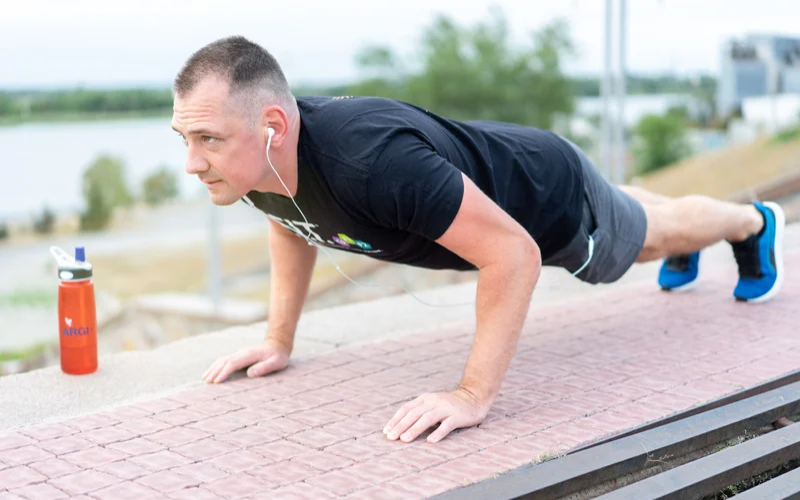
Most problems with this move come down to losing a rigid body line. These are the ones to watch for:
- Hips sagging or piking. Your hips shouldn't drop toward the floor or your butt rise toward the ceiling. Squeeze your glutes and abs and keep one line from head to heels.
- Swaying and shoulder rotation. This is the most common fault, and it cancels the anti-rotation benefit you're there for. Keep your shoulders square to the floor during every tap.
- Legs lifting. Your feet shouldn't pop up when a hand leaves the ground. Widen your stance if they do.
- Slapping the tap. A hard slap usually means momentum is doing the work. Touch the shoulder lightly and with control.
- Skipping the pushup. Without a full-range pushup between taps, you're just doing plank shoulder taps and losing the chest work.
Rushing deserves its own mention. Many men struggle to stay level during the taps, so they speed up to avoid failing. Fast taps almost always come with extra body movement. A little wobble is normal, since nobody stays perfectly still, but slow down if you're swaying.
End your set when a tap causes a clear hip shift. That's usually the first sign your core has stopped controlling the position.
Regressions and Progressions to Match Your Level
Before you try the full move, check that you can do about 10 clean standard pushups and hold a high plank for 30 seconds without your hips sagging. That's a practical guideline from coaching experience, not a research finding, but it's a useful gut check.
Easier Options
If you're not there yet, or your hips rock during the taps, step back with one of these:
- Plank shoulder taps. Skip the pushup and alternate taps from a high plank. Start with 4 sets of 5 slow reps.
- A wider stance. Feet wider than shoulder-width give you a bigger base and less twisting force. Narrow them gradually as control improves.
- Hands elevated. Place your hands on a bench or box so your upper body carries less weight.
- Knees down. This is a real step down in ab demand, not just a cosmetic change.
Harder Options
Work through these in order, moving on only when the current step feels solid:
- Cleaner reps, with no hip shift or shoulder rotation.
- A 1 to 2 second pause in the single-arm position before each tap.
- A narrower stance, eventually bringing your feet together.
- More reps per set.
- Feet elevated on a low step, which shifts more load onto your hands and makes balance harder.
Add reps only when every rep in a set keeps your hips and shoulders square.
Programming and Protecting Your Joints After 40
You can slot this move in a few ways. Use it as a warm-up to wake up your whole body, as the chest-and-core piece of a bodyweight session, or as a core finisher at the end. Two or three sessions a week works well, with a day between hard pressing sessions so your shoulders and wrists recover.
Look After Your Joints
Each joint has its own weak spot here:
- Wrists. A flat palm puts the wrist near 90 degrees of extension, and every tap adds load to the supporting wrist. Pushup handles, parallettes or hex dumbbells keep it neutral.
- Shoulders. Elbows flared out to about 90 degrees can irritate the rotator cuff. Keep them near 45 degrees and stick to controlled sets.
- Low back. Hip sag shifts load onto your lumbar spine. If you have a history of back pain, master plank shoulder taps first and keep your hips from dropping.
Let pain guide your choices. If it's sharp or more than mild, regress with an incline, knees or handles. If wrist or shoulder pain lasts about two weeks, get it assessed.
Why Pushup Strength Is Worth Building
Pushup capacity is worth training for its own sake. In a study of 1,104 active male firefighters with an average age of 39.6, the men who could do more than 40 pushups had a far lower risk of cardiovascular events over 10 years than those who managed fewer than 10.
That's an observational link, not proof that pushups caused the difference, and it says nothing about the shoulder tap variation specifically.
Keep in mind that the lab research behind this exercise mostly used young participants, and none of it studied men over 40. Start conservatively, build control first, and give the move a place in your next workout.
Conclusion
The pushup with shoulder tap gives you a chest exercise and an anti-rotation core test in one move, and it fits easily into a warm-up, a bodyweight session or a finisher.
Start with 4 sets of 8 to 12 slow, level reps, and scale the move up or down until your hips stay square on every rep. Add it to your next workout, and let control, not speed, tell you when you're ready to make it harder.