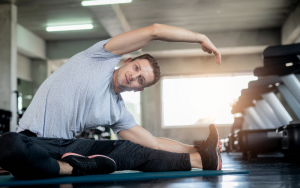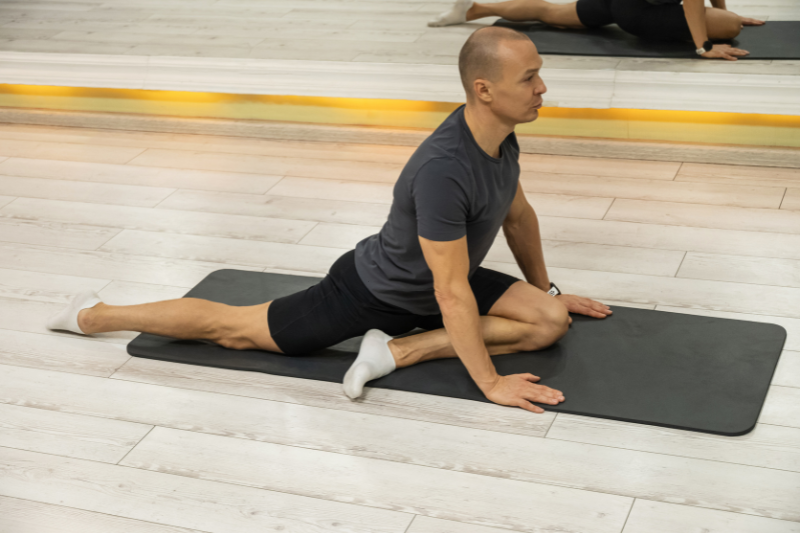
The five best stretches for tight hip flexors are the half-kneeling stretch, the supine stretch (Thomas test position), pigeon pose, the couch stretch, and the standing hip flexor stretch — each one targets a different part of the hip flexor complex so no muscle gets left out.
Keep reading for step-by-step instructions on how to do each one correctly, how long to hold them, and the one form cue that determines whether any of these stretches actually work.
Why Your Hip Flexors Get Tight (And Why It Matters)
Most adults sit for 6–10 hours a day, and that's really all it takes. When you're seated, your hip flexors are held in a shortened position for hours at a time — and over time, they simply adapt to that length.
The muscles don't know you plan to stand up eventually. They just shorten to match the demand placed on them.
The psoas is the most problematic one. It runs from your lumbar spine — specifically the vertebrae from T12 down to L5 — directly to the top of your femur.
When it stays chronically short, it pulls your pelvis forward into what's called an anterior tilt, increasing the curve in your lower back. That's why tight hip flexors and low back pain so often show up together.
Weak glutes make things worse. When your hip flexors are overactive, they suppress glute activation through a mechanism called reciprocal inhibition — your nervous system essentially turns down the opposing muscle to reduce tension.
Physical therapists refer to the resulting pattern as Lower Crossed Syndrome: tight hip flexors and spinal erectors paired with weak glutes and abdominals. It's a self-reinforcing cycle that affects posture, movement, and how you feel at the end of a long day at a desk.
Two things worth knowing before you start stretching:
- Stretching addresses the tightness — it restores length to muscles that have shortened from prolonged sitting
- Glute strengthening addresses the weakness — without it, the imbalance that created the problem in the first place remains
Stretching is still the right starting point. But if you want lasting improvement rather than temporary relief, strengthening the glutes eventually needs to be part of the picture too.
The One Form Cue That Makes Every Stretch Work
Before getting into the individual stretches, there's one thing you need to understand — because without it, none of them will work the way they're supposed to.
Every stretch on this list requires a posterior pelvic tilt. That means squeezing the glute on the stretching side and tucking your tailbone under, flattening the curve in your lower back. It sounds minor. It isn't.
When you skip this step, the stretch shifts away from the hip flexors entirely and compresses the lumbar spine instead — which is the exact opposite of what you're trying to do.
How to find it before you stretch:
- Stand or kneel upright and let your lower back settle into its natural arch
- Squeeze the glute on the side you're about to stretch — firmly, not lightly
- At the same time, tuck your tailbone under as if you're trying to flatten your lower back
- You should feel your pelvis rotate slightly backward and your lower back flatten
That's it. In many cases, just getting into this position produces a noticeable stretch before you've moved anywhere else.
The reason this cue matters so much comes down to anatomy. Your hip flexors attach to the pelvis and lumbar spine. If your pelvis is tilted forward — which is its default position for most people with tight hip flexors — the muscle is already in a slackened position.
Moving into a stretch from there just takes up that slack without ever actually lengthening the tissue. The posterior tilt puts the pelvis in the right position so the stretch has somewhere to go.
One thing to watch throughout every stretch: the moment your lower back starts to arch, the posterior pelvic tilt is gone. That's your cue to reset — not push deeper.
The 5 Best Hip Flexor Stretches
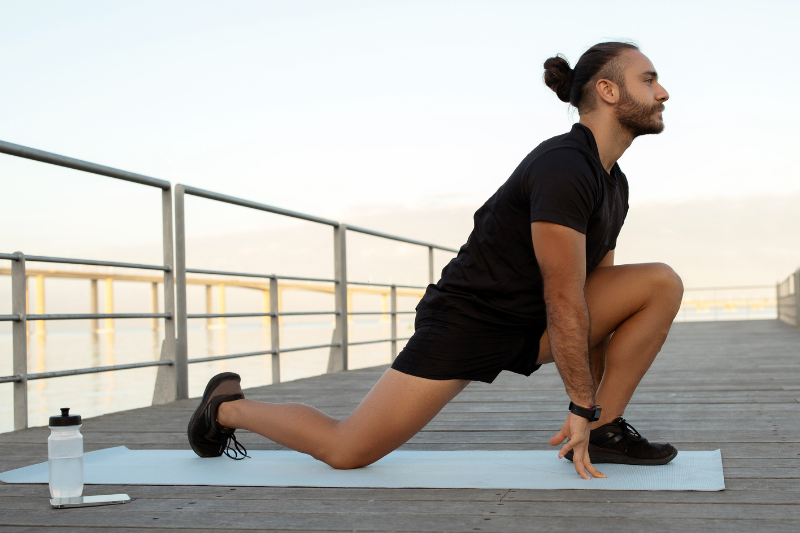
1. Half-Kneeling Hip Flexor Stretch
This is the most widely recommended hip flexor stretch across physical therapy and fitness — and it earns that reputation. It directly targets the iliopsoas, your body's primary hip flexor, while also hitting the rectus femoris and sartorius.
- Kneel with a pad under your back knee, both knees at 90 degrees, front knee directly over the ankle
- Squeeze the glute on the kneeling side and tuck your tailbone under before moving anything else
- Shift your hips forward slowly — move from the hips, not by leaning your torso
- Stop when you feel a firm stretch in the front of the kneeling-side hip
- For a deeper stretch, raise the arm on the kneeling side overhead and lean gently toward the opposite side
Hold 30–60 seconds per side, 2–3 reps, at least twice daily. The most common mistake is letting the lower back arch — the moment that happens, you're stretching your spine, not your hip flexors.
2. Supine Hip Flexor Stretch (Thomas Test Position)
This is the safest option on the list. Your spine stays fully supported throughout, and gravity provides the stretch — no muscular effort required.
A 2024 study found that just 3 minutes in this position produces both immediate and lasting improvements in hip flexor flexibility, making it especially useful for anyone with back sensitivity or difficulty kneeling.
- Sit at the very edge of a firm bed or table, tailbone at the edge
- Lie back and pull both knees to your chest, pressing your lower back flat against the surface
- Hold one knee firmly to your chest and slowly lower the other leg, letting it hang freely
- Keep your back flat — don't let it lift off the surface
Hold 30–60 seconds per side, 2–4 reps. If your hanging leg can't reach table level, your iliopsoas is tight.
3. Pigeon Pose
Pigeon pose is efficient in a way the others aren't — it stretches the hip flexors of the back leg and the deep external rotators of the front leg at the same time.
- From all fours, bring one knee forward behind the same-side wrist, shin angled toward the opposite hip
- Extend the other leg straight back, foot flat on the mat, leg in line with the hip
- Keep hips level — place a block or folded blanket under the front hip if one side lifts
- Stay upright on your hands or walk them forward to lower your chest for a deeper stretch
Hold 60–90 seconds per side, 3–4 times per week. If you have knee or SI joint issues, substitute the reclined figure-4 position lying on your back instead.
4. Couch Stretch
The couch stretch is the most intense option here. It targets the rectus femoris — the quad muscle that crosses both the hip and knee — more completely than any other stretch because it combines hip extension with deep knee flexion simultaneously.
- Kneel facing away from a couch or wall, sliding one knee into the corner where the floor meets the surface
- Step the other foot forward, knee at roughly 90 degrees
- Squeeze the back glute, tuck the tailbone, and engage your core
- Slowly raise your torso — start hinged forward with hands on the floor, and work toward upright over time
Hold 45–60 seconds per side, 2–3 reps. Skip this one if you have significant knee issues, and use thick padding under the back knee throughout.
5. Standing Hip Flexor Stretch
No floor space, no kneeling, no equipment — this stretch works anywhere. It's the most practical option for breaking up long periods of sitting during the day.
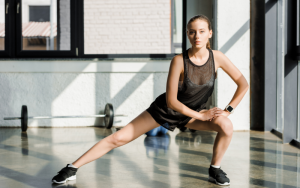
- Stand tall and take a generous step forward with one foot, front knee slightly bent, back leg straight
- Squeeze the back glute and tuck your pelvis under
- Push your hips gently forward until you feel a stretch in the front of the back hip
- Add an overhead reach on the back-leg side for a deeper stretch through the psoas
Hold 20–30 seconds per side, 2–3 reps. Repeat every 30–45 minutes of sitting. The most common mistake is leaning the torso forward — keep it upright and let the hips do the moving.
How Long to Hold and How Often to Stretch
Research gives pretty clear answers here. A well-known 1997 study found that 30 seconds is the minimum effective hold time for improving range of motion — and that stretching longer than 60 seconds didn't add meaningful benefit for most people.
If you're over 65, aim for the higher end of that range since age-related tissue stiffness means your muscles need a little more time to respond.
For frequency, the threshold for measurable flexibility gains is at least 5 minutes of total weekly stretching per muscle group. That's not per session — it's cumulative across the week. Three days a week gets you there at minimum, but daily practice produces noticeably better results over time.
One thing most people skip: warming up first. Deep static stretching on cold muscles is less effective and increases injury risk. Five to ten minutes of light movement — even just walking — is enough to raise tissue temperature before you stretch.
If you want faster results, try PNF stretching. The contract-relax method works like this:
- Move into the stretch and hold until you feel a firm pull
- From that position, press the stretching leg gently against the floor for 5–10 seconds — an isometric contraction
- Relax, breathe out, and sink slightly deeper into the stretch
Research shows PNF can produce 10–15% greater range-of-motion gains compared to static stretching alone. It takes an extra 10 seconds per rep and is worth adding once you're comfortable with the basic positions.
The practical summary: hold each stretch 30–60 seconds, do 2–3 reps per side, stretch at least 3 days a week, and warm up first.
Building Your Routine — How to Put It All Together
The five stretches work because they cover different muscles from different angles. No single stretch does everything — the iliopsoas, rectus femoris, sartorius, and tensor fasciae latae each respond to different positions. Variety isn't optional here; it's what makes the routine complete.
Here's how to structure it practically:
- Daily: Half-kneeling stretch and supine stretch. These two cover the iliopsoas most directly and are accessible enough to do every day without much setup.
- 3–4 times per week: Couch stretch or pigeon pose. Both are more demanding and target deeper tissue, so they don't need to be daily — but skipping them entirely means the rectus femoris and deep rotators don't get addressed.
- Throughout the workday: Standing stretch. Every time you get up from your desk, take 30 seconds per side. It takes less than a minute and interrupts the cycle of your hip flexors shortening back up between sessions.
The biggest mistake people make when starting a stretching routine isn't choosing the wrong stretches — it's inconsistency. Two focused sessions a week done well will outperform seven half-hearted ones. Pick the schedule you can actually stick to, start there, and build from it.
And remember what the previous section covered: the posterior pelvic tilt applies to every stretch in this routine. That one cue — glute squeezed, tailbone tucked — is what separates a stretch that works from one that just feels like you're doing something.
Conclusion
Tight hip flexors are almost always a product of how much time you spend sitting, and consistent stretching is the most direct way to address it.
The five stretches here cover every major muscle in the hip flexor complex — use the half-kneeling and supine stretches as your daily foundation, add pigeon pose or the couch stretch a few times a week for deeper work, and treat the standing stretch as a quick reset throughout your day.
Get the posterior pelvic tilt right on every single rep, and you'll get more out of five minutes of focused stretching than most people get from twice the time.