This 15-minute ab workout for men runs through six exercises in a circuit — dead bugs, bicycle crunches, reverse crunches, forearm planks, Russian twists, and lying leg raises — hitting every region of your core with short rest periods and no equipment needed.
Keep reading for the full breakdown of each exercise, how to scale it to your level, and what you can realistically expect from training it three times a week.
How This 15-Minute Workout Is Structured
The routine follows a circuit format where six exercises run back-to-back, each targeting a different core function — spinal flexion, anti-extension, rotation, and stabilization.
Because no two consecutive exercises work the same muscle group, one area recovers while the next works, which is what makes 15-second rest periods between sets realistic rather than brutal.
The time breaks down like this:
- Warm-up: 90 seconds
- Working sets + rest: 12 minutes
- Cool-down: 90 seconds
Every second is accounted for, including transitions between exercises, which are built into those 15-second rest windows.
The exercise order is also deliberate. It opens with a controlled activation drill to wake up the deep stabilizers, moves into dynamic movements that challenge the rectus abdominis and obliques, and closes with isometric holds that demand endurance from already-fatigued muscles.
That progression — activation, then dynamic, then isometric — isn't arbitrary. Finishing with stabilization work when you're tired is what builds real-world core endurance, not just performance on fresh muscles.
90-Second Warm-Up
Skipping the warm-up on ab work is a common mistake. These 90 seconds aren't just about getting blood moving — they specifically activate the transverse abdominis (your deepest abdominal layer) and mobilize the lumbar spine before you load it. That preparation matters because most of the exercises that follow demand spinal stability from the first rep.
Cat-Cow — 30 seconds Start on all fours, wrists under shoulders, knees under hips. Inhale as you drop your belly toward the floor and lift your chest, then exhale as you round your spine toward the ceiling and tuck your chin. Move slowly and deliberately. This mobilizes the entire spinal column and switches on the deep core muscles you'll rely on throughout the circuit.
Standing Torso Rotations — 30 seconds Stand with feet shoulder-width apart and arms bent at 90 degrees in front of you. Rotate your torso left and right in a controlled rhythm, keeping your hips square. The rotation should come from your obliques — not momentum. Think of this as a direct primer for the Russian twists later in the circuit.
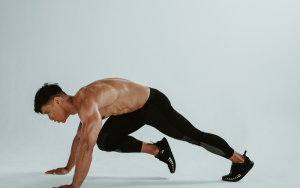
Slow Mountain Climbers — 30 seconds Get into a push-up position and drive one knee toward your chest, pause briefly, then switch. The key word is slow — about half the speed you'd use in a cardio context. The goal here is core activation, not elevated heart rate. Keep your hips level with your shoulders throughout; letting them sag or pike removes virtually all core engagement from the movement.
The Six-Exercise Circuit
Exercise 1: Dead Bug
2 sets × 10 reps per side | 15 sec rest between sets | Targets: transverse abdominis, deep stabilizers
Lie on your back with arms extended toward the ceiling and knees bent at 90 degrees, shins parallel to the floor. Press your lower back firmly into the ground — this contact point is non-negotiable throughout the entire movement. Simultaneously extend your right arm overhead and your left leg straight out, hovering both just above the floor, then return and switch sides.
If your lower back lifts off the floor at any point, you've gone too far. Shorten the range of motion until you can hold that contact for every rep. Exhale as you extend; inhale as you return.
- Beginner: Extend only the leg, keeping both arms raised, until you build the coordination to add the opposite arm
- Advanced: Slow the tempo to 3 seconds out, 3 seconds back
Exercise 2: Bicycle Crunch
2 sets × 20 reps per side | 15 sec rest between sets | Targets: rectus abdominis, obliques
Lie on your back with fingertips lightly behind your head — touching, not clasped. Lift your shoulder blades off the floor. Bring your right elbow toward your left knee while extending your right leg straight out about six inches off the floor, then switch sides in a smooth pedaling motion.
An ACE-sponsored EMG study ranked the bicycle crunch as the single most effective exercise for rectus abdominis activation out of 13 exercises tested. The reason it works so well is the brief pause and squeeze at each twist — speed-cycling through reps kills that activation. Never pull on your neck; your hands are there for light support only.
- Beginner: Keep the extended leg higher (around 12 inches) and reduce to 10 reps per side
- Advanced: Hold a 2-second squeeze at each twist and drop the extended leg closer to the floor
Exercise 3: Reverse Crunch
3 sets × 12–15 reps | 15 sec rest between sets | Targets: lower rectus abdominis
Lie on your back with arms at your sides, palms down. Bend your knees to 90 degrees and lift your feet off the floor. Contract your abs to curl your hips off the ground, bringing your knees toward your chest — your tailbone should visibly lift at the top. Lower slowly until your hips just touch the floor, then go again without pausing at the bottom.
The most common mistake here is swinging the legs to generate momentum. The movement is a pelvic curl, not a leg kick. Exhale forcefully as you crunch up; that forceful exhalation during peak contraction is one of the most overlooked factors in effective ab training.
- Beginner: Drop to 8–10 reps and allow a brief pause at the bottom of each rep
- Advanced: Perform with straight legs (straight-leg reverse crunch) or hold a light dumbbell between your feet
Exercise 4: Forearm Plank
2 sets × 30–45 seconds | 15 sec rest between sets | Targets: transverse abdominis, rectus abdominis, erector spinae
Elbows directly under shoulders, forearms parallel, body forming a straight line from head to heels. Squeeze your glutes, brace your abs as if bracing for a punch, and push your elbows into the floor. No hip sag, no piking.
A 30-second plank with perfect form beats a 90-second plank with sagging hips — once form breaks, the set is over regardless of the clock. One useful cue: think about pulling your elbows toward your toes (without actually moving them) to increase abdominal engagement.
- Beginner: Drop to your knees or reduce the hold to 15–20 seconds
- Advanced: Add a weight plate on your upper back, or transition directly into side planks — 15 seconds per side — without touching down
Exercise 5: Russian Twist
2 sets × 15 reps per side | 15 sec rest between sets | Targets: internal and external obliques
Sit with knees bent and feet flat on the floor. Lean your torso back to roughly 45 degrees — you should feel your abs engage just to hold the position. Clasp your hands in front of your chest and rotate your entire torso left, bringing your hands toward the floor beside your hip, then rotate right.
The rotation must come from your trunk, not your arms. Keep your chest lifted and shoulders back; rounding forward shifts the work to your hip flexors instead of your obliques. Lifting your feet an inch off the floor noticeably increases the difficulty and pulls in the transverse abdominis.
- Beginner: Keep feet planted, no weight, 10 reps per side
- Advanced: Hold a medicine ball (8–10 lbs) with arms extended and feet off the floor
Exercise 6: Lying Leg Raise
2 sets × 10–12 reps | 15 sec rest between sets | Targets: lower rectus abdominis, hip flexors
Lie flat on your back, legs straight, hands tucked under your glutes for support. Lift your legs together until they're perpendicular to the floor, then lower them slowly over 3 full seconds, stopping when your heels are about two inches from the floor. Don't let them touch — keep the tension on and go straight into the next rep.
The lowering phase is where the real work happens. If your lower back lifts off the floor during the descent, you've gone too low — stop the movement at whatever point your back starts to arch. That controlled lowering is what separates this from a hip flexor exercise.
- Beginner: Bend your knees to 90 degrees, which shortens the lever arm and makes the movement significantly more manageable
- Advanced: Move to hanging leg raises from a pull-up bar — 3 to 4 sets of 10–15 reps — widely regarded as one of the most effective lower-ab exercises available
90-Second Cool-Down

Don't skip this. The cool-down releases the muscles you just worked and decompresses the lumbar spine after the flexion and stabilization demands of the circuit. Three stretches, 30 seconds each.
Cobra Stretch — 30 seconds Lie face down, place your palms on the floor beside your chest, and press your upper body up while keeping your hips on the ground. You'll feel a deep stretch along the entire rectus abdominis — the same muscle you just worked through crunches, leg raises, and bicycle crunches. Breathe deeply and let your lower back relax into the position.
Child's Pose — 30 seconds From all fours, sit your hips back onto your heels and extend your arms forward along the floor, forehead resting on the ground. This stretches the lower back and releases tension in the spinal erectors that worked hard to keep you stable through planks and leg raises. It's a direct countermovement to the extension you just held in the cobra stretch.
Supine Spinal Twist — 30 seconds total (15 seconds per side) Lie on your back and pull one knee across your body toward the opposite side of the floor, keeping both shoulders flat. This decompresses the obliques and lumbar region — two areas that take significant load during Russian twists and reverse crunches. Hold 15 seconds, switch sides, and you're done.
How to Scale This Workout to Your Level
The workout is written for intermediate trainees, but it adjusts cleanly in both directions without needing to swap in entirely different exercises.
Beginners should use the modifications listed under each exercise and extend rest periods to 30 seconds between sets. To keep the total time reasonable with those longer rests, drop the plank to one set and the reverse crunch to two sets. The volume reduction is a fair trade — untrained abs respond well to lower workloads, and perfect form on fewer reps will do more for you than sloppy reps at full volume. Once you can complete every set cleanly with 15-second rest periods, you're ready to move up.
Intermediate trainees should run the workout exactly as written. When you can get through every set and rep without form breakdown — consistently, not just on a good day — start adding external resistance: a medicine ball for Russian twists, a dumbbell between the feet for leg raises, or a weight plate on your back for planks.
Advanced trainees should implement the harder modifications across the board:
- Hanging leg raises in place of lying leg raises
- Loaded planks instead of bodyweight
- Weighted Russian twists with feet elevated
- Slow-tempo dead bugs (3 seconds out, 3 seconds back)
When those become manageable, ab wheel rollouts (2–4 sets of 5–10 reps) and hollow body holds (3 sets of 30 seconds) are strong substitutes for the plank and dead bug respectively.
You can also shift to an EMOM format — set a 15-minute timer, perform one exercise at the top of each minute, and use the remaining seconds as rest, cycling through three exercises for five rounds. It's the same time window with significantly higher density.
How Often to Train and What to Expect
Train abs 2–3 times per week on non-consecutive days. Like any other muscle group, the core needs recovery time between sessions — daily exhaustive ab training doesn't accelerate results, it just limits your ability to train with quality. A focused 15-minute circuit three times per week is enough stimulus for measurable strength and endurance gains.
Two scheduling notes worth paying attention to:
- Don't program this the day before heavy squats or deadlifts. Fatigued abs compromise your ability to brace under heavy loads, which is both a performance and safety issue.
- If you train full-body, place this routine at the start of your session — after your general warm-up but before your main lifts, while you're still fresh enough to maintain form.
On expectations: this workout builds core strength, muscle thickness, and endurance. What it won't do on its own is make your abs visible. That part comes down to body fat, and body fat comes down to nutrition.
Core muscles do hypertrophy with consistent training, but not dramatically — the definition most men are after becomes visible when there's a caloric deficit driving fat loss, not when ab volume goes up. The workout does its job by building the muscle underneath. Your diet determines whether anyone can see it.
Conclusion
Six exercises, 15 minutes, three times a week — that's the full framework.
Follow the circuit as written, scale it to your level, and progress systematically by adding resistance or difficulty once your form is solid.
Pair it with a nutrition plan that supports fat loss and you'll have both the strength and the definition to show for it.