Tight hips almost always come down to the same two things: too much sitting and not enough movement through your hip's full range — and a consistent daily program of joint prep, active mobility drills, and end-range holds is what fixes it.
Keep reading for the exact 25-minute routine, broken down step by step, so you can start making real progress today.
The Rules That Make This Program Work
Before jumping into the exercises, there are four principles worth understanding — not because they're interesting theory, but because ignoring them is exactly why most people stretch for months and see nothing change.
The first is consistency over intensity. Ten minutes daily will do more for your hips than a 90-minute session on Sunday. Your nervous system adapts through repetition, not occasional heroic effort.
The second is end-range loading. Stretching only where you're comfortable does very little. To expand your range, you have to spend time at the edge of it — that's where adaptation actually happens.
Two more rules that work together:
- Breathe into it. A slow 4–6 second exhale reduces muscle guarding and lets you relax deeper into each position. This isn't a cue to ignore — it's a neurological tool.
- Active before passive. Always do moving drills before static holds. This signals to your nervous system that the range is intentional, not a threat.
Skip these and the program becomes a collection of stretches. Follow them and it becomes a system.
Block 1 — Joint Prep (5 Minutes)
Don't skip this. These two movements wake up the hip joint, increase synovial fluid, and tell your nervous system that controlled movement is coming. Think of it as warming up the hardware before running the software.
1. Hip CARs (Controlled Articular Rotations) — 3 minutes
Stand on one leg, hold a wall for balance. Slowly draw the largest circle you can with your lifted knee — forward, out to the side, behind you, and back around. The key word is slowly: aim for 5–8 seconds per circle. Do 3 reps in each direction per leg.
Two things to watch: keep the standing glute squeezed throughout, and don't let your pelvis tilt or rotate to compensate. If it does, your range is outrunning your control — shrink the circle.
2. Quadruped Hip Circles — 2 minutes
Get on hands and knees with your core lightly braced. Lift one knee and draw slow, deliberate circles leading with the knee — 5 clockwise, 5 counterclockwise per side. Your lower back should stay completely still. Any spine rotation means the hip isn't doing the work.
Block 2 — Active Mobility Drills (8–10 Minutes)
This is the core of the program. These drills don't just stretch your hips — they build usable range, meaning your body will actually trust and use the mobility you're developing.
1. Deep Squat Prying — 3 minutes
Stand with feet shoulder-width apart, toes pointed out 30–45 degrees. Squat all the way down, heels on the floor if possible. Place your elbows inside your knees and gently press them outward while keeping your spine tall — this is the “prying” part. Hold the bottom position for 60–90 seconds, shifting your weight side to side to explore the range. Stand up, shake it out, and repeat for 2–3 rounds. If your heels lift, place a small plate or folded mat under them until the range improves.
2. 90/90 Transitions — 3 minutes
Sit on the floor with both legs bent at 90 degrees — one shin in front of you, one to the side. Sit tall on both sit bones and hold each side for 30–45 seconds. Then begin rotating slowly between sides for 8–10 transitions total. This hits both external and internal hip rotation — and internal rotation is the one most people never train. If your hips feel stuck in one direction, that's exactly where you need the most time.
3. Kneeling Hip Flexor Lunge — 2 minutes
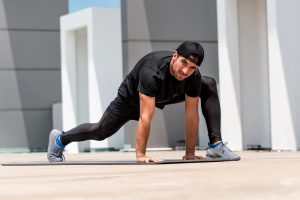
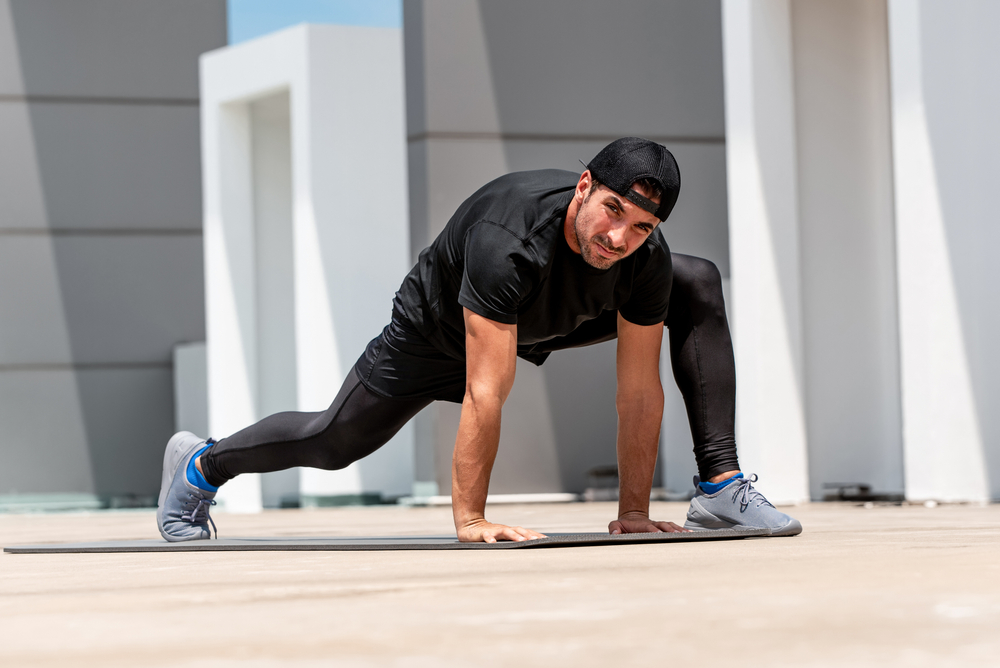
Take a half-kneeling position with both knees at 90 degrees. Before driving your hips forward, tuck your pelvis under slightly — a posterior tilt. This step is non-negotiable. Without it, you're arching your lower back instead of lengthening the hip flexor. Once you feel the stretch in the front of the back hip, squeeze that side's glute as hard as you can. This triggers reciprocal inhibition, where the nervous system relaxes the hip flexor in response to the glute firing. Hold the squeeze for 5 seconds, relax for 2, and repeat 5–6 times per side.
4. Hip Airplane — 2 minutes
Stand on one leg and hinge forward at the hip until your torso is roughly parallel to the floor. From there, slowly rotate your pelvis — drop the floating hip toward the floor, then lift it toward the ceiling. That's one rep. Do 8–10 in each direction per leg, moving with full control. Unlike passive stretching, this builds active rotational strength in a loaded position, which is what makes new range stick.
Block 3 — Passive End-Range Loading (7–8 Minutes)
This is where tissue remodeling happens. The active drills built the range — now you're teaching your body to settle into it. Move slowly, breathe deliberately, and resist the urge to rush through these holds.
1. Pigeon Pose — 3 minutes (90–120 seconds per side)
From a plank position, bring one shin forward toward the opposite wrist, angling it somewhat parallel to your hips. Lower your hips to the floor and walk your hands forward, resting your forehead or forearms on the mat. Hold for 90–120 seconds per side. On every exhale, let the hip sink a few millimeters deeper — don't force it, just allow it.
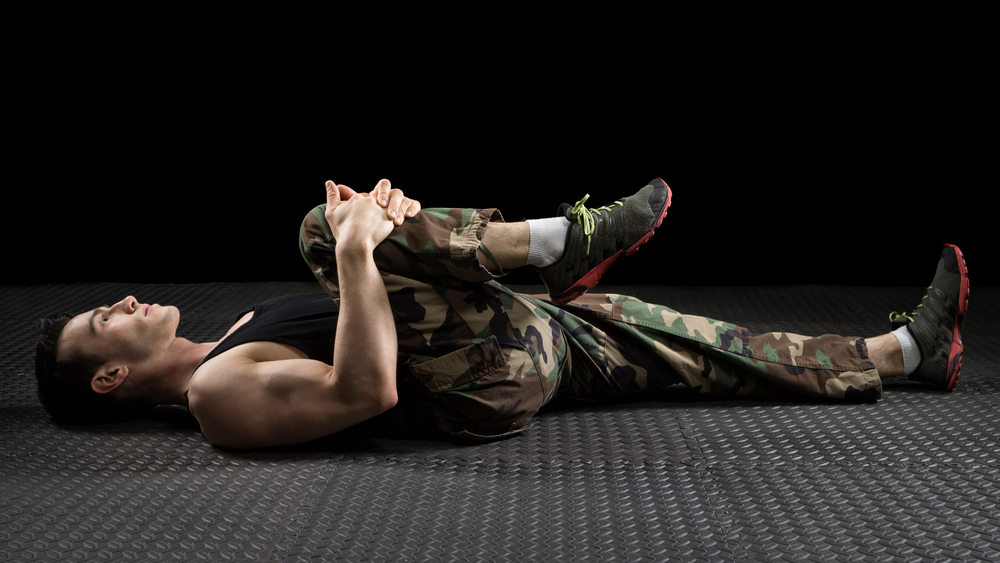
If this position feels too intense, the supine figure-4 works just as well: lie on your back, cross one ankle over the opposite knee, flex that foot, and pull the bottom leg toward your chest.
2. Frog Stretch — 2 minutes
From hands and knees, spread your knees wide with your shins parallel and feet in line with your knees. Rock your hips gently back and forward, find the deepest comfortable position, and hold for 90 seconds. This targets the adductors — the inner thigh muscles that most hip programs ignore entirely — making it one of the more valuable holds in the whole routine.
3. PNF Figure-4 Glute Stretch — 3 minutes
Lie on your back and cross your right ankle over your left knee, flexing the right foot. Pull the left leg toward your chest until you feel a stretch deep in the right glute. Now run three contract-relax cycles:
- Hold the stretch for 20 seconds
- Push your right knee away from your body against your own hand resistance for 6 seconds at roughly 75% effort
- Relax completely, then pull deeper for another 20 seconds
The isometric contraction triggers autogenic inhibition — a neurological response that causes the target muscle to relax more fully after the contraction ends. It's one of the most effective techniques available for gaining range of motion, and three cycles per side is enough to feel a real difference.
How the Program Progresses Over 8 Weeks
The program isn't static — it evolves in three distinct phases, each building on the last.
Weeks 1–2: Foundation
Do the full program daily and focus on simply getting into the positions without forcing anything. Your nervous system needs to recognize these shapes as safe before it will let you go deeper. Don't measure progress by how far you can stretch — measure it by how comfortable the positions feel.
Weeks 3–4: Loading
Increase all passive hold times to 2 minutes. In the 90/90, begin slowly lifting the back shin off the floor to add active internal rotation. In the kneeling lunge, add a slight lateral reach to intensify the hip flexor stretch. These small additions matter — they shift the program from range exploration to range ownership.
Weeks 5–8: Strengthening the New Range
This phase is where most programs stop short. Flexibility without strength is range your body won't trust, and the nervous system will quietly reclaim it. Add a Jefferson Curl, Bulgarian split squat holds at depth, and goblet squat static holds — 60 seconds at the bottom — to make the gains permanent.
Optional Evening Add-On
If you can fit in a second short session, two movements accelerate progress significantly:
- Couch Stretch: Back foot up on a couch or wall in a kneeling lunge, pelvis tucked hard — 90–120 seconds per side
- Legs-Up-The-Wall Hip Opener: Legs up a wall, let them fall into a wide V, breathe and let gravity work for 3–5 minutes
The Mistakes That Keep Hips Tight
Most people who struggle with tight hips aren't doing nothing — they're doing the wrong things, or the right things poorly. These are the five patterns worth breaking.
Stretching without strengthening. Flexibility your body doesn't trust won't last. New range has to be loaded and strengthened, or the nervous system quietly takes it back.
Skipping the posterior pelvic tilt in hip flexor stretches. This is the most common error in the entire program. Without that pelvic tuck, you're extending your lower back — not stretching the iliopsoas at all.
Rushing through holds. Neurological change needs a minimum of 30–60 seconds. Structural tissue change needs 2 minutes or more. Fifteen-second holds are largely wasted effort.
Ignoring internal rotation. Most people only do pigeon and figure-4, both of which target external rotation. Internal rotation is equally important and far more neglected — the 90/90 and hip airplane are your primary tools for it.
Being inconsistent. One long session after several missed days is no substitute for 10–15 minutes daily. The nervous system adapts through repetition, and there's no shortcut around that.
Conclusion
Tight hips respond well to this program when you follow it daily — the combination of joint prep, active drills, and end-range loading covers everything your hips need to move freely again.
The full routine takes around 24 minutes, and most people notice a real difference within 3–4 weeks, with significant improvement by week 8.
Start with Block 1 today, add the rest as you get comfortable, and just keep showing up consistently — that's what actually moves the needle.