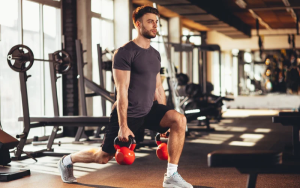
You can build bigger legs with only dumbbells if you do 10–20 hard sets per muscle each week, stop each set 0–3 reps short of failure, train through a full, deep range of motion, and add reps or weight over time, and a 45–60 minute session will burn roughly 200–400 calories along the way.
Keep reading for the full two-day workout, the best exercises for each muscle, and a clear look at what leg day can and can’t do for fat loss.
What Makes Legs Grow With Dumbbells
Dumbbells don’t change the rules of muscle growth. Your legs respond to the same factors they would with a barbell or machine, and once you know what those are, a rack of dumbbells can do the job.
Volume and Frequency
The biggest factor you control is weekly volume. Aim for 10–20 hard sets per muscle each week, since 10 or more sets clearly beat fewer than five. Growth keeps climbing as you add sets, though each extra set gives a bit less than the one before.
When you count sets, give exercises that only partly train a muscle half credit. Bulgarian split squats, for example, count as a full set for your quads but about half a set for your hamstrings.
Spread that volume over two sessions. The benefit tops out at around 11 sets per muscle in one workout, so 20+ sets crammed into a single day mostly go to waste. Training twice a week matters because it spreads the work, not because frequency itself drives growth.
Effort and Range of Motion
End most sets 0–3 reps short of failure. Pushing closer to failure helps size more than strength. Keep true failure for safer lifts like calf raises, hip thrusts, and goblet squats rather than heavy RDLs.
Depth pays off too:
- Full squats grew the glutes 6.7% (versus 2.2% for half squats) and the adductors 6.2% (versus 2.7%), while quad growth was about the same.
- Calf raises focused on the bottom stretch grew the calves about 15.2%, compared with 6.7% for full-range reps.
Most of this research used beginners, so experienced lifters may see a smaller edge.
Reps, Rest, and Tempo
- Reps: Anywhere from about 6 to 30 builds muscle. Past roughly 30, your heart and lungs tend to give out before your legs do.
- Rest: Take more than 60 seconds, and closer to 90 seconds or longer works better for legs.
- Tempo: Lower the weight over 2–3 seconds. Reps lasting 0.5–8 seconds work about equally well, but reps over 10 seconds fall short.
Finally, single-leg and two-leg training build muscle about equally. Single-leg moves roughly double the load each leg handles, which is the simplest way to get more out of light dumbbells.
The Best Dumbbell Exercises for Each Leg Muscle
Each muscle in your legs responds best to a slightly different movement, so a good dumbbell plan covers all of them rather than leaning on squats alone.
- Quads: Goblet squats and Bulgarian split squats, both taken to full depth, form the base. Raise your heels on a plate if tight ankles limit how low you can go. Split squats with the rear foot elevated produce muscle activity similar to a back squat with half the load, which makes them a strong pick when your dumbbells are light.
- Glutes: Deep squats and split squats already cover them well. Squats and hip thrusts led to similar glute growth, and squats added more thigh muscle on top, so hip thrusts are a nice extra rather than a must.
- Adductors: Full-depth squats, sumo goblet squats, and lateral or Cossack lunges.
- Calves: Single-leg raises off a step with a deep stretch at the bottom. Bending your knees shifts more of the work to the soleus.
Hamstrings need their own attention, because squats don’t grow them. The dumbbell RDL is your main tool, and six weeks of RDLs with a slow lowering phase raised hamstring size by about 10%.
Pair it with a knee-bending move such as a dumbbell prone leg curl or a sliding leg curl. Single-leg RDLs are also worth using, since they work both the inner and outer hamstrings about as hard as a machine leg curl.
One caution: how hard a muscle works during a lift doesn’t predict how much it grows. Hip thrusts light up the glutes in the moment yet didn’t build clearly more glute muscle.
The Two-Day Dumbbell Leg Workout
Train legs twice a week with 48–72 hours between sessions, such as Monday and Thursday. Across the week, this gives you about 12–16 sets each for quads, glutes, and hamstrings, plus 6–8 sets each for adductors and calves. Each session takes about 50–60 minutes.
Two quick notes on the terms below. RIR (reps in reserve) is the number of clean reps you could still have done. Tempo “3-1-X” means 3 seconds down, a 1-second pause, and an explosive lift.
Warm-Up (8–10 Minutes)
Start with 2–3 minutes of easy movement, then do one round of bodyweight squats, hip hinges, reverse lunges, deep calf raises, and lateral lunges. Before your first exercise, do 8 reps at about 50% of your working weight, then 4 reps at about 75%.
Day A: Squat and Hinge
- Goblet squat: 4×8–15, tempo 3-1-X, RIR 1–2, rest 2–3 minutes. Go to parallel or deeper.
- Dumbbell RDL: 4×8–12, tempo 3-0-1, RIR 1–2, rest 2 minutes.
- Bulgarian split squat: 3×8–12 per leg, RIR 0–2.
- Hip thrust: 3×10–20 with a 2-second squeeze at the top, RIR 0–1.
- Single-leg calf raise: 4×10–20 to failure, pausing 2 seconds in the stretch. Finish the last set with 5–10 partial reps in the bottom half.
Day B: Single-Leg and Stretch
- Sumo goblet squat: 3×10–15
- Single-leg RDL: 3×8–12 per leg
- Deficit reverse lunge (front foot on a 5–10 cm step): 3×8–12 per leg
- Dumbbell prone or sliding leg curl: 3×10–20
- Lateral or Cossack lunge: 2×8–10 per side
- Seated calf raise: 3×15–25
Short on Time? Use Supersets
Pair exercises and rest after each pair:
- Goblet squat + calf raise
- Bulgarian split squat + hip thrust (both hit the glutes, so expect slightly fewer reps)
- Leg curl + lateral lunge
Keep RDLs as straight sets. This cuts sessions to about 35–45 minutes and burns about the same total calories. Just don’t rest less than 60 seconds on squats, split squats, or RDLs, or your later sets will suffer.
How to Progress With Light or Heavy Dumbbells
Use Double Progression
Pick a rep range, such as 8–12, and choose a weight you can lift for the low end at your target RIR. Add reps each session until every set hits the top of the range, then move up to the next dumbbell and start again at the bottom.
Follow a 12-Week Block
- Weeks 1–4: Stop at RIR 2 on compound lifts and RIR 1 on isolation work.
- Weeks 5–8: Add one set to the first two exercises each day and tighten effort to RIR 1–2.
- Weeks 9–11: Take the last set of each exercise to RIR 0–1, but always leave at least 1 rep on RDLs.
- Week 12: Deload by cutting sets in half and stopping at RIR 3 or more. Then restart with heavier weights or harder versions.
If your reps stall for 2–3 sessions in a row, change one thing: the tempo, your stance, a deficit, or the exercise itself.
Adjust for Your Equipment
With light dumbbells (about 2–12 kg), go single-leg wherever you can and push 15–30 reps to RIR 0–1. You can make each set harder with 3–4 second lowering phases, 1.5 reps, deficits, bottom-range partials, mechanical drop sets, or rest-pause sets.
With heavy dumbbells (about 20–50+ kg), keep squats and RDLs in the 6–12 rep range. When your grip gives out before your legs, use straps or hold one dumbbell goblet-style. Switch hip thrusts to single-leg once your heaviest dumbbell stops challenging you.
When you run out of weight, move up a difficulty ladder instead. For quads, that might look like this: goblet squat → heels-elevated goblet squat → 1.5-rep goblet squat → Bulgarian split squat → deficit Bulgarian split squat → paused 1.5-rep Bulgarian split squat.
How Many Calories Does Dumbbell Leg Day Burn?
Lifting burns about 4–8 calories per minute across a full session, with squat-type exercises at the higher end. In real measurements, an eight-exercise session burned about 342 calories in 61 minutes, while a group lifting class and a heavy lifting session burned about 302 and 289 calories. If you weigh 80 kg and train for 50 minutes, expect roughly 230–390 calories.
The afterburn is smaller than many people claim. It adds about 6–15%, so a 300-calorie session gives you roughly 18–45 more, not the several hundred you sometimes hear about.
Supersets don’t change much either:
| Supersets | Straight sets | |
|---|---|---|
| Calories per minute | 8.3 | 6.3 |
| Total calories | 279 | 259 |
They do produce 33% more afterburn, but that works out to about 5 calories.
For comparison, a 45-minute conditioning class burned about 485 calories. Cardio wins on calories. Leg day’s real value is building muscle and keeping it, especially while you’re eating in a deficit.
Form Cues, Common Mistakes, and Tracking Progress
A few cues keep your main lifts on target:
- Goblet squat: Keep your elbows inside your knees and your chest tall.
- Bulgarian split squat: Use a short stance for quads, or a longer stance with about a 30° forward lean for glutes.
- RDL: Soften your knees, push your hips back, and lower to about mid-shin.
- Calf raise: Pause in the deepest stretch, and don’t bounce out of it.
The most common mistakes are stopping sets at 4–6 RIR, cutting depth, and skipping hamstring work.
Others include resting under 60 seconds on every lift, letting your grip give out first, dragging reps past 10 seconds, and switching exercises every week.
To track progress:
- Log the load, reps, and RIR for every set.
- Count weekly sets per muscle, giving secondary sets half credit.
- Measure your thighs and calves every 4 weeks.
- Aim to gain 0.25–0.5% of your body weight per week.
- Now and then, take a safe lift to true failure to check your RIR estimates.
Keep in mind that most of this research was short-term, used beginners, and didn’t test dumbbell-only programs. Treat every calorie figure as an estimate.
Conclusion
Dumbbells can build bigger legs as long as you hit 10–20 hard sets per muscle each week, train close to failure through a full range of motion, and keep adding reps, weight, or difficulty.
Expect each session to burn a modest 200–400 calories, and lean on leg day mainly to build and keep muscle rather than to drive fat loss. Start with the two-day plan, log every set, and give it a full 12 weeks before you judge the results.