Mountain climbers do work your core, but no exercise can guarantee a shredded midsection.
They train the abs and obliques to hold your trunk steady while your legs move, yet visible definition depends mostly on overall body fat.
Keep reading for the six variations, how to do each one, and what results you can realistically expect.
What Mountain Climbers Do for Your Core (and Where the “Shred” Claim Falls Short)
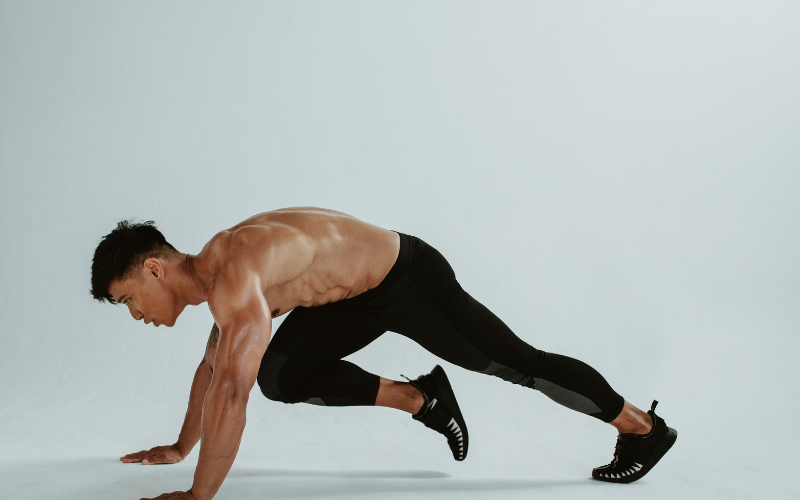
A mountain climber is basically a moving plank. Your abs and obliques mostly work to keep your trunk steady against the pull of each knee drive, so your torso doesn’t sag, pike, or rotate.
Your hip flexors and quads do the actual leg movement, while your shoulders, chest, triceps, and serratus anterior hold you up.
How hard the core works during the standard floor version is still unclear, since no peer-reviewed study has reported its activation levels. Related exercises give you a rough idea, though:
- A 2013 study of 20 people doing 16 exercises found that ab and lower-back activation was highest in moves that also called for shoulder and glute work.
- A suspended knee tuck, the closest relative to a mountain climber, activated the core about 29% less than a roll-out and 13% less than a body saw.
So you can count mountain climbers as solid core work, just not the top activator.
How to Do the Standard Mountain Climber with Good Form
Getting the setup right matters more than how fast you move. Follow these steps:
- Start in a high plank with your hands directly under your shoulders, fingers spread, and feet about hip-width apart.
- Squeeze your shoulders, core, and glutes to create tension through your whole body. Keep your head neutral and your gaze on the floor just ahead of your hands.
- Brace as if someone were about to poke you in the stomach.
- Drive one knee toward your chest without letting your hips rise, then return it to the plank and switch legs.
Throughout the set, keep your hips no higher than your shoulders. It helps to think of the move as a plank with movement, since the plank position is what you’re training your core to hold.
Once you can keep that position steady, you can try a faster version where both legs switch at the same time, one going back as the other comes forward. As a rule of thumb, though, work slow and controlled first and add speed later.
The 6 Mountain Climber Variations and What Each One Does
Each variation shifts the demand a little differently, so the right pick depends on what you want from the set.
1. Standard
This is the baseline. Your rectus abdominis and transverse abdominis work to keep your trunk rigid while your hip flexors drive the knees. It’s a good default for general core work and conditioning.
2. Cross-Body
Drive your knee toward the opposite elbow. The added rotation puts more demand on your obliques. Keep your shoulders level and move a bit more deliberately than you would in the standard version. You’ll only feel the twist at your waist if your upper body stays stable. Pick this one when you want extra oblique work.
3. Spider-Man
Bring your knee to the same-side elbow, with the foot landing outside your hand. The side-bending works your obliques and the quadratus lumborum, and it opens up your hip flexors, abductors, and adductors. Keep your hips low. If that’s too much, beginners can step slowly into a low lunge instead. Choose this one when you want hip mobility along with lateral core work.
4. Slider
Put sliders, paper plates, or towels under your feet on a smooth floor. Your feet never unload, so your abs, stabilizers, and quads stay under tension the whole time. To shift the focus to your obliques, slide the knee across your body toward the opposite shoulder. This version suits you when you want to build anti-extension endurance.
5. Feet-to-Wall or Decline
Place your feet up on a wall or bench. This moves much more of the work to your shoulders and arms, and the higher your feet go, the more strain your shoulders take. Treat it as a shoulder-plus-core move rather than a “more abs” move. It fits best when shoulder-dominant strength is your goal.
6. Slow-Tempo
Take 2 to 3 seconds to bring the knee in, pause briefly, then take 2 to 3 seconds to return. You get more time under tension and less help from momentum, and keeping your hips still is the test of whether the tempo is right. Squeeze the glute and hamstring of the working leg to bring them in, since the leg work is otherwise mostly quads. Use this version when you want to build control before adding speed.
Common Mistakes and How to Fix Them
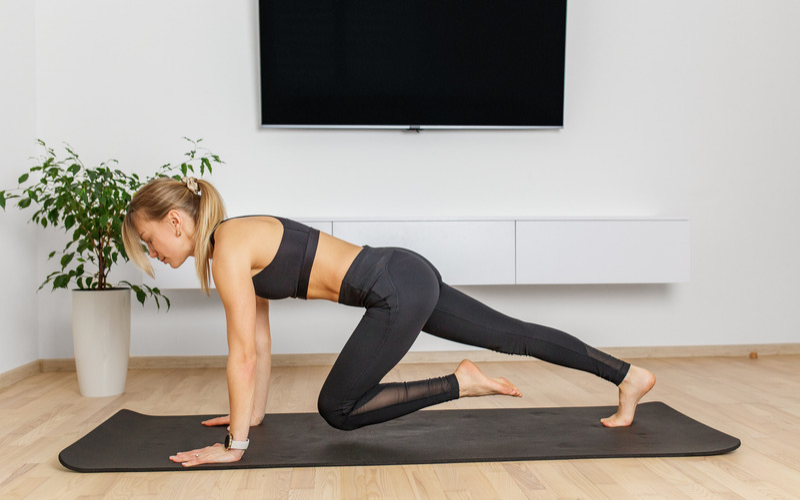
Most form problems come down to the hips, and they tend to creep in as you tire.
- Hips piking up: This is the most common error. Lower your hips, re-brace, and slow down.
- Hips sagging: A sagging midsection means your core isn’t switched on, and it adds stress to your lower back. Stop, reset the plank, then add the legs back in.
- Shoulders drifting behind your hands: This takes the focus off your core. Keep your wrists under your shoulders and press the floor away.
Other fixes are quicker:
- Speed over form: Momentum starts doing the abs’ job. Switch to the slow-tempo version, or count only the reps where your hips stay still.
- Lazy knee drives: Bring your knees up powerfully, like the front of a sprinter’s stride.
- Locked or flared elbows: Point them back without locking them, and press your fingers into the floor.
- Head hanging: Keep your neck in line with your spine.
How to Program, Scale, and Progress Mountain Climbers
Think of your training in two lanes, and keep them separate so the fast version doesn’t replace the controlled one.
- Strength and control: Do 2 to 3 sets of 10 to 15 slow reps. If you’re a beginner, you can start with 2 to 3 sets of 10 to 20 reps per leg.
- Conditioning: Use intervals such as 20 seconds on and 10 seconds off for 6 to 8 rounds (a 6-minute block works well). Another option is 30 to 60 seconds per variation with 30 to 60 seconds of rest, repeated for 5 to 10 rounds.
Scaling down
If the standard version is too hard, work through these from easiest to hardest:
- Plank holds for 10 to 20 seconds
- Incline climbs with your hands on a bench or wall
- Marching steps
- Push-up handles, which help if your wrists complain
- Forearm versions
Moving up
Before you progress, check that you can do 60 seconds of clean mountain climbers and 15 strict push-ups. The rule that matters most is simple: advance only when your hips stay level and your hands stay stacked under your shoulders.
Once you pass that test, you can change your hand position (closer to your feet or farther forward), wear a weight vest, or add instability with sliders, a stability ball, or a suspension trainer. Combos also work, such as 4 climbers followed by 2 push-ups or burpees for 30 seconds.
If you have wrist, shoulder, or low-back pain, stick with the gentler options and check with a clinician first.
The Evidence on “Shredding” and What to Do Instead
“Shredded” means visible muscle definition, and that depends mostly on how much body fat you carry. Training your abs doesn’t change that much on its own.
The research backs this up:
- In a 6-week trial of 24 sedentary adults, ab exercise had no significant effect on abdominal fat or waist size, even though curl-up performance improved.
- A meta-analysis of 13 studies and 1,158 people (ages 14 to 71) found no spot reduction, with an effect size of −0.03 (p = 0.508).
One study points the other way. A 2023 trial of 16 overweight men added torso-rotation and crunch machine work to treadmill running, 4 days a week for 10 weeks.
The added ab work produced 697 g more trunk-fat loss, but total fat loss was similar between groups. The study is too small to overturn the bigger picture, and it didn’t test mountain climbers.
Mountain climbers also aren’t the strongest core exercise on paper. Roll-outs, body saws, and posterior-tilt planks all score higher.
A front plank with a posterior pelvic tilt produced about 120% of maximum contraction in the internal oblique and 111% in the external oblique, and suspended planks and roll-outs topped 100% in the rectus abdominis.
So here’s a practical plan:
- Use mountain climbers for core stability and conditioning.
- Pair them with higher-activation moves if peak core strength is your goal.
- Handle fat loss through nutrition and total training volume.
Conclusion
Mountain climbers are a smart, time-efficient tool for core stability and conditioning, but they won’t guarantee visible abs.
Pick the variation that fits your goal, let your form decide when you progress, and keep your expectations tied to your overall body fat.