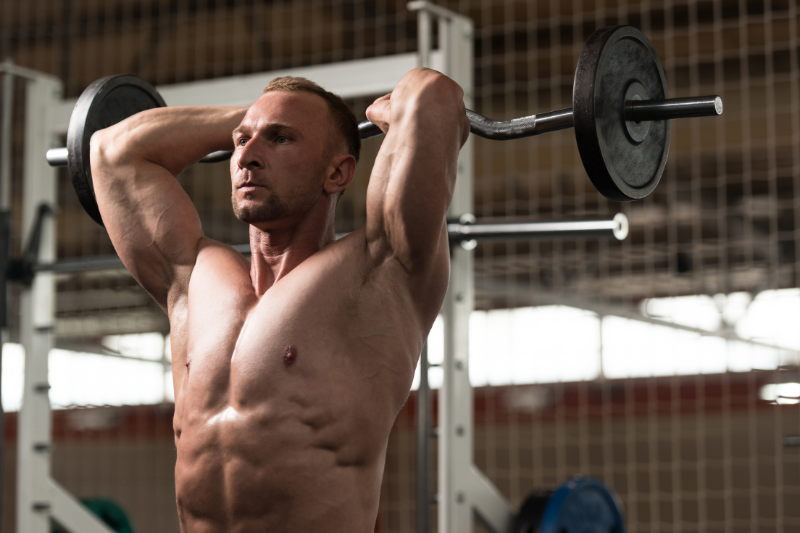
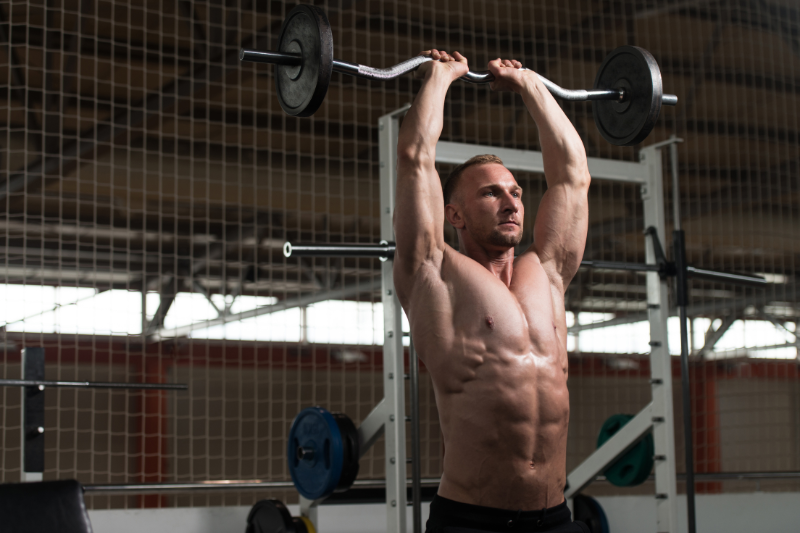
To do the standing overhead barbell triceps extension with perfect form, press the bar to a locked-out position directly above your head, then lower it behind your skull by breaking only at the elbows — keeping your upper arms vertical and stationary throughout — and drive it back up to a hard lockout.
Your core stays braced, your glutes are squeezed, and your elbows stay close to your head the entire time.
Read on for a full breakdown of setup, execution, programming, and the mistakes that can get you hurt.
Why the Long Head of the Triceps Makes This Exercise Different
Your triceps has three heads — the medial, lateral, and long head. The first two originate on the humerus and only cross the elbow, so they do their job regardless of where your arms are positioned.
The long head is different. It originates on the scapula and crosses the shoulder joint, which means arm position directly affects how much work it can do.
When your arms are down at your sides — as in pushdowns — the long head shortens at the shoulder and loses force-producing capacity.
Raise your arms overhead and the opposite happens: the long head is pulled into a deep stretch and held there while your elbows extend. That combination of length and load is what makes this exercise work.
A 12-week study found overhead extensions produced roughly 40% more triceps growth than pushdowns, with the long head benefiting most.
Worth noting: the overhead arm actually showed lower EMG readings — which tells you that muscle activation on its own doesn't predict growth. Tension at a lengthened position does.
How to Set Up and Get the Bar Overhead Safely
Before the bar moves, your body position needs to be locked in: feet hip- to shoulder-width apart, knees soft but not bent, chest tall, shoulder blades pulled down and back, and core braced. A slightly staggered stance works if you tend to sway.
How you get the bar overhead should depend on how much you're lifting:
- Light to moderate loads: Clean the bar from the floor, reverse-curl it to your chest, and strict-press it overhead to lockout.
- Heavier sets: Set the bar in a rack at chest height, unrack it with a close overhand grip, step back, and press up — this saves energy for the actual work.
- Near-failure or max loads: Use a partner hand-off so you start already in the locked-out position.
Once overhead, your arms should be fully extended with the bar stacked above the crown of your head — not in front of your face — and your wrists neutral. If a straight bar bothers your wrists, an EZ-curl bar works just as well here without giving up any of the benefit.
Grip, Elbow Path, and the Most Important Technical Detail
Use a pronated (overhand) grip with your thumbs wrapped around the bar, hands about 6–8 inches apart. Going narrower creates a balance problem and concentrates strain on the wrists; going wider forces the elbows out and pulls the front delts and rotator cuff into a movement that should be isolating the triceps. Keep your wrists locked in line with your forearms throughout — don't let them bend back under load.
Now the part that matters most: your upper arms stay vertical and completely still for the entire rep. Only the forearms move. This is the detail that separates a productive set from a shoulder and elbow problem.
The cue that works best here is “elbows by your ears” or “biceps glued to your head.” The moment your elbows drift outward, the load shifts away from the triceps and onto the shoulders. If you can't keep them in, the weight is too heavy — it's that simple.
Step-by-Step Execution and Breathing
- Set your brace. Before the bar leaves lockout, inhale and tighten your core as if bracing for a punch. Squeeze your glutes, drop your ribs, and keep a slight bend in your knees. This full-body tension is what protects your lower back throughout the set.
- Lower the bar behind your head. Break only at the elbows and bring the bar down in a controlled arc over about two to three seconds. The bar must travel behind the skull — if it stays in front, the long head never gets the stretch that makes this exercise worth doing.
- Pause at the bottom. Let the forearms touch or nearly touch the biceps, then hold for one second. This kills any momentum and forces your triceps to own the stretched position rather than bounce out of it.
- Drive back to lockout. Extend the elbows and exhale as you press the bar back up. Finish with a hard lockout and a brief squeeze — the triceps are built to fully extend the elbow, so don't cut that short.
One note on breathing: for heavier sets, holding your breath through the eccentric and into the concentric helps stiffen the trunk. For higher-rep hypertrophy work, the standard inhale-down, exhale-up pattern is fine. Either way, the brace comes first.
Sets, Reps, and Where It Fits in Your Program
Keep your reps in the 8–15 range, with 10–20 being a reasonable target for pure hypertrophy work. Heavy low-rep sets don't belong here — peak tendon stress occurs at the bottom of the movement where the stretch is deepest, and pairing maximum load with maximum stretch is the fastest route to a distal triceps tendinopathy. Save the heavy work for close-grip bench or dips.
For most training goals, 3–5 sets once or twice per week is the right dose. The frequency cap isn't arbitrary — tendons recover slower than muscle, so more sessions don't mean more growth here.
In terms of weekly triceps volume, most intermediate lifters do well in the 6–16 sets per week range across all triceps work. This exercise counts toward that total.
Two practical programming notes:
- Placement: Always after your primary pressing movement — bench press, overhead press, or close-grip bench. Never first.
- Progression: Fill out your rep range before adding weight. When you're ready to load up, move in 2.5–5 lb increments.
Common Mistakes and When to Skip This Exercise
These four errors come up constantly, and each one has a direct fix:
| Mistake | Why It Matters | Fix |
|---|---|---|
| Lumbar hyperextension | Transfers load to the lower back; most injury-prone error | Squeeze glutes, drop ribs, reduce weight |
| Elbow flare | Shifts work to shoulders, defeats the purpose | “Elbows by your ears,” go lighter |
| Partial range of motion | Cuts out the stretched position — the whole point of the exercise | “Chase the stretch” on every rep |
| Bar drifting in front of the head | Turns the movement into a press; long head gets no stretch | Bar travels behind the skull, always |
When to Skip It Entirely
This exercise loads the triceps tendon while it's simultaneously stretched and compressed against the elbow — a combination that sports medicine research specifically links to triceps tendinopathy. Skip it if you have any of the following:
- Active triceps or elbow tendinopathy
- Shoulder impingement or rotator cuff issues
- AC joint pain
- A current lumbar disc or facet condition
Substitutes That Preserve the Benefit
You don't have to give up lengthened-position triceps training if this variation doesn't work for you. A cable overhead extension keeps constant tension while being gentler on the tendon.
The seated incline French press suits anyone lacking shoulder mobility. An EZ-bar version solves wrist discomfort, and a single-arm dumbbell lets each shoulder find its own best path.
Conclusion
The standing overhead barbell triceps extension is one of the most effective tools for triceps growth, but it earns that reputation only when the technique is honest — controlled eccentrics, elbows locked by your ears, and a spine that doesn't cheat.
Get those things right and you're getting more out of each set than almost any other triceps exercise in the gym.
If the straight bar version isn't accessible to you yet, a cable or EZ-bar overhead extension gets you most of the same benefit while you build toward it.