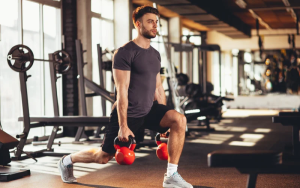
The five best exercises to strengthen knee extension are the leg extension, straight leg raise, banded terminal knee extension, Spanish squat, and Bulgarian split squat — each one targeting a different part of the quadriceps that the others miss.
Keep reading to see exactly how each exercise works, who it's best suited for, and how to program them based on your goals.
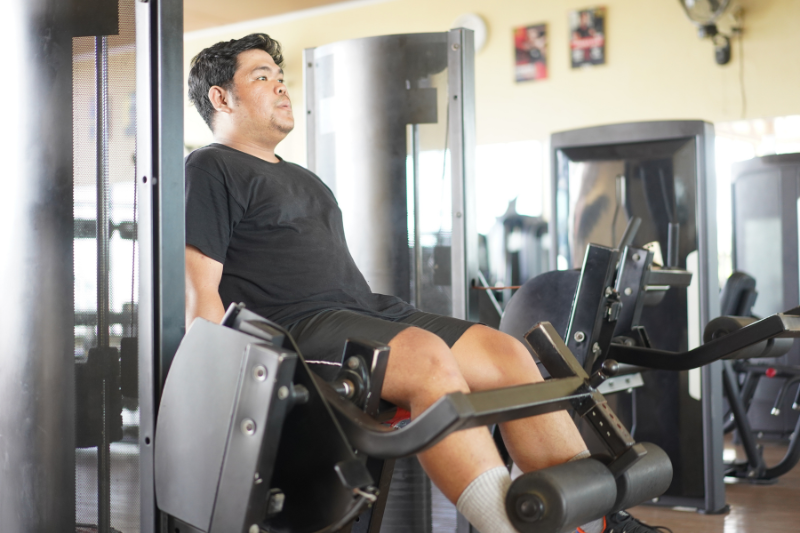
Leg Extension — The Only Exercise That Truly Builds the Rectus Femoris
Squats and lunges are great, but they have a blind spot: the rectus femoris. Because multi-joint movements involve hip extension, the RF never gets fully loaded — and the research shows it.
Over 10 weeks, leg extensions produced rectus femoris thickness gains of 11–17%, compared to just 2–8% from back squats. For complete quad development, the machine leg extension isn't optional.
Two setup details make a bigger difference than most people realize:
- Seatback angle: Reclining to roughly 40° of hip flexion lengthens the rectus femoris and drives greater hypertrophy than sitting upright at 90°. If your machine allows it, use it.
- Foot position: Toes neutral hits all four heads evenly. Toes turned in shifts more demand to the vasti; toes out biases the rectus femoris.
For hypertrophy, aim for 3–5 sets of 8–15 reps at 60–80% of your 1RM, twice a week.
One important caveat for anyone coming back from ACL reconstruction: hold off on maximal loading through the 0–30° range for the first 8–12 weeks. The anterior tibial shear in that range puts unnecessary stress on a healing graft.
Straight Leg Raise — The Starting Point After Knee Surgery
After any knee surgery, the straight leg raise is where quad recovery begins. The benchmark is simple but telling: can you lift a fully locked leg without the knee buckling?
That involuntary bend — called extensor lag — signals the quad isn't firing reliably yet, and no other exercise should come before you've solved it.
Here's how to do it correctly:
- Lie on your back with the opposite knee bent and foot flat on the floor.
- Lock the working knee completely — no bend at all.
- Raise the leg to the height of the opposite bent knee.
- Hold for 2–10 seconds, then lower slowly.
If the knee bends on the way up, stop and re-establish your quad set before trying again. The movement only counts when the leg stays locked throughout.
A common early target is 30–50 total reps per day across the first two post-op weeks. That sounds like a lot, but it's spread across multiple short sessions — not done all at once.
One thing worth knowing: the rectus femoris is actually more active during the straight leg raise than during a quad set, while the VMO dominates during the quad set. That's why you pair them rather than pick one — they're training slightly different things.
Once the movement feels solid, progress looks like this: add 1–5 lb ankle weights, introduce a slight external hip rotation to bias the VMO, and eventually work in 4-way SLR variations to bring the hip stabilizers into the picture.
Banded Terminal Knee Extension — Closed-Chain VMO Activation Without the Joint Stress
Most knee exercises either load the VMO well or go easy on the joint — banded terminal knee extension does both. The VMO fires hardest in the final 15–30° of extension, and that's exactly the range TKE targets.
Because it's done standing in a closed-chain position, it also produces roughly 30% less patellofemoral joint stress than full-range seated knee extension.
That combination makes it one of the most versatile knee exercises available — useful in early ACL rehab, post-TKA recovery, patellofemoral pain, and as a pre-lift activation drill for healthy athletes.
Setup matters more than people think. Here's how to get it right:
- Anchor a resistance band at knee height around a rack or post.
- Step into the loop so the band sits in the popliteal crease — the back of the knee — not on the patella.
- Walk forward until the band pulls your knee into 15–30° of flexion.
- Stand upright, foot flat, then drive the knee to full extension without hyperextending.
- Hold for 1–5 seconds, then resist the band back slowly.
Dosing by context:
- Early rehab: 2 sets of 12 reps with 6-second holds, 2–3 times daily
- Performance/activation: 1–3 sets of 10–20 reps before a training session
Progression moves from double-leg support to single-leg stance, and eventually to step-downs with a TKE cue built in. If end-range extension causes patellofemoral pain, dial back to short-arc work until tolerance builds — don't push through it.
Spanish Squat — Quad-Dominant Loading for Tendon Health
If you're dealing with patellar or quadriceps tendinopathy, the Spanish squat is the exercise most rehabilitation protocols point to — and for good reason.
It produces significantly higher rectus femoris activation than both standard and wall squats, with minimal hamstring involvement.
More importantly, it places substantial load directly on the patellar tendon, which is exactly the stimulus needed to drive the tissue remodeling that tendinopathy recovery depends on.
What makes it different from a regular squat is the setup. A strap anchored at knee height and looped behind both calves acts as a counterbalance, letting you sit straight down with a near-vertical shin and an upright torso.
That position is what shifts the demand onto the quads. Lean forward and you've essentially done a regular squat — the quad emphasis disappears.
How to set it up:
- Anchor a thick strap or resistance band to a rack at knee height.
- Loop it behind both upper calves and walk back until it's taut.
- Stand tall, then sit straight down to 70–90° of knee flexion.
- Keep your torso upright and shins as vertical as possible throughout.
Two dosing tracks depending on where you are in recovery:
- Pain modulation (isometric): 5 sets of 45-second holds at roughly 70% effort, 2–3 times daily. This approach is well-supported for producing immediate, meaningful pain relief that can last up to 45 minutes — useful on heavy training days.
- Tissue capacity (heavy slow resistance): 4 sets progressing from 15 down to 6 reps across weeks, using a controlled 3-1-3 tempo, every other day. This is the phase that actually rebuilds tendon strength over time.
One note of caution: if you have acute patellofemoral joint pain rather than tendon pain, deep knee flexion may provoke symptoms. In that case, start with isometric holds at a shallower angle and progress gradually.
Bulgarian Split Squat — The Highest Vasti Stimulus You Can Get
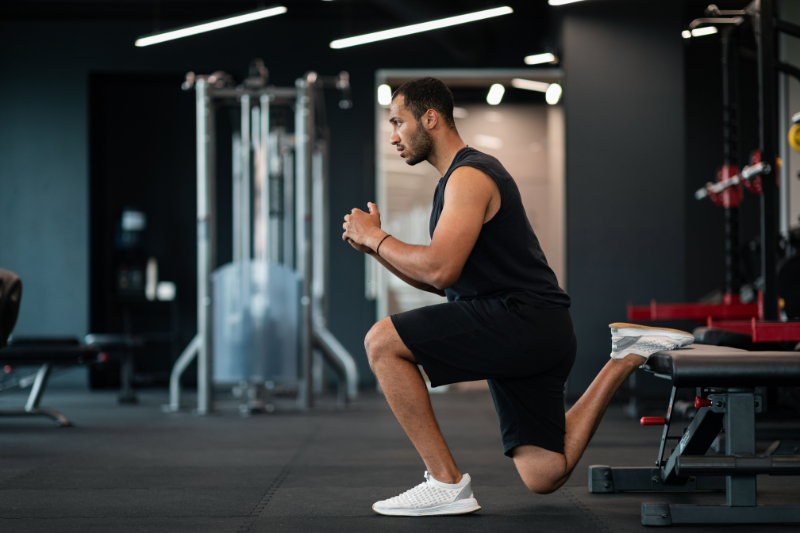
Among common lower-body exercises, the Bulgarian split squat sits at the top for vastus lateralis and vastus medialis activation — roughly 85% and 68% of maximum voluntary contraction respectively. That's higher than split squats, half squats, lateral step-downs, and reverse Nordics.
On top of that, training one leg at a time naturally exposes strength imbalances between sides, which makes this exercise particularly valuable in late-stage ACL rehab where side-to-side deficits are common and often undertreated.
Setup for maximum quad stimulus:
- Stand about three foot-lengths in front of a bench 12–16 inches high.
- Place the top of your rear foot on the bench, front foot flat with toes pointing forward.
- Keep your torso upright and let the front knee travel forward over the toes as you descend.
- Lower until the rear knee lightly touches the floor, then drive through the whole front foot to stand.
The torso position here is worth emphasizing. Leaning forward roughly 40° shifts the demand toward the glutes and away from the quads — so if quad development or rehab is the goal, stay tall.
Dosing by goal:
- Strength: 3–5 sets of 4–8 reps per leg at RPE 7–9
- Hypertrophy: 3–5 sets of 8–15 reps per side, twice weekly
- Rehab: 3 sets of 10–12 reps at bodyweight with a 3-1-1 tempo
Progression path: bodyweight split squat → bodyweight Bulgarian → goblet or dumbbell → barbell → deficit Bulgarian → paused reps and eccentric-emphasis tempos.
The most common error is front-knee valgus — the knee caving inward on the way down. Keep it tracking over the second and third toes throughout. If you have patellofemoral pain, build tolerance with step-ups first.
Step-downs generate roughly 20% more patellofemoral joint stress at the same knee flexion angle, so that sequencing isn't arbitrary.
How to Combine These Five Exercises Based on Your Goal
The core principle across all the research is straightforward: no single exercise covers the quadriceps completely. The rectus femoris needs open-chain isolation, the VMO responds to terminal-range work, and the vasti grow best under heavy unilateral load.
A well-built program needs at least one exercise targeting each of those three stimuli — which ones you prioritize depends on where you're starting from.
For rehab (post-ACL or post-TKA): Begin with quad sets, straight leg raises, and banded TKE. These build the neural foundation and VMO activation needed before anything heavier is appropriate. Hold off on heavy open-chain loading through the terminal range until at least 8–12 weeks post-surgery — the joint simply isn't ready before that.
For patellofemoral pain: Mid-range TKE and Spanish squats are your anchors. Step-ups should come before step-downs, and deep leg extensions or Bulgarian split squats should wait until you've built tolerance in the easier variations first. Pushing into deep flexion too soon tends to set things back rather than move them forward.
For hypertrophy and performance: Pair leg extensions with Bulgarian split squats. The leg extension targets the rectus femoris in a way no compound movement can match, while the Bulgarian split squat produces the highest vasti activation of any common bodyweight exercise. Together they cover the regional gaps each leaves on its own. Aim for roughly 10 weekly sets per muscle group as a baseline volume target.
| Exercise | Primary Target | Best Use Case | Recommended Dose |
|---|---|---|---|
| Leg Extension | All heads, RF emphasis | Hypertrophy, RF isolation | 3–5 × 8–15, 60–80% 1RM |
| Straight Leg Raise | Rectus femoris, VMO | Post-surgical rehab | 2–3 × 10–12, 2–3× daily |
| Banded TKE | VMO, terminal range | Rehab, activation | 2 × 12 with 6s holds |
| Spanish Squat | Distal quads, patellar tendon | Tendinopathy rehab | 5 × 45s isometric or 4 × 6–15 tempo |
| Bulgarian Split Squat | Vasti (VL/VM) | Performance, late-stage rehab | 3–5 × 4–15/leg, 2×/week |
Conclusion
Training knee extension effectively comes down to one principle: the quadriceps has four heads, and each one responds to different demands.
A program built around these five exercises — whether you're recovering from surgery, managing tendon pain, or chasing hypertrophy — covers every stimulus the research points to.
Pick the exercises that match where you are right now, follow the dosing guidelines, and progress from there.