Three 30-minute sessions a week — 90 minutes total — is genuinely all it takes to capture the bulk of the health and fitness returns that resistance training has to offer, and the research backs this up firmly.
Keep reading to see exactly how to structure those sessions so none of that time goes to waste.
How Little Exercise Do You Actually Need?
Less than you think. The relationship between exercise and results isn't linear — it's a curve that rises steeply at first, then flattens out fast. The biggest chunk of what strength training gives you arrives early, and every extra hour you pour in after that buys progressively less.
Two large 2022 meta-analyses put a number on this. Peak reductions in all-cause mortality, cardiovascular disease, and cancer death all occur at around 30–60 minutes of muscle-strengthening activity per week. Past that point, the curve doesn't just flatten — it can actually reverse.
One analysis found that combining strength training with regular aerobic activity (think walking) delivered a 40% reduction in all-cause mortality and a 60% reduction in cardiovascular death. You don't need to live in the gym to hit that threshold.
So what's the actual minimum? A 2021 narrative review in Sports Medicine laid it out plainly:
- At least 4 hard sets per muscle group per week
- Reps in the 6–15 range
- Sets taken close to failure
That's the floor. Three movement categories — a leg press, an upper-body push, and an upper-body pull — cover all the major muscles. That's the entire skeleton of an effective program.
It gets more interesting. A meta-analysis on single-set training found that one set of 6–12 reps at 70–85% of your max, done two to three times a week to failure, produces statistically significant strength gains in trained men — pooled improvements of +7.7 kg on bench press and +17.5 kg on squat over 8–12 weeks.
A separate review of 35-plus studies found no significant difference in strength or hypertrophy between single and multiple sets across periods of up to 25 weeks.
The practical upshot is what you might call the 70/25 principle: a lifter who shows up three times a week, picks the right compound exercises, and pushes close to failure can capture roughly 70% of the muscle and strength gains of someone training much more — at about 25% of the time cost. The extra hours most people log aren't building more muscle. They're just eating more of the week.
Why Compound Lifts Are the Only Ones Worth Your Time
If you're working with 30 minutes, isolation exercises — curls, lateral raises, tricep kickbacks — are the first thing to cut. The research on this is pretty clear: adding single-joint movements to a program built around compound lifts produces no meaningful extra growth in muscle size or strength.
One trial found that ten weeks of lat pulldowns alone produced statistically equivalent bicep growth to lat pulldowns combined with dedicated curl work. Same gains, half the exercises.
The reason compounds dominate comes down to stimulus per minute. A barbell row trains your lats, rhomboids, mid-traps, rear delts, biceps, and forearms in a single rep.
A conventional deadlift generates near-maximal muscle activation across your glutes, hamstrings, erectors, quads, and traps simultaneously. A curl trains your biceps. On a 30-minute clock, that trade-off isn't close.
There's also a progression advantage. Adding 2.5 kg to your bench press is a small percentage jump — manageable, sustainable. The same 2.5 kg added to a curl is a massive relative increase, making consistent progressive overload much harder to maintain. Compounds keep you progressing longer.
Six movement patterns cover every major muscle in your body:
- Squat (knee-dominant) — quads, glutes, core
- Hinge (hip-dominant) — hamstrings, glutes, erectors
- Horizontal push — chest, front delts, triceps
- Horizontal pull — lats, rhomboids, biceps
- Vertical push — shoulders, triceps
- Vertical pull — lats, biceps, rear delts
Five or six exercises spanning these patterns, loaded onto a single rack with an attached bench and pull-up bar, covers essentially everything. No machine-hopping, no equipment shuffles — just work.
The Actual Program — Two Sessions, Three Days a Week
Full-body training three times a week is the right structure for this constraint, and not just because it sounds simple. Spreading volume across three sessions keeps per-session fatigue low — the only way 30 minutes is actually sufficient.
It's also resilient to real life: if you miss a day, no muscle group goes more than a few days without a stimulus. Upper/lower splits don't offer that buffer.
Research comparing the two approaches found equivalent hypertrophy and strength when total volume is matched, so there's no downside to going full-body here.
The program runs two alternating sessions — Day A and Day B — in an ABA/BAB weekly rotation.
Day A — Squat Focus
- Back squat (or goblet squat / leg press) — 3 sets of 5–8 reps
- Bench press supersetted with chest-supported row — 3 sets each (5–8 on press, 8–12 on row)
- Romanian deadlift — 2 sets of 8–12
- Lat pulldown — 2 sets of 8–12
Day B — Hinge Focus
- Trap-bar or conventional deadlift — 3 sets of 3–5 reps
- Overhead press supersetted with pull-ups or pulldowns — 3 sets each (5–8 on press, 6–10 on pulls)
- Leg press or Bulgarian split squat — 2 sets of 8–12
- Face-pull or cable row — 2 sets of 10–15
The rep prescription is deliberate. Heavier compounds sit in the 5–8 range where load progression is easiest to track; supporting work runs 8–12, which is where the research consistently shows the best hypertrophy response for accessory movements.
The time arithmetic works out like this:
- Warm-up — 4 minutes
- Heavy compound with full rest periods — ~9 minutes
- Superset block (push + pull paired) — ~9 minutes
- Two accessory pairs — ~3–4 minutes each
Total: roughly 29 minutes. The supersets are what make this possible — more on those in the next section.
Supersets and Rest Periods — The Biggest Time Savers

The instinct to shorten rest periods to save time is understandable but counterproductive. A well-known rest period trial found that 3-minute rests produced superior hypertrophy and strength gains compared to 1-minute rests in trained lifters.
Cutting rest doesn't just feel harder — it actually costs you results. The smarter solution is to use that rest time productively rather than eliminate it.
That's where antagonist supersets come in.
Pairing a push movement with a pull movement means one muscle group recovers while the other works. A study comparing traditional bench-then-row training to alternating bench-pull supersets found the superset condition completed identical volume in roughly half the time with no loss in performance.
An 8-week follow-up confirmed equivalent strength and power gains — while logging only 4.5 total hours of training versus 10.1 hours in the traditional group.
More recent meta-analyses have confirmed the same finding, and there's evidence that the antagonist's brief contraction may actually aid recovery in the prime mover, sometimes allowing more total reps.
Pairings that work well:
- Bench press + chest-supported row
- Overhead press + pull-up or pulldown
- Leg press + leg curl
- Any push/pull combination at adjacent stations
Pairings to avoid:
- Bench press + overhead press
- Any two movements that load the same muscle group
Pairing similar movements drops volume load substantially — you end up fatiguing the same muscles twice rather than letting one recover while the other works.
For accessory work, myo-reps are worth knowing. The protocol runs like this: do 15 reps at 1–2 reps shy of failure, rest for 5 breaths, then do mini-sets of 3–5 reps with the same short rest until you can no longer hit the rep target. The whole cluster takes about two minutes and delivers roughly the equivalent stimulus of three traditional sets.
It works because the muscles are already pre-fatigued, so even the lighter mini-sets recruit high-threshold motor units — the ones most responsible for growth.
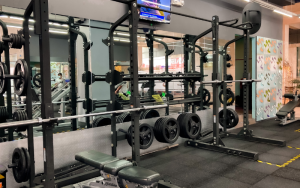
On the equipment side, a single power rack with an attached bench and pull-up bar handles every exercise in this program. Squats, presses, rows, deadlifts, and chin-ups all happen within a six-foot footprint.
When the gym is busy and you can't hold two stations, switch to rest-pause sets at one station — brief intra-set pauses that extend a single set long enough to match the volume of multiple traditional sets. Same time savings, one piece of equipment.
How to Keep Getting Stronger Without Adding Time
Most people assume that when progress slows, the answer is more — more sets, more exercises, more sessions. For a minimalist program, that instinct will break the entire structure. The good news is that you have two effective progression tools that don't require a single extra minute.
Tool 1: Double Progression
Pick a rep range for each lift and work within it. For heavy compounds, that's 5–8 reps. For accessories, 8–12. Start every new weight at the bottom of the range, and only move up when every set hits the top.
In practice, it looks like this:
- Week 1: 3×5 at 80 kg
- Week 2: 3×6 at 80 kg
- Week 3: 3×7 at 80 kg
- Week 4: 3×8 at 80 kg — add weight next session
- Week 5: 3×5 at 82.5 kg — cycle repeats
Simple, clear, and sustainable for years without ever adding a set or an exercise.
Tool 2: Proximity to Failure
Effort is a stronger driver of muscle growth than volume. Research on training close to failure confirms that hypertrophy improves as sets approach failure — and that training to 1–2 reps shy of failure matches training all the way to failure for muscle growth. For strength work, stopping 3–5 reps short works just as well.
Early in a training block, leave a few reps in the tank on most sets. As weeks progress, inch closer to failure on your later sets. This naturally increases stimulus over time without touching session length, set count, or exercise selection.
When to Deload
Every 4–8 weeks, watch for these signals:
- Multiple lifts stalling simultaneously
- Persistent joint aches that don't resolve between sessions
- Sleep quality dropping noticeably
When two or more of these show up together, cut your loads to 50–60% or halve your sets for a week. This isn't optional recovery — it's what keeps the progression cycle running. Skipping deloads when your body is signaling fatigue tends to turn a one-week fix into a multi-week stall.
The broader point is that effort and consistency drive progress far more than volume does. Showing up three times a week, pushing hard on a small handful of movements, and methodically adding weight over time will outperform a bloated program that burns you out within two months.
Programs That Actually Fit 30 Minutes (And Famous Ones That Don't)
Most beginner programs the internet recommends were never designed with a 30-minute limit in mind. Before picking one, it helps to know which ones actually fit.
Programs that will run over:
- StrongLifts 5×5 — runs 75–100 minutes once weights get heavy
- Starting Strength — 60–90 minutes per session by design
- Boring But Big / Building the Monolith — both overflow the budget significantly
Programs that genuinely fit:
- Pavel Tsatsouline's Simple & Sinister — 100 one-arm kettlebell swings plus 10 Turkish get-ups, 20–30 minutes, complete strength and conditioning in two movements
- Dan John's Easy Strength — five movement patterns, 2×5 each, never to failure, 15–25 minutes, built specifically for lifters who prioritize consistency over intensity
- Reddit's Basic Beginner Routine (Phrak's Greyskull variant) — three exercises per session with a final AMRAP set, explicitly capped at 30–45 minutes, solid first three months
- Jeff Nippard's Minimalist template — 1–2 hard sets per exercise with drop sets and myo-reps integrated, science-based pacing under 45 minutes
- Vanilla 5/3/1, three-day with minimal assistance — one main lift, one AMRAP set, plus 25–50 reps each of a push, pull, and core movement; fits 30–40 minutes and runs sustainably for years
Protecting Your Time in a Commercial Gym
The program is only half the equation. How you show up matters just as much.
Schedule sessions during off-peak windows — 5:30–7 AM, 11 AM–1 PM, or after 8 PM. Commercial gyms peak between 5 and 8 PM on weekdays, when waiting for a rack alone can consume your entire session budget.
Pre-load every session before you walk in. Apps like Boostcamp, Liftosaur, Hevy, and Strong auto-populate weights and run rest timers — knowing your exact loads before arrival saves several minutes per session and removes any decision-making once you're there.
Use the in-app rest timer rather than your social feed. Phone scrolling between sets is the single most correctable time leak in any gym.
A few other habits worth keeping:
- Bring your own water so you never abandon your station
- Use headphones as a passive “do not disturb” signal
- When the gym is empty, run supersets across two adjacent stations; when it's crowded, switch to myo-reps or rest-pause at a single station
One more thing worth knowing: for accessory work, machines are just as effective as free weights for building muscle. A large meta-analysis found no significant hypertrophy difference between the two.
If the bench is taken, use the chest press machine. If the squat rack is occupied, use the leg press. Save the barbell for your heavy compound of the day, where load precision matters most.
The Honest Bottom Line
Most lifters in commercial gyms are spending two to four times the time needed to capture the bulk of available results.
Maintenance volume sits around 6 hard sets per muscle per week. Minimum effective volume is 8–12. Returns flatten fast past 20.
Dropping from 10 weekly sets to just 1–4 retains roughly 64% of expected gains — and even that floor produces meaningful strength progress in trained lifters.