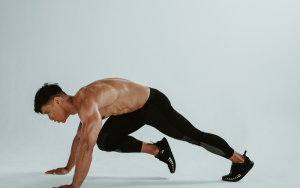
To do pike pushups correctly, get into an inverted V position with your hips high, then lower your head forward and down so it lands ahead of your fingertips — not straight between your hands — forming a triangle with both hands on the floor.
Keep your forearms vertical, elbows tracking over your hands, and finish each rep with a full lockout and shoulder shrug at the top.
Keep reading for a detailed breakdown of setup, muscle activation, common mistakes, and how to progress toward handstand pushups.
What Makes the Pike Pushup Different (and Worth Doing)
Most bodyweight exercises train horizontal pushing — your chest, front shoulders, and triceps working together as you press parallel to the floor.
The pike pushup breaks from that pattern entirely. It's a vertical press, which means the load shifts almost entirely onto the front and side deltoids, replicating the muscle demand of an overhead press without a single piece of equipment.
That's a genuinely rare combination. Outside of a handstand pushup, there's no other equipment-free movement that trains the shoulders in a true vertical pressing pattern — which is exactly why the pike pushup holds a unique spot in calisthenics programming.
It also sits at the center of a clear progression path. If your goal is wall handstand pushups, pike pushups aren't just a warm-up option — they're the primary bridge exercise that builds the specific strength and motor patterns you'll need.
Skipping them, or treating them as a throwaway movement, typically means stalling out when you attempt more advanced overhead work.
A few other things worth knowing before you dive in:
- It scales well. Beginners can elevate their hands to reduce load; advanced trainees can elevate their feet or add a deficit to increase it.
- It doesn't require anything. No bars, no rings, no weights — just floor space.
- Standard pushups don't train the same muscles. If overhead pressing strength is the goal, horizontal pushing won't get you there regardless of how many reps you accumulate.
How to Set Up the Inverted V Position
Start in a standard pushup position, then walk your feet toward your hands until your body forms a clear inverted V — think yoga downward dog. Your hips should be pushed as high toward the ceiling as possible. From there, getting the fine details right is what separates a productive set from a frustrating one.
Hands and feet:
- Hands shoulder-width apart, fingers spread, index fingers pointing forward (or very slightly turned out to protect the wrists)
- Feet hip-width apart — rising onto your tiptoes is fine and often helps lift the hips higher
The distance between your hands and feet matters more than most people expect. Aim for roughly a 90-degree angle at the hips — around 36 inches for most people, though your proportions will affect this. Moving just one inch forward or backward shifts the difficulty noticeably. Too close and the exercise becomes exponentially harder; too far and the angle flattens out, turning it into a decline pushup that trains your chest instead of your shoulders.
Once your stance is set, lock your arms straight and actively shrug your shoulders up toward your ears, pushing the floor away.
Your head hangs naturally between your arms with your gaze directed back through your legs. Then engage your core and squeeze your glutes — both should stay contracted throughout the set to keep the pike shape rigid.
A quick alignment check before your first rep: you should be able to draw a straight line from your hip through your shoulder to your ear. If that line breaks anywhere, adjust your position before you start lowering.
The Movement — Head Path, Elbow Tracking, and Lockout

The single most important cue in the entire exercise is this: your head travels forward and down, not straight down between your hands.
At the bottom of the rep, your nose or forehead should touch the floor ahead of your fingertips, with your head and both hands forming a triangle on the ground.
Get this right and everything else becomes easier to manage. Get it wrong and the whole movement breaks down — more on that in the mistakes section.
The descent: Bend your elbows and lower yourself with control over 2–3 seconds. Keep your forearms vertical throughout — elbows tracking directly over your hands, never drifting outward. An optional one-second pause at the bottom eliminates the stretch reflex and builds strength at the hardest point in the range of motion, which is worth doing once you're comfortable with the movement.
The press: Push the floor away with real intent. Gripping the floor hard as you press generates full-body tension through a principle called irradiation — the harder you grip, the more force your whole body produces. Press with explosive intent even if the actual movement is slow.
The lockout: At the top, fully straighten your arms and shrug your shoulders back up toward your ears. This completes the scapular elevation and engages the serratus anterior and trapezius — skipping it cuts the range of motion short and leaves real strength gains on the table.
Breathing follows a simple pattern: inhale through the nose on the way down, exhale forcefully through the mouth as you press up. The inverted position makes breath-holding tempting, but avoid it — it limits output and can cause dizziness. One refinement worth adding: breathe into your stomach rather than your chest. Diaphragmatic breathing increases core stability in the pike position and can realistically add a rep or two per set.
Muscles Worked
The pike pushup is biomechanically a vertical press, which shifts muscle recruitment significantly compared to a standard pushup.
The primary movers are the anterior (front) deltoid and lateral (side) deltoid, with the triceps brachii contributing heavily during elbow extension and the final lockout.
The upper pec assists, but its role here is minor — horizontal pressing movements like standard pushups or dips will always do more for chest development.
Research on overhead pressing shows anterior deltoid activation peaking at around 33% of maximum voluntary isometric contraction, and the pike pushup's nearly vertical pressing angle closely replicates that pattern.
It's one of the few bodyweight movements where the shoulders are genuinely the primary target rather than a supporting player.
Stabilizers keeping everything together:
- Serratus anterior — protracts the shoulder blades during the press
- Lower trapezius — stabilizes the scapulae throughout the movement
- Core (rectus abdominis, obliques, erector spinae) — works isometrically to hold the pike position
- Calves, hamstrings, and glutes — keep the lower body anchored and the shape rigid
One muscle notably absent from this list is the posterior (rear) deltoid. It acts as an antagonist during the press, meaning it lengthens rather than contracts.
If rear delt development is part of your training goals, you'll need to address it separately with rowing or face pull variations — pike pushups won't cover it.
The Six Most Common Form Mistakes
1. Dropping the head straight down between the hands This is the most damaging error you can make. It forces the elbows to flare outward, increases joint stress, reduces range of motion, and produces zero carryover to handstand pushups. The fix is simple: aim your nose at a spot on the floor well ahead of your fingertips before you even begin lowering.
2. Elbow flare Almost always a direct consequence of the wrong head path rather than a standalone error. When the head drops straight down, the elbows have nowhere to go but out. Pointing your index fingers slightly forward at setup naturally discourages flare — and if the head path is correct, the elbows tend to track properly without much extra thought. Left uncorrected, consistent elbow flare creates real shoulder impingement risk over time.
3. Hips sagging during the set The moment your hips drop, the exercise stops being a shoulder press and becomes a decline pushup. The load shifts to your chest and the whole point of the movement is lost. If your hips are sinking mid-set, your core or shoulders have fatigued — end the set there rather than grinding out more bad reps.
4. Rounding the back The pike shape requires hinging at the hips, not the spine. A rounded back disrupts the A-frame position, compromises spinal alignment, and makes it harder to maintain the correct pressing angle. If you're rounding, your hamstrings may be too tight to hold the position — a slight knee bend is a better fix than compensating through the spine.
5. Cutting the range of motion short Stopping well before your head reaches the floor limits muscle engagement and does little for strength development. If full depth isn't yet achievable, use a regression — hands on a bench or a wider stance — rather than performing shallow reps at the full variation. Partial reps at the wrong level don't build toward anything.
6. Moving too fast Speed bleeds tension. A controlled 2–3 second descent keeps the muscles loaded throughout the rep and significantly reduces injury risk at the shoulder joint. Rushing through reps is one of the more common ways people accumulate joint irritation without realizing the movement is the cause.
Progressions and Programming
The pike pushup sits in the middle of a clear progression ladder. Where you start depends on what you can currently do with good form — and where you go next depends on earning the right to move up, not just feeling ready.
If you can't yet do a full pike pushup with proper form, start with one of these regressions:
- Incline pike pushup (hands on a bench or step) to reduce how much bodyweight you're pressing
- Wider hand placement, which shortens the range of motion
- Partial range of motion — lowering halfway before pressing back up
- A slight knee bend if tight hamstrings are preventing you from holding the pike angle
The progression ladder once you've mastered the floor version:
- Feet on a chair (knee height) — loads approximately 77% of bodyweight onto the upper body
- Feet on a couch or similar (hip height) — raises that to roughly 83%; placing feet near the edge increases difficulty
- Deficit pike pushups — hands on parallettes or yoga blocks, letting the head descend below hand level for extended range of motion
- Wall handstand pushup negatives — controlled lowering only, no press
- Wall handstand pushups — the end goal of this entire progression
The rule at every stage: hit 3 sets of 8–10 clean reps before moving up, and stay at each foot elevation for at least six weeks. On the deficit variation specifically, reach 3–5 sets of 3 solid reps before attempting wall handstand pushup work.
Programming by level:
| Level | Sets x Reps | Frequency | Rest |
|---|---|---|---|
| Beginner | 2–3 x 5–8 | 2x per week | 1–2 min |
| Intermediate | 4 x 8–12 | 3x per week | 1–2 min |
Place pike pushups early in your session while the shoulders are fresh. Pair them with a horizontal push — standard pushups or dips — and at least one pulling movement to keep the shoulder girdle balanced.
Before each session, run through scapular wall slides, palm pulses, and wrist pushups to prepare the joints for the overhead loading angle. Finally, mark your hand and foot positions on the floor — consistent setup produces consistent results, and small position changes shift the difficulty more than most people expect.
Conclusion
The pike pushup rewards attention to detail — get the head path, elbow tracking, and lockout right, and you have one of the most effective shoulder-building tools available without any equipment.
Work through the progressions patiently, treat form consistency as the main metric rather than rep count, and the path to handstand pushups becomes a lot more straightforward than it looks.
Mark your positions, follow the programming, and let the reps accumulate.