The best quad workout combines a heavy compound movement like the hack squat or high-bar back squat, a secondary compound such as the leg press or Bulgarian split squat, and a seated leg extension — performed in that order, two to three times per week, for a total of 12–18 hard sets spread across the week.
Keep reading for the full breakdown of exercises, sets, reps, frequency, and recovery so you can put it all together.
Why Your Quads Need More Than Just Squats
Your quadriceps are made up of four separate muscles, and they don't all respond to the same exercises.
Three of them — the vastus lateralis, vastus medialis, and vastus intermedius — cross only the knee joint, which means any squat variation loads them well. The fourth, the rectus femoris, is different.
The rectus femoris crosses both the hip and the knee. During a squat, as your knee extends, your hip extends at the same time — and those two movements pull against each other, leaving the rectus femoris barely working.
A 2019 study by Kubo et al. measured zero rectus femoris growth after 10 weeks of squat-only training, while the other three heads grew significantly.
The practical takeaway is simple:
- Compound movements (squats, hack squats, leg press) build the three vasti
- Isolation work (leg extensions) builds the rectus femoris
You need both to develop complete quads.
The Best Quad Exercises, Ranked
Not all quad exercises are equal. Here's how they stack up, and why.
Tier 1: Non-Negotiables
1. High-bar back squat. The foundation of quad training. Squat to at least 120° of knee flexion — research confirms deep squats produce significantly more quad growth than shallow ones.
Wear heeled lifting shoes or elevate your heels, keep your stance narrow to moderate, and let your knees travel freely over your toes. The more upright your torso, the harder your quads work.
2. Hack squat. The back support removes balance demands entirely, letting you focus on loading the quads through a deep range of motion.
Feet low and narrow on the platform, go as deep as possible, control the descent. It typically allows greater knee flexion than the leg press, which gives it a slight edge.
3. Seated leg extension. The most important exercise for rectus femoris development — and the most overlooked. One key detail: lean the seatback further back rather than sitting upright.
Training at a reclined hip angle produces significantly greater RF hypertrophy. Keep reps in the 10–30 range and avoid going heavy.
Tier 2: Strong Supporting Exercises
- Leg press. Effective across a uniquely wide rep range of 5–30. Feet low and narrow, full depth without your lower back lifting off the pad. Ideal for adding volume when your back is already taxed from squats.
- Bulgarian split squat. Quad activation matches the back squat at equivalent loads. Elevate your front heel to push even more demand into the quads. Excellent for correcting left-right imbalances.
- Reverse Nordic curl. Loads the rectus femoris in its lengthened position — the opposite of leg extensions. Kneel on a pad, hips fully extended, and lean back by bending only at the knees. Pairs well with leg extensions for complete RF development.
- Cyclist squat. Heels elevated 2–4 inches, narrow stance, torso completely vertical. The most quad-dominant free-weight squat variation available.
How to Structure Your Quad Workout
Every quad session should follow the same basic sequence: heavy compound first, secondary compound second, isolation last.
Compounds performed on pre-fatigued muscles carry higher injury risk and lower performance — so always lead with your heaviest work.
Keep the exercise count to 1–3 movements per session. Cramming five exercises into one brutal leg day is less effective than spreading that volume across multiple sessions during the week.
Rep ranges by exercise:
| Exercise | Effective Rep Range |
|---|---|
| Squats / hack squats | 5–15 reps |
| Leg press | 5–30 reps |
| Leg extensions | 10–30 reps |
Avoid heavy sets on leg extensions — high loads create unnecessary knee stress without adding meaningful growth stimulus. On squats, sets of 25+ just exhaust your lungs and lower back before your quads are done.
Rest periods follow the same logic as exercise order. Take 2–3 minutes between sets of compounds to let your nervous system and breathing recover fully. For leg extensions, 30–60 seconds is enough since there's no cardiovascular or spinal demand involved.
Sample session layout:
- Hack squat — 3 sets × 8–12 reps (rest 2–3 min)
- Leg press — 3 sets × 10–20 reps (rest 2–3 min)
- Seated leg extension — 3 sets × 15–25 reps (rest 30–60 sec)
How Often to Train Quads and How Many Sets Per Week
For most intermediate lifters, 2–3 quad sessions per week hits the sweet spot. This lets you spread your weekly volume across multiple sessions without exceeding what your body can productively absorb in a single workout — roughly 8–12 sets per session before diminishing returns kick in.
Weekly volume landmarks to know:
| Volume Type | Sets Per Week |
|---|---|
| Maintenance | 2–4 sets |
| Minimum effective | 4–6 sets |
| Maximum adaptive | 6–14 sets |
| Maximum recoverable | 14–18 sets |
Your goal during a growth phase is to work within that maximum adaptive range — enough stimulus to drive progress, not so much that recovery breaks down.
Frequency is mainly a tool for distributing that volume sensibly across the week rather than piling it all into one session.
A practical three-day structure that works well:
- Monday (heavy): Barbell squat 3×5–10 + hack squat 3×5–10
- Wednesday (moderate): Hack squat 3×10–20 + leg press 3×10–20
- Friday (light): Leg extension 3×20–30 + leg press 3×20–30
This heavy-to-light progression across the week keeps intensity manageable while accumulating enough total volume to drive consistent growth.
Progressive Overload — How to Keep Growing
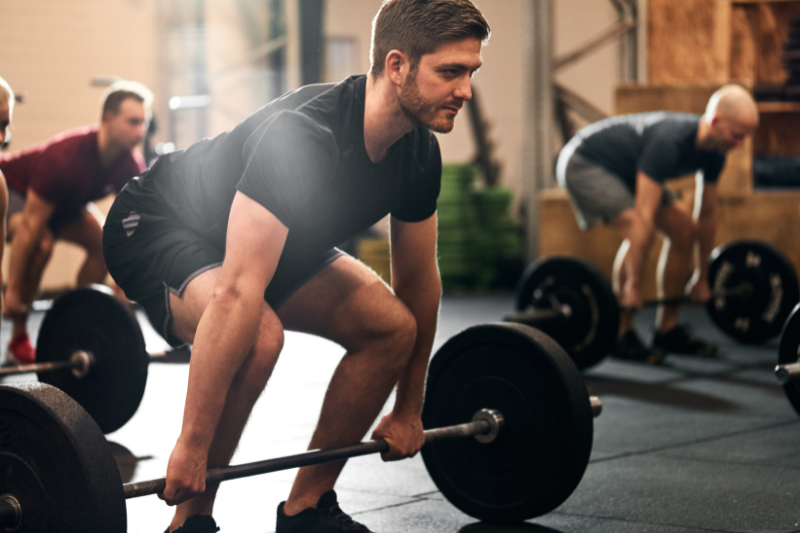
Without progressive overload, your quads adapt and stop growing. The question isn't whether to overload — it's which method to prioritize.
The three main methods, in order of priority:
- Add sets. The most well-supported approach for hypertrophy blocks. Add 1–2 sets per muscle group per week across a mesocycle, starting at your minimum effective volume and building toward your maximum recoverable volume.
- Add load. Aim for 2–5% increases per week on compound movements. When standard weight jumps feel too large, fractional plates keep progression moving without forcing sloppy reps.
- Increase range of motion. Squatting deeper, using fuller leg press ROM, or reclining the seatback further on leg extensions all count as progressive overload — and this method is frequently overlooked.
For rep-based progression, the 2-for-2 rule is practical: increase the weight when you can hit 2 extra reps beyond your target on the last set for two consecutive sessions.
How a mesocycle should look:
- Week 1: Start at minimum effective volume, ~3–4 reps in reserve (RIR)
- Weeks 2–4: Add 1–2 sets per week, reduce RIR by roughly 1 per week
- Final week: Near 0–1 RIR, approaching maximum recoverable volume
- Deload week: Drop back to minimum effective volume at ~50% of training loads
Deload every 4–8 weeks — closer to 4 for more advanced lifters. If your sleep is deteriorating, appetite is dropping, or you can't match previous session performance, that's a signal to deload sooner.
Recovery: What to Do Between Sessions
Training breaks your quads down — recovery is where they actually grow. Leave at least 48–72 hours between intense quad sessions. If you're following the three-day heavy/moderate/light structure outlined earlier, the spacing handles itself naturally.
The non-negotiables:
- Protein: 1.6–2.2g per kilogram of bodyweight daily, spread across 4–5 meals with at least 30g of high-quality protein per meal. Muscle protein synthesis stays elevated for 24–48 hours after training, so rest day protein intake matters just as much as post-workout nutrition.
- Sleep: 7–9 hours per night. Growth hormone peaks during sleep, protein synthesis is most active, and cortisol drops to its lowest levels. Poor sleep directly undermines both recovery and next-session performance.
- Creatine monohydrate: 3–5g daily. The most researched supplement in resistance training — it supports greater training volume and modestly speeds recovery. No loading phase needed.
Foam rolling is worth adding if quad soreness is limiting your training. Rolling from the hip flexors down to just above the knee, pausing on tender spots for 30 seconds or more, can reduce muscle soreness and improve passive knee range of motion by up to 8 degrees — which translates directly to better squat depth.
Persistent soreness beyond 72 hours or a consistent inability to match your previous session's numbers are both signs you need more recovery time before your next session.
Conclusion
Building bigger quads comes down to a few non-negotiables: pair your compound movements with seated leg extensions, train 2–3 times per week within the 12–18 weekly set range, and always prioritize depth over the weight on the bar.
Progress by adding sets first, then load, and take your recovery as seriously as the training itself. Stay consistent with that framework and the results will follow.