Most men's glutes stay underdeveloped because they rely too heavily on squats, train them once a week, and never address the activation and nutrition gaps that block real growth.
To fix that, you need to diversify your exercise selection, hit your glutes 2–3 times per week, activate them properly before lifting, eat enough to support muscle growth, and drop the habits that are quietly killing your progress — keep reading for a breakdown of each.
Pick Exercises That Actually Load the Glutes
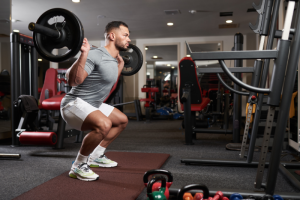
Squats are a solid movement, but they're primarily a quad exercise. EMG data shows that hip thrusts produce roughly twice the glute activation of back squats — yet here's the catch: when researchers measured actual muscle growth over nine weeks, both exercises produced equal gluteus maximus hypertrophy.
That tells you something important. They work through different mechanisms, which means you need both, not one or the other.
Think of your glute training in three categories:
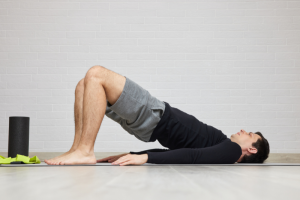
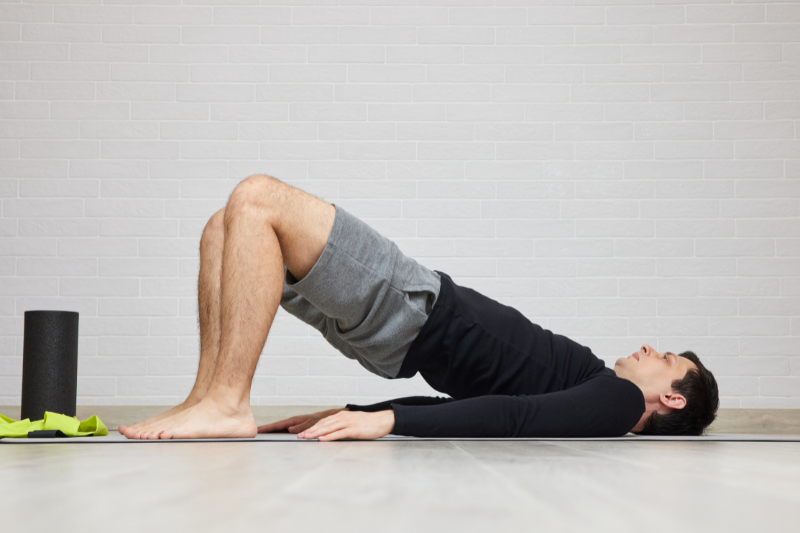
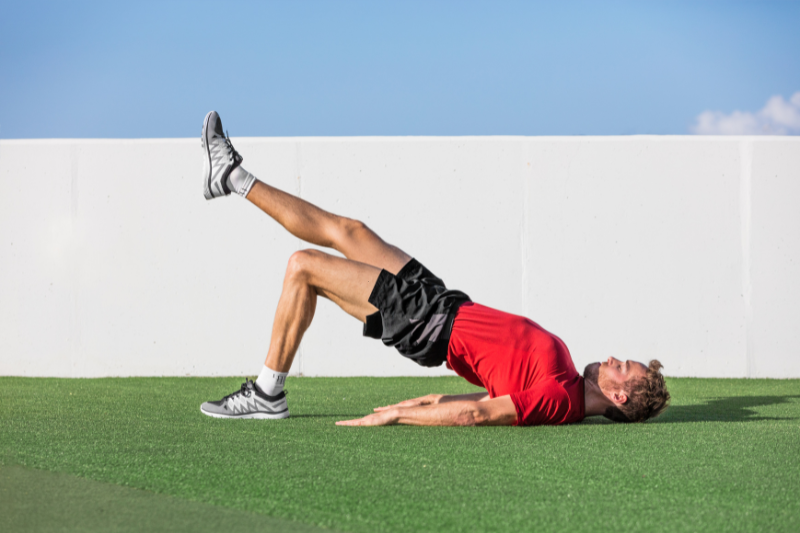
- Peak-contraction exercises — hip thrusts, glute bridges, cable kickbacks. These load the glute hardest at full hip extension, which is where glute neural drive peaks.
- Stretch-loaded exercises — Romanian deadlifts, Bulgarian split squats, deep lunges. These create tension when the muscle is lengthened, which drives a different hypertrophic signal.
- Unilateral movements — step-ups, single-leg RDLs. Because one leg handles all the stabilization, pelvic demand goes up sharply, producing some of the highest overall glute activation of any exercise category.
A few small technique adjustments also make a measurable difference. Rotating your feet outward during hip thrusts increases glute activation, as does taking a wider stance on squats with toes turned out.
Placing your feet higher on the leg press deepens hip flexion and pulls the glutes into the movement more. Driving through your heels rather than the balls of your feet shifts recruitment toward the posterior chain across almost every lower-body exercise.
Train Glutes 2–3 Times Per Week With Enough Volume
Training glutes once a week is one of the most common programming mistakes men make. Muscle protein synthesis stays elevated for only 48–72 hours after a training session, which means a single weekly leg day leaves your glutes in a non-growing state for the better part of the week.
Spreading your volume across two or three sessions solves this — and research consistently shows that training a muscle at least twice per week produces more hypertrophy than once, even when total weekly volume is the same.
How much volume do you actually need?
- Minimum effective volume: 6–8 direct sets per week to stimulate growth at all
- Sweet spot: 10–20 sets per week, including indirect work from squats and deadlifts
- Recovery ceiling: Around 16 sets per week of direct glute work before recovery starts to break down
Rep ranges matter more than most men realize. The gluteus maximus is made up of roughly 70% slow-twitch and 30% fast-twitch fibers, which means it responds across a wide loading spectrum. A well-designed week hits all of it:
- Heavy sets of 5–8 reps on deadlifts and squats for fast-twitch recruitment
- Moderate sets of 8–15 reps on hip thrusts and split squats for mechanical tension
- Higher rep sets of 15–25+ on kickbacks, lunges, and banded work for metabolic stress
For progressive overload, the double progression method works well. Pick a rep range — say 8–12 — and work up to the top of that range across all sets before adding weight.
The 2-for-2 rule gives you a clear trigger: if you hit two extra reps beyond your target on the last set for two consecutive sessions, add 5–10 lbs and reset to the bottom of the range.
Over a 4–6 week mesocycle, add one to two sets per week, then deload at around half your volume before starting the next cycle at a slightly higher baseline.
Activate Your Glutes Before You Lift
If you sit for most of the day, there's a good chance your glutes are partially shut off by the time you get to the gym. Prolonged sitting tightens the hip flexors while the glutes lengthen and weaken — a pattern clinicians call gluteal amnesia.
The practical result is that when you squat or hinge, your quads and lower back take over while your glutes contribute far less than they should. A 5–10 minute activation routine before your working sets addresses this directly and measurably improves the quality of everything that follows.
A simple pre-lift protocol:
- Banded lateral walks — 2–3 sets of 10 steps per direction with a band above the knees to target the gluteus medius
- Glute bridges with a 2-second hold — 2–3 sets of 12–15 reps, focusing on a hard squeeze at the top
- Clamshells — 2 sets of 12–15 reps per side to wake up the deep external rotators
- Fire hydrants or donkey kicks — 2 sets of 10 reps per side for transverse-plane activation
The mind-muscle connection is real, but it has limits. Research shows that consciously focusing on squeezing the target muscle works well at loads up to around 60% of your one-rep max. Above that threshold, the effect largely disappears.
This means internal cueing — actively thinking about the glute contracting — is most valuable during warm-ups, activation work, and moderate-load accessories, not during heavy deadlifts where your focus should shift to external cues like “push the floor away.”
For squats, the cue “spread the floor apart” — pushing your feet outward against the ground — activates the external rotators and pulls the glutes into the movement.
For hip thrusts and bridges, focus on a hard squeeze at lockout with a slight posterior pelvic tilt, which research confirms significantly increases gluteus maximus activity compared to a neutral or anteriorly tilted pelvis.
Tempo is another lever worth using. Slowing the eccentric phase to 3–4 seconds on RDLs and hip thrusts removes momentum and forces the glutes to control the load.
Adding a 1–2 second pause at peak contraction ensures the muscle is genuinely engaged rather than just riding the stretch reflex.
Set durations between 20 and 70 seconds tend to produce the best hypertrophy results, so moderate tempos across most of your reps — rather than grinding out excessively slow singles — is the practical target.
Eat to Support Muscle Growth
No training program builds muscle without the nutrition to back it up. Hypertrophy is a systemic process — your glutes can't grow in isolation from your overall energy balance.
That said, bigger surpluses don't mean faster muscle growth. Research shows that large caloric surpluses mostly add fat rather than accelerating gains.
The practical target is 200–500 calories above your maintenance intake, producing a weight gain rate of roughly 0.25–0.5% of your body weight per week.
Protein is the most important variable to get right. The research is fairly consistent: hypertrophy benefits plateau at around 1.6 g of protein per kg of body weight per day. For a 180 lb (82 kg) man, that works out to roughly 130–180 g of protein daily, or about 0.7–1.0 g per pound.
How you distribute that matters too — spreading intake across 4–5 meals spaced 3–4 hours apart, with 20–40 g of protein per meal, keeps muscle protein synthesis consistently elevated throughout the day.
Carbohydrates are what actually fuel your heavy hip thrusts, squats, and deadlifts. Muscle glycogen is the primary energy source for high-intensity training, and men tend to burn through it faster than women during intense sessions.
Aim for 3–7 g of carbohydrates per kg of body weight daily, and time a mixed carb-and-protein meal 1–3 hours before your training session.
On supplements, keep it simple. The supplement industry overcomplicates this significantly. Only one supplement has consistently strong evidence for improving hypertrophy:
- Creatine monohydrate — 3–5 g daily increases intramuscular phosphocreatine stores, allowing more total work per set and measurably increasing muscle thickness over 8–12 weeks
Vitamin D and omega-3 fatty acids (1–2 g/day) offer modest additional support, particularly for men who spend most of their time indoors, but neither moves the needle the way creatine does. Get the basics right first.
Fix the Habits That Are Killing Your Progress
Most men who struggle to build glutes aren't failing because of bad genetics or the wrong exercises — they're repeating the same few mistakes session after session. These are fixable, but only if you know what to look for.
Squats-only programming is the most widespread issue. Squats are a quad-dominant movement, and while they do engage the glutes, EMG data consistently shows they activate the gluteus maximus at roughly half the rate of hip thrusts.
Men who build their lower-body training around squats and leg presses tend to develop strong quads with noticeably lagging glutes.
The fix is straightforward: add at least two dedicated hip-extension exercises — hip thrusts, RDLs, cable pull-throughs — to every lower-body session, and treat squats as one tool among several rather than the foundation of everything.
Ego lifting is quietly destroying your results. When you load more weight than you can control, other muscles step in to compensate. On hip thrusts, the lower back hyperextends.
On squats, the quads take over. Reps bounce at the bottom with no real glute engagement. The counterintuitive fix is to reduce the weight until you can actually feel the glutes working through every rep.
Down sets — dropping the weight 10–20% after your heavy straight sets — are a practical way to accumulate additional quality volume with far better muscle connection.
Two more habits worth addressing:
- Neglecting the gluteus medius. The glutes are three muscles — maximus, medius, and minimus — and compound movements barely touch the medius, which controls hip abduction and pelvic stability. Skip abduction work and your glutes will look flat from the side regardless of how strong your hip thrust is. Add 2–4 sets of machine hip abductions or banded lateral walks per session at 12–20 reps.
- Cutting range of motion short. Research on deep-range training shows roughly twice the hip extensor hypertrophy compared to shortened-range reps. Squat to at least parallel, reach full hip extension on every hip thrust rep, and stretch deep at the bottom of every RDL. Partial reps feel harder but deliver less.
Finally, if you're not tracking your workouts, progressive overload is essentially guesswork. The men who build impressive glutes over time are the ones who know exactly what they lifted last session and are deliberately adding to it — an extra five pounds, one more rep, an additional set per mesocycle. Write it down.
Conclusion
Building bigger glutes comes down to five things: the right exercise selection, enough training frequency and volume, proper activation, solid nutrition, and ditching the habits that stall your progress.
None of these require a complete training overhaul — small, consistent adjustments applied over 8–12 weeks produce measurable results. Pick one area to improve this week and build from there.