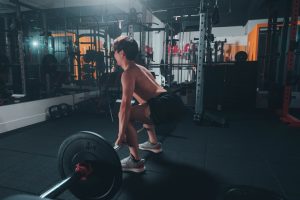
The five exercises that target the inguinal crease muscle are supine psoas marches, active straight leg raises, Copenhagen planks, hanging leg raises, and transversus abdominis draw-ins.
Keep reading for detailed instructions on how to perform each movement correctly, why they work, and how to program them into your training routine for stronger hips, better core stability, and reduced injury risk.
What the Inguinal Crease Actually Is
Despite what fitness culture suggests, the “inguinal crease muscle” isn't a muscle at all.
What you see when you look at that distinct line where your thigh meets your lower abdomen is actually a surface landmark created by the inguinal ligament—a tough band of connective tissue running from the anterior superior iliac spine at your hip bone down to the pubic tubercle.
You might also hear it called the hip crease, inguinal fold, or simply the V-line.
Here's the important part: you can't train this ligament directly because ligaments don't contract like muscles do.
However, several muscles either pass underneath it, attach to it, or originate from structures right next to it.
When people talk about strengthening the inguinal crease, they're really talking about these five muscles:
The iliopsoas—a combination of your psoas major and iliacus—serves as your body's strongest hip flexor and runs directly beneath the inguinal ligament into your anterior thigh.
Just below and toward the inside of the crease sits the pectineus, a flat, quadrangular muscle that works as both a hip flexor and adductor.
The sartorius, which happens to be the longest muscle in your entire body, originates right at the lateral anchor point of the inguinal ligament and contributes to hip flexion, abduction, and external rotation.
The adductor longus starts from the pubic bone at the medial end of the crease region—this is the muscle most people strain when they talk about pulling a groin muscle.
What makes the transversus abdominis unique among these is that it's the only major muscle that directly attaches to the inguinal ligament itself.
This deep abdominal muscle literally anchors into the lateral portion of the ligament, which is why targeted TVA work matters for this region.
Together, these muscles create the borders and floor of what anatomists call the femoral triangle, the region sitting directly beneath your inguinal crease.
Any effective training program for this area needs to address three key movement patterns: hip flexion, adduction, and deep core stabilization.
Exercise 1: The Supine Psoas March Builds the Deepest Hip Flexors
This is the foundational movement for building real inguinal crease strength. The supine psoas march directly and intensely activates both the iliopsoas and pectineus—the two muscles most central to this region.
Research shows that supine hip flexion exercises produce greater than 60% maximal voluntary isometric contraction of the iliopsoas, while the pectineus reaches peak activation of 62.8% during this movement. That's the highest activation recorded for the pectineus across all tested exercises.
How to perform it: Lie flat on your back with both legs extended. Engage your core by gently pressing your lower back into the floor.
Slowly draw one knee toward your chest as far as you comfortably can while keeping the opposite leg straight and pressed firmly against the ground. Hold the top position for 3 to 5 seconds, then lower with control. Alternate sides.
To increase difficulty, loop a resistance band around both feet. This setup forces the stationary leg's hip flexors to work isometrically while the moving leg works concentrically, doubling the training stimulus.
Focus on these form cues. Keep your lower back in contact with the floor throughout the entire movement—if it arches, you've pushed beyond your current strength level.
Think about pulling your thigh into the hip socket rather than simply lifting your knee upward.
Exhale as you lift. Rotating your knee slightly outward at the top of the movement shifts recruitment more toward the pectineus and iliopsoas over other hip flexors.
Watch out for these common mistakes:
- Arching your lower back, which shifts the workload away from the deep hip flexors and onto your lumbar spine
- Using momentum instead of slow, controlled flexion
- Letting the straight leg bend or lift off the floor, which reduces the stabilization challenge for your core and opposite hip
Programming approach: Perform 2 to 3 sets of 8 to 12 repetitions per side with 3- to 5-second holds at the top. Train this exercise 2 to 3 times per week.
Progress by adding a resistance band first, then ankle weights, then combine it with dead bug arm movements for an additional core challenge.
Precautions: Avoid this exercise if you have an active inguinal hernia. Stop immediately if you feel sharp pain in your hip joint or groin, as this could indicate a labral tear or impingement.
Those with hip labral pathology should consult a physical therapist before performing this movement.
Exercise 2: Active Straight Leg Raises Intensify the Demand
The active straight leg raise is a natural progression from the psoas march. What changes here is the lever arm—keeping your knee extended throughout the movement dramatically increases the challenge.
This extended position demands significantly more from your iliopsoas, rectus femoris, pectineus, and sartorius all at once.
The rectus femoris stays under continuous load while your iliopsoas drives hip flexion against a much longer moment arm.
This exercise is trusted enough to be included in the AAOS hip conditioning program as a standard rehabilitation movement.
How to perform it: Lie on your back with one knee bent and that foot flat on the floor. Extend the opposite leg fully. Tighten your abdominals to stabilize your pelvis.
Keeping the working leg completely straight, raise it upward until your thigh aligns with the opposite bent knee—roughly 45 to 60 degrees of hip flexion.
Hold for a count of 2 at the top, then lower over 3 to 5 seconds. Repeat for the prescribed repetitions, then switch sides.
The lift must originate from your hip, not from swinging or using momentum. Press your lower back gently into the floor before beginning each repetition.
Pointing your toes slightly outward shifts recruitment toward the pectineus and deeper hip flexors. Keep the non-working leg firmly pressed against the ground with the glute engaged.
Common mistakes to avoid:
- Arching your lower back as the leg rises—this indicates inadequate core engagement
- Bending the working knee, which reduces the challenge and shifts effort to the quadriceps
- Lifting too quickly, sacrificing time under tension and reducing muscle activation
- Failing to engage the core before initiating the lift, which allows the pelvis to tilt anteriorly
Programming: Perform 3 sets of 10 to 15 repetitions per side. Start with bodyweight only, then add ankle weights in 1-pound increments as strength improves. Train 2 to 3 times per week on non-consecutive days.
Precautions: This exercise is contraindicated immediately after hip surgery unless you've been explicitly cleared by your physician.
Stop if you experience groin pain, clicking, or snapping at the hip. If you have lower back issues, you must ensure proper core engagement to prevent lumbar hyperextension.
Exercise 3: Copenhagen Planks Are the Gold Standard for Inner Crease Muscles
The Copenhagen plank holds the strongest research backing of any exercise targeting the adductors and pectineus—the muscles running along the medial, or inner, portion of the inguinal crease.
It produces the highest adductor longus EMG activation of any adductor exercise examined in research.
More practically, adding Copenhagen exercises to warm-up programs significantly reduced groin injury prevalence in male soccer players. An 8-week Copenhagen program increases eccentric hip adduction strength by 35.7%.
Beginner version: Lie on your side with your bottom elbow bent at 90 degrees, positioned directly under your shoulder.
Place your top leg, bent at the knee, on a bench or sturdy chair so the inner knee rests on the surface. Your bottom leg hangs freely below.
Lift your hips off the ground into a side plank position, using the adductors of the top leg to support your weight.
Then lift your bottom leg upward to touch the top leg's knee. Lower the bottom leg without touching the floor. Repeat.
Advanced version: Same setup, but support the top leg at the foot or ankle on the bench, keeping it fully extended. The bottom leg is also fully extended.
Lift your hips into a side plank, then raise and lower the bottom leg with a 3-second lowering phase each repetition.
This long-lever position dramatically increases the demand on the entire adductor group and obliques.
Maintain a perfectly straight line from shoulders through hips—no sagging or piking.
Avoid any rotation of the hips or shoulders. Use a slow, controlled tempo of 3 seconds up and 3 seconds down. Keep the bottom leg straight throughout.
Watch for these errors: Sagging the hips toward the ground is the most common mistake and reduces adductor engagement.
Over-relying on the support arm instead of the top leg's adductors defeats the purpose.
Allowing the torso to twist or slouch compromises core activation. Bending the top leg in the advanced version reduces the lever arm and lowers difficulty prematurely.
Programming: Beginners should start with 3 to 4 sets of 10- to 20-second isometric holds using the short-lever knee version.
Progress to 2 to 3 sets of 6 to 15 dynamic repetitions, 2 to 3 times per week. The advanced long-lever version can be built to 3 sets of 10 to 15 reps over 6 to 8 weeks.
Precautions: This exercise requires baseline hip and core strength—jumping to the advanced version prematurely risks adductor strain.
If the exercise causes groin pain during or lasting more than 1 to 2 days after, regress to an easier variation. Avoid entirely during an active adductor strain or acute groin injury.
Exercise 4: Hanging Leg Raises Challenge the Entire Anterior Hip Chain
This is an advanced compound movement that intensely loads the iliopsoas through its full range of hip flexion while demanding significant core stabilization at the same time.
What makes hanging leg raises uniquely challenging is that your body hangs freely—your hip flexors must work against gravity through a large arc of motion with no mechanical assistance.
The exercise recruits the iliopsoas, rectus femoris, sartorius, and your full abdominal wall, making it one of the most comprehensive inguinal crease exercises available.
How to perform it: Hang from a pull-up bar with a secure overhand grip and your shoulder blades engaged, pulled slightly down and back.
You have two variations to choose from based on your current strength level:
Knee raise variation (easier): Flex your hips and knees together, raising your knees above hip level. Hold briefly at the top, then lower under control.
Straight leg variation (harder): Keep both legs fully extended and raise them through hip flexion until they reach approximately 90 degrees. Lower slowly over 3 to 4 seconds. Avoid any swinging or momentum.
Engage your core throughout to prevent your lower back from arching. Initiate the movement from your hip flexors, not from swinging your legs.
Keep the movement slow and deliberate—a 2-second lift and 3- to 4-second lowering tempo is ideal.
Maintain shoulder blade engagement to protect your shoulder joints. Breathe steadily and exhale during the lift.
Common mistakes include: Using momentum or swinging, which transfers effort away from the hip flexors and onto the shoulders and lats.
Arching your lower back indicates your core cannot stabilize your pelvis at that range of motion—regress to bent-knee raises if this happens.
Incomplete range of motion, meaning not lifting high enough, limits iliopsoas activation. Grip failure can cut sets short; use lifting straps if needed.
Programming: Perform 2 to 3 sets of 8 to 15 reps, 2 to 3 times per week.
Start with knee raises and progress to straight-leg raises over several weeks. For further progression, hold a light dumbbell between your feet or add ankle weights.
Precautions: This exercise is not recommended for those recovering from hip, shoulder, or wrist injuries. It requires adequate grip strength and shoulder stability.
If you experience a pinching sensation at the front of your hip—possible femoroacetabular impingement—reduce your range of motion or switch to a supine variation.
Exercise 5: TVA Draw-Ins and Safety Considerations

TVA Draw-Ins Strengthen the Ligament's Only Direct Muscular Attachment
The transversus abdominis draw-in is unique among inguinal crease exercises because the TVA is the only major muscle that directly attaches to the inguinal ligament.
While the other exercises target muscles that pass near or under the inguinal crease, this movement strengthens the muscle whose fibers literally anchor into the ligament itself.
The TVA is your body's deepest abdominal muscle and plays a critical role in lumbar spine stabilization, intra-abdominal pressure regulation, and—at low body fat levels—the visible definition of the inguinal V-line.
How to perform it: Lie on your back with knees bent and feet flat on the floor. Take a complete exhale, expelling all air.
Draw your belly button inward toward your spine as deeply as you can, creating a “hollowing” of the lower abdomen.
You should feel tension deep in the lower belly, below the navel, near the inguinal area. Hold this contraction for 5 to 10 seconds while breathing shallowly. Release gently and repeat.
This is a soft, deep contraction—not a crunch or a forceful brace. Your rib cage should not lift; the movement is entirely internal.
Keep your shoulders and upper back completely relaxed. You should be able to maintain light breathing while holding the contraction.
Learn the movement on your back first, as it's too easy for the rectus abdominis and external obliques to compensate in other positions.
Common mistakes to watch for: Performing a crunch instead of a draw-in is the most frequent error—the rectus abdominis should remain relaxed while the deep TVA engages.
Holding your breath entirely rather than maintaining shallow breathing reduces effectiveness and increases intra-abdominal pressure unnecessarily.
Rushing through repetitions undermines the neuromuscular connection this exercise is designed to build. Tensing the pelvic floor excessively can accompany TVA activation but should not be the primary focus.
Programming: Perform 3 to 5 sets of 10 repetitions with 5- to 10-second holds.
This exercise can be performed daily because the TVA recovers quickly and responds well to frequent low-intensity activation.
Progress by performing the draw-in while seated, then standing, then integrating it as a base activation during planks, squats, and other compound movements.
Precautions: If you have an existing inguinal hernia, consult your doctor before performing this exercise, as increasing tension around the inguinal canal could potentially aggravate symptoms.
This exercise is not recommended during acute lower back pain flare-ups without guidance from a physical therapist. Stop if you feel discomfort in the groin area.
Key Safety Considerations and Broader Benefits
Several important safety factors apply to all inguinal crease training. Anyone with an existing or suspected inguinal hernia—which carries a lifetime risk of 27% in men and 3% in women—should consult a surgeon before beginning these exercises.
Exercises that dramatically increase intra-abdominal pressure, such as heavy deadlifts or breath-held crunches, should be avoided in that population.
Femoroacetabular impingement is a common cause of groin pain in adults ages 20 to 45.
It presents as a pinching sensation at the hip crease during deep flexion. If this occurs during any exercise, reduce your range of motion immediately and seek evaluation.
The benefits of strengthening the inguinal crease muscles extend well beyond aesthetics.
Strong hip flexors improve running speed and stride length. Research shows that targeted hip-flexor training performed 3 times per week for just 10 minutes per session produces substantial strength gains within 6 weeks.
Strong adductors, built through exercises like the Copenhagen plank, significantly reduce groin injury risk in athletes.
The iliopsoas stabilizes the lumbar spine and hip joint, meaning well-conditioned inguinal crease muscles contribute to reduced lower back pain and improved posture.
A balanced approach—strengthening both the hip flexors and their antagonists like the glutes and hamstrings—prevents the anterior pelvic tilt and Lower Crossed Syndrome that plague people who sit for extended periods.
Training these movements 2 to 3 times per week with progressive overload over a minimum of 6 to 8 weeks will produce measurable strength gains.
However, visible definition of the inguinal crease itself depends primarily on body fat levels, typically requiring 6 to 13% body fat, meaning nutrition and overall conditioning must accompany targeted exercise.
Key Safety Considerations and Broader Benefits
Anyone with an existing or suspected inguinal hernia should consult a surgeon before beginning these exercises. The lifetime risk stands at 27% for men and 3% for women, making this a common concern.
If you fall into this category, avoid exercises that dramatically increase intra-abdominal pressure—heavy deadlifts and breath-held crunches are the primary culprits.
Femoroacetabular impingement is another common issue, particularly in adults ages 20 to 45. It presents as a pinching sensation at the hip crease during deep flexion.
If you experience this during any of the five exercises, reduce your range of motion immediately and seek evaluation from a healthcare provider.
The benefits of strengthening these muscles extend well beyond aesthetics.
Strong hip flexors directly improve running speed and stride length. Research demonstrates that targeted hip-flexor training performed just 3 times per week for 10 minutes per session produces substantial strength gains within 6 weeks.
Strong adductors, built through exercises like the Copenhagen plank, significantly reduce groin injury risk in athletes—a critical factor if you play any sport involving lateral movement or kicking.
The iliopsoas stabilizes both the lumbar spine and hip joint, which means well-conditioned inguinal crease muscles contribute to reduced lower back pain and improved posture.
However, you need balance. Strengthening both the hip flexors and their antagonists—the glutes and hamstrings—prevents anterior pelvic tilt and Lower Crossed Syndrome, the postural dysfunction that plagues people who sit for extended periods.
Training these five movements 2 to 3 times per week with progressive overload over a minimum of 6 to 8 weeks will produce measurable strength gains.
But here's the reality about visible definition: the inguinal crease itself becomes visible primarily based on body fat levels, typically requiring 6 to 13% body fat.
This means nutrition and overall conditioning must accompany your targeted exercise work. You can build incredibly strong hip flexors and adductors without ever seeing a defined V-line if your diet doesn't support fat loss.
Conclusion
The five exercises presented here—supine psoas marches, active straight leg raises, Copenhagen planks, hanging leg raises, and TVA draw-ins—collectively address every muscle group surrounding the inguinal crease through hip flexion, adduction, and deep core stabilization.
Commit to training these movements 2 to 3 times per week with proper form and progressive overload, and you'll build measurable strength within 6 to 8 weeks.
Remember that visible definition depends on lowering your body fat through nutrition and conditioning, not just targeted exercise alone.