The best skinny man transformation plan comes down to three things done consistently: eating 300–500 calories above what your body burns daily, training compound lifts 3–4 days a week with progressive overload, and sleeping 7–9 hours every night — with creatine monohydrate as the one supplement worth adding.
Keep reading for the exact numbers, meal strategies, training programs, and recovery habits that turn that simple formula into real, measurable muscle.
Why Skinny Guys Struggle to Build Muscle (And What's Actually Going On)
If you've ever eaten what felt like a huge amount of food and still not gained weight, you're not imagining things — your body is genuinely working against you.
Skinny guys tend to have higher NEAT, or non-exercise activity thermogenesis, which is the energy your body burns through everyday movement like fidgeting, pacing, and general restlessness.
This happens unconsciously, and it can burn up to 700 extra calories a day when you're overfed. That's nearly an entire extra meal your body is quietly torching before you even step into a gym.
The other half of the problem is perception. Most hardgainers are convinced they eat a lot — until they actually track it. Research shows skinny guys underestimate their caloric intake by 20–30%, which means what feels like a solid day of eating often falls well short of what's needed to gain weight.
The fix isn't eating “more” in a vague sense; it's knowing your exact numbers and hitting them every day.
Here's the thing though: your training is probably not the problem. The bottleneck for almost every skinny guy who isn't growing is calories, not programming.
A decent training plan in a proper caloric surplus will outperform even the most perfectly designed program if you're undereating.
Being a hardgainer is a real metabolic reality, but it's entirely solvable — it just means your nutritional approach needs to be more deliberate and aggressive than it would be for someone with a slower metabolism.
How to Eat for Muscle Gain When You Have a Fast Metabolism
Start with your Total Daily Energy Expenditure. Use the Mifflin-St Jeor equation to find your baseline: BMR = (10 × weight in kg) + (6.25 × height in cm) − (5 × age) + 5, then multiply by your activity factor — 1.2 if you're mostly sedentary, 1.55 for moderate activity.
Once you have that number, add 300–500 calories on top. For most skinny guys in their late teens to mid-twenties, this lands somewhere between 2,800 and 3,500 calories a day.
Track everything using an app like MyFitnessPal or MacroFactor, weigh yourself every morning, use weekly averages, and adjust by 100–200 calories every 2–3 weeks based on the trend.
Your macro targets, in order of priority:
- Protein: 1 gram per pound of bodyweight daily, split across 4–6 meals with 20–40g per serving
- Carbohydrates: 4–6 g/kg/day — these are your primary training fuel, not the enemy
- Fats: 20–30% of total calories, with a minimum of 0.5 g/kg for hormonal health
Protein is the one number you can't shortchange. Beyond roughly 0.73 grams per pound of bodyweight daily, additional protein stops meaningfully increasing muscle gain — but you still want to hit that gram-per-pound target as a practical buffer to ensure you're covered.
The scale should be moving at 0.5–1.0 pound per week. If you're gaining faster than that consistently, your surplus is too aggressive and fat is accumulating faster than muscle.
Slower is actually better here — research shows slower gainers build similar muscle with significantly less fat than those bulking too aggressively.
Two practical strategies that make a real difference:
Liquid calories. A single shake made with 2 scoops of whey protein, 2 cups of whole milk, a banana, 2 tablespoons of peanut butter, and half a cup of oats delivers 800–1,000 calories and around 65 grams of protein.
One or two of these daily, alongside regular meals, can close a significant caloric gap without making you feel stuffed.
Eating by the clock. Don't wait until you're hungry — hardgainers with small appetites often go hours without eating and wonder why the scale doesn't move. Set an alarm every 2.5–3.5 hours and eat on schedule.
Before bed, take in 30–40 grams of casein protein, which research shows increases overnight muscle protein synthesis by around 22% without affecting fat metabolism.
The Training Structure That Builds Muscle on a Skinny Frame
Train each muscle group twice a week. Research consistently shows this is the sweet spot for beginners — enough frequency to accumulate meaningful volume without overwhelming recovery.
In practice, that means either a full-body program three days a week or an upper/lower split four days a week. Both work; the best choice is whichever one you'll actually stick to.
Volume targets to build toward:
- Starting point: 10–12 hard sets per muscle group per week
- After several months: 15–20 sets as your work capacity improves
- Approach: Start near the low end and add sets gradually — jumping straight to 20 sets is a fast track to burnout
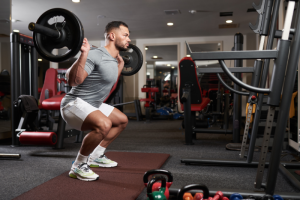
Your program should be built around compound lifts. Squats, bench press, deadlifts, overhead press, barbell rows, and chin-ups recruit the most muscle mass per movement and allow the heaviest loading — that combination of mechanical tension and progressive overload is what actually drives growth. Everything else is secondary.
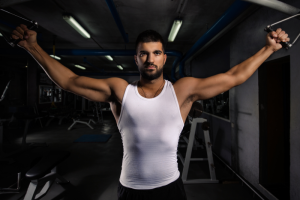
If you're on the taller, longer-limbed side, pay attention to how your body responds to compounds. Ectomorphs with longer limbs often get less muscle activation from movements like rows and presses simply due to leverage disadvantages, which means isolation work — curls, lateral raises, tricep extensions — isn't just vanity. It's a practical gap-filler.
Rep ranges by lift type:
- Main compounds: 6–12 reps per set
- Heavy strength work: 3–5 reps to build the foundation
- Isolation accessories: 12–20 reps
The rep range matters less than effort level. Studies show similar muscle growth occurs anywhere from 5 to 30 reps per set, as long as you're pushing close to failure. Pick a range that lets you train hard and recover well.
Rest periods are worth taking seriously. Give yourself 2–5 minutes between heavy compound sets — cutting this short compromises performance on the next set and reduces your total quality volume.
For isolation work, 60–90 seconds is enough. Finally, keep cardio to one or two low-intensity sessions per week, like walking. Anything more aggressive starts burning the very calories you're working hard to consume and compete with the recovery your muscles need.
Progressive Overload — The Only Way to Keep Growing

Your body only builds muscle when it has a reason to. Without steadily increasing the demands you place on it — more weight, more reps, more sets — adaptation stops. This is progressive overload, and it's the single mechanism that separates a training program from just going through the motions.
As a beginner, the approach is straightforward: add 5 pounds to upper body lifts and 10 pounds to lower body lifts every session. That's it. This linear progression works remarkably well for roughly 3–6 months before the easy gains slow down. When progress stalls, you have a few options — add reps at the same weight, add sets over time, or move into periodized programming that varies intensity across weeks.
Two programs worth running:
GZCLP (Cody Lefever) is the strongest recommendation for hardgainers. It uses a three-tier structure:
- T1: Heavy compound lifts at 5×3 for strength
- T2: Moderate compound lifts at 3×10 for hypertrophy volume
- T3: Accessories at 3×15 for targeted muscle development
This structure gives you genuine strength work, meaningful volume, and full flexibility to add the arm and shoulder work that builds a proportional physique on a narrow frame. Its stall protocol is also smarter than most — rather than simply resetting weight, it cycles through rep schemes (5×3 → 6×2 → 10×1) before backing off, squeezing more linear progress out of each weight. Sessions run about 60 minutes, three to four days a week.
5/3/1 for Beginners (Jim Wendler) is the better choice if longevity and injury prevention are priorities. It trains at submaximal loads based on 90% of your true one-rep max, uses AMRAP sets to auto-regulate effort, and programs 50–100 reps of push, pull, and single-leg or core assistance work each session. Progression is slower — 5 pounds per cycle on upper lifts, 10 on lower — but the program runs productively for 6–12 months or longer without burning you out.
Pick one and commit to it for a minimum of 3–6 months. Program hopping is one of the most common ways skinny guys stall — no program produces results if it's abandoned before adaptation has a chance to happen.
Sleep, Recovery, and the Hormonal Side of Muscle Growth
Training creates the stimulus for muscle growth. Food provides the raw materials. Sleep is when the actual construction happens — and most skinny guys treat it as optional.
The numbers make a compelling case for taking it seriously. A single night of total sleep deprivation reduces muscle protein synthesis by 18%, raises cortisol by 21%, and drops testosterone by 24%.
Even chronic mild sleep restriction does serious damage: people sleeping 5.5 hours lose 60% more muscle mass than those sleeping 8.5 hours — on the exact same diet. You can't eat or train your way out of poor sleep.
The target is 7–9 hours every night. Growth hormone, which drives muscle repair, is released primarily during deep slow-wave sleep in the early hours of the night.
Cut sleep short and you're cutting that release window — shifting your hormonal environment away from muscle building and toward breakdown.
Practical sleep habits that actually move the needle:
- Keep your room cool, around 65°F (18°C), and as dark as possible
- Stick to a consistent sleep and wake schedule within 30 minutes, even on weekends
- Stop caffeine after 2 PM — its half-life is 5–6 hours, meaning an afternoon coffee is still partially active at midnight
- Limit alcohol — it suppresses REM sleep and blunts growth hormone release, directly undermining overnight recovery
Deloading is recovery, not weakness. Every 4–8 weeks, pull training volume back by 30–50% for one week. Research shows a mid-block deload produces equivalent muscle and strength gains with 25% fewer total sessions.
Watch for signs that one is overdue: persistent soreness between sessions, strength going backwards, disrupted sleep, or a disappearing appetite — that last one is particularly costly for hardgainers.
Stress management deserves a mention here too. Chronically elevated cortisol — whether from overtraining, poor sleep, or life pressure — actively breaks down muscle tissue and impairs adaptation.
Regular moderate exercise, adequate sleep, and basic stress outlets like walking or social connection keep cortisol in a range where your body can actually build rather than break down.
The Only Supplement Worth Your Money (And Realistic Expectations)
The supplement industry targets skinny guys specifically because the desire to speed up results makes for an easy sale. The reality is short: one supplement has genuine, well-replicated evidence behind it. Everything else is largely a waste of money.
Creatine monohydrate is the one. Take 3–5 grams daily, every day. No loading phase is necessary, though loading at 20g/day for 5–7 days reaches saturation faster if you want a quicker start. It's cheap, proven safe in studies running up to five years, and confirmed to increase fat-free mass in both trained and untrained lifters.
The 1–3 pounds of initial water retention it causes is intramuscular — it actually makes muscles look fuller, which for a skinny guy is a welcome side effect. It must be creatine monohydrate specifically; no other form has been shown to work better.
What else is worth considering:
- Protein powder: A convenient food, not a magic supplement. Whey works well in shakes and post-workout due to its fast digestion and high leucine content. Use it to fill gaps in your daily protein target, not as a replacement for real meals.
- Vitamin D: Worth adding at 2,000–6,000 IU of D3 daily if your blood levels fall below 30 ng/mL. Deficiency impairs type II muscle fiber function and reduces strength — common in people who train indoors or live at higher latitudes.
- Caffeine: 3–6 mg/kg taken 60 minutes before training modestly improves both strength and endurance. Useful, but only if it doesn't cut into sleep quality. The trade-off is never worth it.
Skip all of these:
- BCAAs: Redundant if you're hitting your protein target. Whey protein is already 25% BCAAs.
- Testosterone boosters: A review of 50 products found only 24.8% of ingredients had any data supporting increased testosterone — and 10.1% of ingredients actually decreased it.
- Mass gainers: Overpriced combinations of sugar and maltodextrin. The homemade shake from the nutrition section costs a fraction of the price and delivers better ingredients.
- Glutamine: Absorbed by the gut before it reaches muscle tissue. No meaningful benefit for healthy lifters.
Setting realistic expectations matters as much as any supplement. In your first year of consistent training and eating, you can realistically gain 20–25 pounds of muscle.
Visible changes typically appear at 8–12 weeks — the point where others start noticing — with dramatic shifts possible within 6–12 months. After year one, the rate slows: roughly 10–12 pounds in year two, 5–6 in year three, and 2–3 pounds annually beyond that.
One benchmark worth keeping in mind: the natural fat-free mass index (FFMI) ceiling sits at around 25 for even genetically gifted lifters.
Many of the dramatic transformations circulating on social media exceed this — an estimated 6.4% of young men globally use anabolic steroids, and a significant portion of “natural” transformation posts are chemically assisted. Measure your progress against where you started, not against someone else's highlight reel.
Conclusion
Building muscle as a skinny guy isn't complicated — eat 300–500 calories above maintenance with at least 1 gram of protein per pound of bodyweight, train compound lifts 3–4 days a week with progressive overload, and protect your sleep like it's part of the program, because it is.
Add 3–5 grams of creatine daily, pick either GZCLP or 5/3/1 for Beginners, and run it consistently for months without second-guessing the process.
The first year delivers the biggest returns of your entire lifting career — 20–25 pounds of muscle is within reach, but only if you stop searching for a better plan and start executing the one you have.