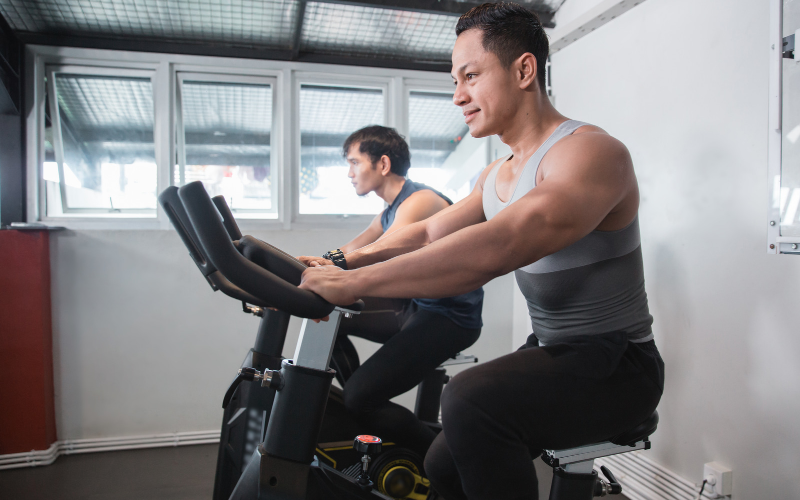
Worried that your morning run or bike ride might undo the work you put in at the gym?
For most people, the answer is no: adding a moderate amount of cardio to a solid lifting program doesn’t measurably reduce muscle growth, though a few exceptions exist, so keep reading for a more detailed explanation.
What the Research Says About Cardio and Muscle Growth
Combining endurance work with lifting is called concurrent training, and the “interference effect” is the idea that it blunts your results compared with lifting alone.
The concept goes back to a 10-week study in 1980, where the group that did both developed less strength than the lifting-only group. That finding shaped gym advice for decades, but later research has shrunk it considerably.
The meta-analyses, in order
The first large meta-analysis pooled 21 studies and 422 effect sizes. It reported hypertrophy gains of 1.23 for lifting alone, 0.85 for concurrent training, and 0.27 for endurance alone.
Keep in mind that these are changes within each group, so you can’t compare them directly with the later figures below.
The key detail is that the overall hypertrophy difference between lifting-only and concurrent groups wasn’t significant. Only the running subgroup showed a drop, with an effect size of 0.68 versus 1.54 for matched lifting-only groups.
The largest update came later, covering 43 studies and 1,090 participants. Across the 15 studies that measured hypertrophy (389 participants), the difference between groups was −0.01, with zero heterogeneity, meaning the results were consistent from study to study. Maximal strength was also unaffected (−0.06).
A 2026 umbrella review then pulled together 17 meta-analyses covering 144 studies and 1,492 participants. It called the hypertrophy difference trivial (−0.04) and highly stable, while aerobic capacity improved clearly (0.77). So you gain fitness without giving up muscle.
Why the old theory fell short
The theory behind the interference effect sounded convincing. Cardio switches on AMPK, an energy sensor in your cells, and AMPK was thought to shut down mTOR, the pathway that drives muscle building. Most of that evidence came from rodent and cell studies.
Human studies mostly don’t back it up. In one trial, people who combined cardio with lifting grew more muscle than those who only lifted (6% vs 3%), even though their AMPK activity was higher.
Bottom line: at the level you can actually measure, the average penalty for adding cardio is close to zero.
Where Cardio Can Still Get in the Way
The near-zero average hides a few real exceptions. They’re modest, but they matter depending on your goals and training level.
Muscle fiber size
A meta-analysis of 15 biopsy studies (300 participants) found a small negative effect of concurrent training on fiber growth (−0.23).
The effect was larger in type I fibers (−0.34) than in type II (−0.13). It’s unclear why fiber-level results differ from whole-muscle results.
Small biopsy samples and whole-muscle measurements that are too coarse to catch small differences are both possible explanations.
Strength and power
- Explosive strength: Gains dropped (−0.28), mainly when cardio and lifting happened within 20 minutes of each other (−0.31). Separating them by at least 3 hours removed the effect.
- Lower-body strength: Trained lifters had impaired leg 1RM gains in same-session designs (−0.66), but moderately trained and untrained people didn’t. Another large review found a small effect in males but not in females.
Very high endurance volume
Well-trained cyclists who added strength work to heavy endurance training for 12 weeks saw blunted hypertrophy, strength, and power.
Professional road cyclists rarely build substantial muscle at all. Most studies use modest cardio doses, so the “no effect” findings may not apply to endurance-athlete workloads.
What the research can’t tell you yet
Most studies run short (10.4 weeks on average) and recruit untrained or recreational participants, so long-term effects in advanced lifters are largely unknown. If you’re a beginner, you have little reason to worry.
Does the Type of Cardio Matter?

The early meta-analysis found that running, but not cycling, reduced hypertrophy and strength. The usual explanation is that running involves more eccentric loading and muscle damage, while cycling is mostly concentric and closer to the movements you use in lifting. Later evidence doesn’t settle the question cleanly.
Running vs. cycling
One fiber-level analysis found a negative effect on type I fibers with running (−0.81). That estimate rested on only three studies, though, and the difference between running and cycling subgroups wasn’t statistically significant. The largest update found no difference between cycling and running for whole-muscle growth.
HIIT
A review of 14 studies (263 participants) found that HIIT combined with lifting produced similar muscle growth and upper-body strength to lifting alone, but a smaller lower-body strength gain (−0.248).
Within that analysis, cycling HIIT trended worse than running HIIT, which is the opposite of the earlier running finding.
Another trial found that HIIT blunted leg lean-mass gains while moderate continuous cycling did not, although the difference was small. The umbrella review, meanwhile, found no significant effect of intensity.
Other types of cardio
Swimming, rowing, walking, and elliptical work haven’t been tested directly for hypertrophy. Claims that they interfere least are plausible but unproven.
Bottom line: the evidence doesn’t support strong rules. Choosing cycling or another low-impact option for leg-heavy cardio is a cheap hedge, not a requirement.
How Much Cardio Is Too Much?
No one has validated a threshold for when cardio starts to blunt muscle growth. What exists is a mix of correlations and mixed findings.
What the early analysis suggested
The first large meta-analysis linked longer sessions (r = −0.75) and higher frequency (r = −0.26) to smaller lower-body growth. Based on that, it advised avoiding long sessions (over 20–30 minutes) more than 3 days per week. Those are correlations, though, not tested cut-points.
What the larger update found
The larger update didn’t confirm those relationships. Comparing roughly 4 versus 6 weekly sessions showed no hypertrophy difference.
A separate fiber-level analysis found that session count explained 34.6% of the variation in type I fiber results, but its low- and high-frequency groups (about 4.5 vs 6.3 sessions a week) didn’t differ significantly.
Where this leaves you
The range most studies cover, two to three sessions a week of 20 to 60 minutes, showed no detectable interference with whole-muscle growth.
Bottom line: risk likely rises with much longer weekly duration, especially long sessions most days, but the tipping point isn’t known.
Timing, Sequencing, and Eating Enough
When you schedule cardio matters less for muscle size than you might expect. Food intake turns out to matter more than either timing or order.
Timing
For muscle size alone, same-session, same-day, and different-day training showed no significant difference. In the early meta-analysis, for example, same-day training produced an effect size of 0.80 versus 1.06 for separate days, and that gap wasn’t significant.
Separation matters more for strength and power. In one study of 58 amateur rugby players, 24 hours between strength and aerobic work gave the best combined results, 6 hours came second, and no gap at all was worst. The authors advised against scheduling less than 6 hours between contradictory training qualities.
Order within a session
If cardio and lifting have to share a session, lifting first improved lower-body dynamic strength (6.91%) but had no effect on lower-body hypertrophy (1.15%). The umbrella review found no significant order effect, though the trends favored lifting first.
Eating enough
Energy intake is the most overlooked factor. A meta-analysis found that lean-mass gains were impaired in an energy deficit (−0.57) while strength gains weren’t, and a deficit of about 500 kcal per day prevented lean-mass gains altogether.
No concurrent-training analysis controls for food intake, so underfeeding may explain some of the interference blamed on cardio.
Cardio adds energy expenditure, which means a lifter who adds it without eating more can lose growth potential through the deficit rather than through the cardio itself.
The same logic helps explain why professional cyclists, with their huge energy demands, rarely build much muscle.
Bottom line: eat enough to cover the extra cardio, and treat timing and order as secondary adjustments.
A Practical Plan for Adding Cardio to Your Lifting
You don’t need to skip cardio out of fear. At moderate doses, there’s no measurable muscle penalty and a clear aerobic benefit. These steps help you keep both.
Set up your week
- Keep volume moderate. Aim for two to three sessions a week of roughly 20 to 40 minutes. If you want to do more, scale up gradually and watch your lifting performance for signs that it’s slipping.
- Pick the right mode. For longer leg-focused sessions, choose cycling or another low-impact option.
- Separate cardio and leg training. Leave at least 3 hours between them, ideally 6 or more, or put them on different days. If they must share a session, lift first.
- Use HIIT sparingly. Avoid placing it right before heavy leg work.
- Eat enough. Cover the added energy cost of your cardio, and avoid sustained deficits of about 500 kcal per day or more.
Adjust for your situation
- Trained lifters: Prioritize separation, moderate volume, and adequate food. Small penalties have mostly been detected in this group.
- Endurance athletes: Strength training can raise strength and maintain muscle, but substantial hypertrophy is unlikely at very high volumes.
Individual response varies, so track your lifts and body measurements over a few weeks and adjust from there.
Conclusion
Cardio and muscle growth aren’t the opponents they’re often made out to be. The interference effect is real, but it’s narrow: it shows up mainly with very high endurance volumes, in explosive strength, at the level of individual fibers, and when you’re eating too little.
For most lifters, moderate cardio, sensible scheduling, and enough food are all it takes to keep both goals on track.