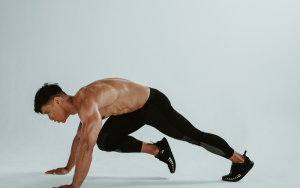
If you're wondering exactly how long to hold a stretch, the answer is about 30 seconds per hold, done 2-4 times per muscle.
Keep reading for the full breakdown of how this changes based on your goals, age, and the type of stretching you're doing.
The Short Answer — What 30 Years of Research Points To
Decades of research on stretch duration keep landing on the same number. Studies comparing 15, 30, and 60-second holds found that 30 seconds consistently produces greater gains in range of motion than 15 seconds, but stretching for a full minute doesn't add anything extra for healthy young adults. That extra 30 seconds is essentially wasted time.
More recent research has shifted the entire framing of the question. Instead of asking “how long should one stretch last,” the better question is “how much total stretching time am I accumulating.”
A large 2025 meta-analysis covering nearly 200 studies and over 6,600 adults found that flexibility gains max out at:
- About 4 minutes of total stretching per muscle, per session
- Roughly 10 minutes per muscle, per week
Once you hit those totals, additional stretching produces no further benefit. This means the exact split between reps and hold times matters far less than people assume.
Six 10-second holds produce results comparable to two 30-second holds, as long as the total time adds up to the same number. Whether you prefer fewer, longer holds or more, shorter ones is largely a matter of personal preference.
There's also a practical ceiling on how many reps are worth doing. Most of the actual muscle-lengthening effect happens within the first two to four repetitions of a stretch.
Piling on additional sets beyond that point delivers diminishing returns, so a moderate rep count is all you need to capture nearly all the available benefit.
Does the Ideal Stretch Time Change Based on Your Goal?
The 30-second rule works well as a general default, but it's not universal. How long you should hold a stretch really depends on what you're trying to accomplish, since flexibility training, warming up, and cooling down all place different demands on your muscles.
Building long-term flexibility. This is where the standard 30-second guideline applies most directly. Hold each stretch for about 30 seconds, accumulate a few minutes of total stretching per muscle, and repeat this most days of the week. Consistency matters more here than any single session.
Warming up before a workout. This is where static stretching becomes counterproductive if overdone. Holding a stretch for too long right before lifting, sprinting, or jumping can temporarily dampen strength and power output. The safer approach is to keep any static holds brief, or skip them entirely and rely on dynamic movement instead, since moving through a range of motion warms up muscles without the performance cost.
Cooling down after exercise. This is actually the ideal window for longer static holds. Muscles are already warm, blood flow is elevated, and there's no upcoming performance demand to worry about, so this is a good time to spend more time in a stretch and chase flexibility gains.
Recovering from an injury. Standard rehab protocols closely mirror general flexibility guidelines: holds of 15 to 30 seconds, several repetitions, spread across a few days per week. One notable exception is joint contractures, which respond to a different approach entirely, low-load prolonged stretching using splints or braces to maintain tension over many minutes or even hours at a time.
Static, Dynamic, and PNF — Why Stretch Type Changes the Numbers
The question of how long to stretch also depends on which technique you're actually using, since each method follows its own timing rules.
- Static stretching is what most people picture: moving into a position and holding it still, typically for 15 to 60 seconds. It's the most researched method for improving range of motion, and it's the technique behind the 30-second guideline covered earlier.
- Dynamic stretching skips sustained holds entirely. Instead, you move continuously through a range of motion, such as leg swings or walking lunges, repeated for about 10 reps per side. This makes it a solid warm-up choice, since it improves mobility without the temporary strength dip that longer static holds can cause.
- PNF stretching follows a more structured sequence. You move into a stretch, contract the target muscle for roughly 6 to 10 seconds, relax, then push into a deeper stretch and hold it for 10 to 30 seconds. Repeating this cycle a few times tends to produce strong flexibility gains, on par with static stretching.
- Ballistic stretching involves bouncing into a stretch rather than holding it steady. It's generally best avoided, since it carries a higher injury risk without producing any meaningfully better flexibility outcome than static holds.
When the goal is purely to increase range of motion, static and PNF stretching come out ahead of dynamic and ballistic methods. Dynamic stretching still has its place, just earlier in your routine as a warm-up rather than as your main flexibility tool.
The Point of Diminishing Returns — and When Longer Holds Backfire

More stretching isn't always better, and there are actually two separate thresholds worth understanding here: one for how much flexibility you gain, and one for how much strength you might temporarily lose.
The flexibility plateau. Once you pass around 30 seconds per hold, or roughly 4 minutes of cumulative stretching per session, additional time stops producing meaningful gains in range of motion. You've essentially captured the available benefit, and stretching longer just extends the session without extending the results.
The performance trade-off. This threshold matters most if you're stretching right before an intense workout, and it follows a fairly clear pattern:
- Holds under 30 seconds: essentially no impact on strength or power
- Holds in the 30-45 second range: still generally fine, with minimal effect
- Holds of 60 seconds or more: can meaningfully reduce strength and power output, with declines averaging around 7.5%
The fix here is straightforward. Keep any pre-workout static holds short, under 30 seconds is the safest zone, and follow them with dynamic movement to prime your muscles for the activity ahead. This combination avoids the strength dip entirely while still loosening up the muscle.
It's worth being clear about what this research does and doesn't mean. Stretching regularly over time doesn't weaken you, and long-term stretch training doesn't compromise your strength.
The issue is narrow: it's specifically about holding a stretch for too long immediately before an explosive activity like sprinting, jumping, or heavy lifting. Stretch earlier in the day, after your workout, or on a rest day, and this concern doesn't apply at all.
Does Age, Fitness Level, or Muscle Group Change the Ideal Duration?
The 30-second guideline holds up well across most populations, but a few personal factors can shift what's actually optimal for you.
Age is the clearest exception. Adults over 65 often respond differently than younger people. Research on this group found that 60-second holds produced faster and longer-lasting improvements in range of motion compared to 30 or 15-second holds. This makes sense physiologically, since tissue tends to become stiffer with age and may need more time under tension to loosen up.
That said, this isn't an ironclad rule. Some newer research complicates the picture and doesn't show the same clear advantage for 60-second holds in older adults.
The practical takeaway is to treat 60 seconds as a reasonable option worth trying if you're older or notably stiff, rather than a strict requirement. Sticking with 30 seconds is still a perfectly valid approach.
Fitness level matters less than you'd think. Whether someone is highly trained or relatively sedentary doesn't appear to change how they respond to a given stretching protocol. A beginner and an experienced athlete following the same routine tend to see similar patterns of improvement, which is a useful thing to know if you assumed your fitness background required a different approach.
Starting flexibility is the strongest predictor. Out of all the individual factors examined, this is the one that consistently holds up: people who begin with tighter, less flexible muscles tend to see bigger improvements from the same amount of stretching. If you're naturally stiff, you have more room to gain, and often gain it faster than someone who's already quite flexible.
Muscle group also plays a role. Not every part of the body responds identically to stretching. Larger, more commonly targeted muscles like the hamstrings tend to show bigger short-term gains in range of motion compared to areas like the spine, which tend to respond more slowly to the same protocol.
Putting It Into Practice — A Simple Stretching Routine by Situation
With all the research covered, here's how it translates into an actual routine you can follow, broken down by the situation you're in.
For general flexibility. Hold each stretch for about 30 seconds, repeating it 2 to 4 times per muscle. Aim for at least 2 to 3 days a week, though stretching daily or close to it will get you results faster. Throughout each hold, you should feel mild discomfort at most, never sharp or genuine pain.
Before a workout. Spend several minutes on a dynamic warm-up, moving through exercises like leg swings or walking lunges rather than holding still. If you want to include some static stretching too, keep each hold under 30 seconds and follow it with movement-based drills so your muscles stay primed for performance.
After a workout or during a dedicated flexibility session. This is your best window for longer holds, whether static or PNF, since there's no upcoming performance demand to protect. Take advantage of warm, pliable muscles to work on real range-of-motion gains.
If you're older or notably stiff. Consider extending your holds to 60 seconds instead of the standard 30. This tends to produce faster, more lasting improvements for this group specifically.
If you're managing an injury or a joint contracture. Follow whatever protocol your physical therapist prescribes. Contractures in particular often call for a very different approach, involving much longer cumulative stretch time than a typical flexibility routine.
A couple of troubleshooting notes worth keeping in mind:
- If your flexibility progress stalls, add more sessions per week or increase total stretching volume rather than holding each stretch longer.
- If you notice you're feeling weaker or sluggish during training, check whether you've been doing long, static holds beforehand, and switch to a dynamic warm-up instead.
Conclusion
At the end of the day, 30 seconds per hold remains the most practical, well-supported default for most people.
But the bigger takeaway is that consistency and total weekly volume matter far more than obsessing over the exact second count on any single stretch.
Use these guidelines as a starting point, then adjust based on your own goals, age, and how your body actually responds over time.