A prison burpee is just a full burpee — squat, plank, push-up, and jump — done for high reps with no equipment, the kind of routine you'd expect to see in a jail cell or a bootcamp class.
Do it right by keeping your hips above your knees in the squat, your hands stacked under your shoulders in the plank, and landing soft on the balls of your feet, then throw it into an EMOM-style workout for the best results.
Keep reading for the full breakdown of proper form, common mistakes, and a complete workout you can start today.
What Is a Prison Burpee? Origin and How It Differs From a Regular Burpee
The burpee didn't start out as a punishing full-body exercise. Royal Huddleston Burpee, a physiologist, invented it in 1939 as part of his PhD thesis at Teachers College, Columbia University.
His original version was a simple four-count movement: squat down with your hands on the floor, kick your feet back, kick them back in, then stand.
There was no push-up and no jump. It was designed as a quick fitness test, not a conditioning drill, and researchers used it to measure how efficiently the heart pumped blood by tracking heart rate before and after four reps.
That changed when the U.S. military got hold of it. Around 1942, the armed forces adopted the burpee as a fitness test for WWII recruits, timing how many a soldier could complete in 20 seconds. The benchmarks were blunt: roughly 8 reps counted as poor, 10 as fair, and 13 or more as excellent.
This is also around when the exercise picked up the push-up and the explosive jump that most people associate with it today, turning a simple squat-thrust test into something far more demanding.
So where does “prison burpee” fit in? It's not an official, standardized name, but a term that stuck in bootcamp and calisthenics culture for one specific reason:
- It's always done with a push-up and a jump on every single rep
- It's programmed for high volume — think dozens of reps, not a handful
- It requires zero equipment and minimal space, which is exactly why it earned the “jail-cell exercise” reputation
The push-up and jump aren't optional extras here; they're what separates a prison burpee from the stripped-down original.
The prison burpee also has a close cousin worth knowing: the military 8-count bodybuilder. This version breaks the movement into eight distinct counts instead of six, adding a plank leg-spread — essentially a jumping jack with your feet — between the push-up and the final jump.
It's a staple in Marine Corps training and has reportedly been used in Navy SEAL prep for decades, with one common story being trainees grinding through 100 non-stop 8-counts every Friday.
The extra leg movement recruits your hip abductors and adductors in a way the standard burpee doesn't, while also adding a counting/discipline element that makes it feel more like a drill than a free-flowing exercise.
To keep the variations straight, here's how they stack up:
- 4-count (original Burpee test) — squat, kick out, kick in, stand. No push-up, no jump.
- 6-count (standard modern burpee) — adds a push-up and/or jump to the original pattern.
- Prison burpee — the full 6-count version, but always with both a push-up and a jump, done for high reps.
- 8-count bodybuilder — the prison burpee's military relative, with a leg-spread added between counts five and six.
Understanding this lineage matters because it explains why “prison burpee” instructions can vary so much online — you're really looking at a harder, higher-volume expression of an exercise that's been evolving for over 80 years.
How to Do a Prison Burpee With Correct Form (Step-by-Step)
Good form on a prison burpee comes down to controlling seven positions in sequence, without letting fatigue turn any of them sloppy. Here's the full movement broken down:
- Start standing tall. Feet hip- to shoulder-width apart, arms at your sides, core braced. This is your reset point between reps.
- Squat down and place your hands on the floor. Your hands should land roughly shoulder-width apart, directly under or just slightly wider than your shoulders. Hinge at the hips and squat down rather than just folding forward at the waist — rounding your lower back here sets up problems for the rest of the rep.
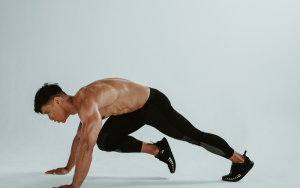
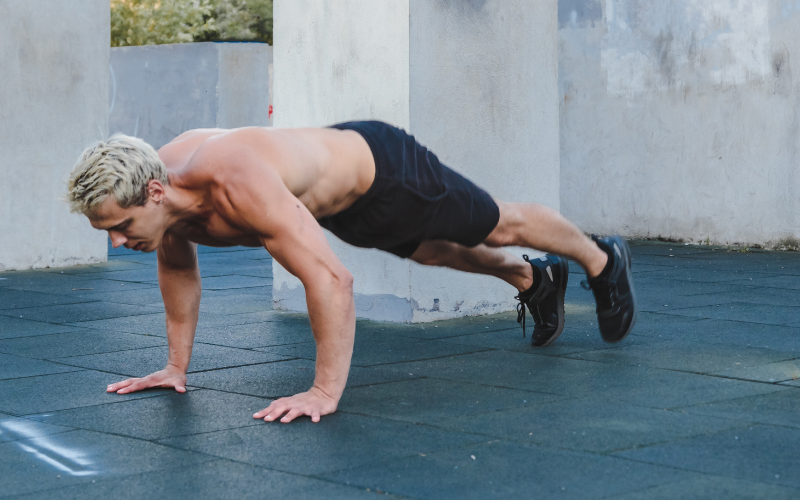
- Kick your feet back into a high plank. Your body should form a straight line from head to heels. Keep your core tight and your hips level — not sagging toward the floor, not piked up in the air. The common cue is “keep your hips above your knees,” which is more accurate than “keep your hips high.”
- Perform one push-up. Lower your chest until it lightly touches or nearly touches the floor, with your elbows tracking back at roughly a 45-degree angle. Keep your neck neutral instead of dropping your head, which throws off your spinal alignment.
- Jump your feet forward so they land between or just outside your hands, knees tracking between your elbows. This brings you back into a low squat.
- Explode upward into a vertical jump, reaching overhead and fully extending through your hips. This is the power component of the movement — don't shortchange it by half-standing.
- Land softly on the balls of your feet, knees slightly bent to absorb the impact, then flow straight into your next rep.
Breathing matters more than most people think here. Exhale on the exertion phases — pushing up out of the push-up and jumping — and inhale on the way down, during the squat and the drop into plank.
Avoid holding your breath through the sequence; find a rhythm you can actually sustain across multiple reps.
As fatigue sets in, slow your cadence to protect your breathing pattern rather than letting it turn into gasping, since form (and breath control) tends to break down before your muscles actually give out.
One quick note on variation: this exact sequence — squat, plank, push-up, jump feet in, explosive jump — is the full prison burpee. Drop the push-up and jump and you're back to the original 4-count squat thrust.
Add a leg spread between the push-up and the jump and you've got the 8-count bodybuilder. Same foundational pattern, different levels of demand.
Common Prison Burpee Mistakes and How to Fix Them
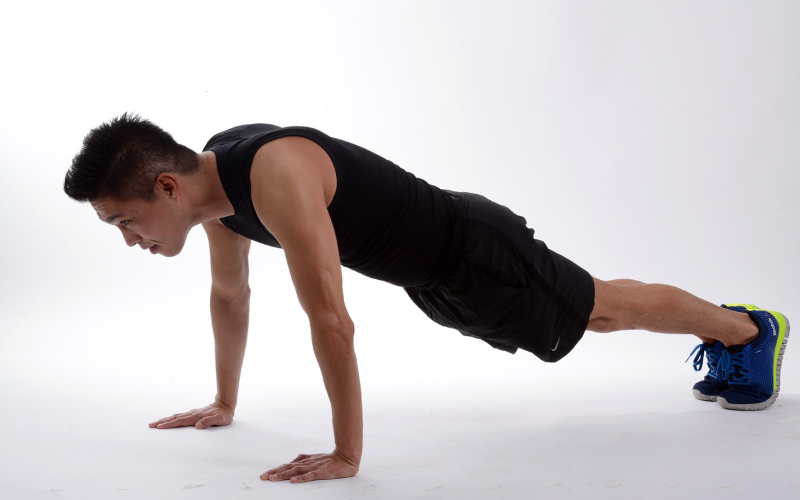
Most prison burpee injuries and “no-reps” don't come from the exercise itself — they come from fatigue-driven breakdowns in form. Here are the mistakes that show up most often, and how to correct each one:
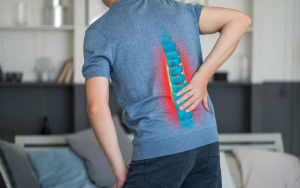
Sagging hips in the plank or push-up. When your lower back dips toward the floor, you're putting unnecessary stress on your spine and losing the core engagement the movement is supposed to build. Fix it by bracing your core and moving your chest and hips as a single unit, keeping your hips level throughout.
Rushing once fatigue sets in. This is a complex, multi-position movement, and speed is the first thing that exposes bad technique. Slow your pace down before your form actually breaks — don't wait until you're already sloppy to make the adjustment.
Hand placement that's too wide or too far forward. This overloads your neck and shoulders in ways that compound over dozens of reps. Keep your hands stacked directly under your shoulders, or just slightly wider, every time you drop into the squat.
Diving your hands into the plank position. Slamming your hands down aggressively turns a controlled movement into a high-impact one and puts unnecessary strain on your wrists. Place your hands with control instead, keeping your wrist, elbow, and shoulder stacked in a straight line.
Landing on your heels with locked legs. This strains your knees and ankles on every single rep, which adds up fast at high volume. Land on the balls of your feet with soft, bent knees — you jump from your heels, but you should always land on your toes and the balls of your feet.
Not reaching full hip extension at the top. Shortchanging the stand — not fully extending your hips before dropping into the next rep — cuts into your conditioning benefit and, in competitive settings, gets flagged as a “no-rep.” Finish every single rep standing fully upright with your hips extended.
Taking on too much volume too soon. Jumping straight into high-rep sets before your body is ready is one of the fastest ways to break down form and risk injury. Start with smaller sets — three to five reps, or two sets of ten — and stop the moment your technique starts slipping, rather than pushing through for the sake of a rep count.
Muscles Worked and Real Fitness Benefits
The prison burpee earns its reputation as a full-body movement because it genuinely trains almost everything at once. Over the course of a single rep, you're engaging:
- Quadriceps, hamstrings, and glutes (squat and jump phases)
- Erector spinae, or lower back muscles (stabilizing the plank and push-up)
- Core and abdominals (bracing throughout the entire sequence)
- Pectorals, anterior deltoids, and triceps (push-up)
- Hip flexors and calves (transitioning between positions and landing)
If you're doing the 8-count bodybuilder version, add hip abductors and adductors to that list, thanks to the leg-spread.
The only major muscle groups largely left out are the biceps and lats — so if you're building a well-rounded routine, pair burpees with a pulling movement.
The cardio benefits are backed by real research, not just gym folklore. A 12-week randomized controlled trial involving 319 inactive young men found that equipment-free burpee interval training raised VO2max by roughly 13% — a gain that matched what the cycling sprint-interval group achieved in the same study. For context, prior sprint-interval research had generally shown VO2max increases in the 4% to 9% range, which makes the burpee results notably strong for an exercise that requires zero equipment. Participants in the supervised burpee training reached 91% to 94% of their maximal heart rate, confirming this is genuinely high-intensity work, not a warm-up drill.
Burpees also go head-to-head with sprints in terms of cardiorespiratory demand. A separate peer-reviewed study compared 30-second all-out burpee bouts to 30-second cycle sprints in a small group of moderately trained college-aged participants. The result: there was no statistically significant difference between the two in terms of percentage of peak VO2 or peak heart rate reached. In plain terms, an all-out burpee set stresses your cardiovascular system about as hard as an all-out bike sprint.
That said, a popular claim floating around fitness content — that “10 burpees equal a 30-second sprint” — is a misattribution worth clearing up.
It's often credited to the American College of Sports Medicine, but the actual research came from a 2014 study published in the NSCA's Journal of Strength and Conditioning Research, and the study never actually stated “10 burpees” as a specific equivalent. That framing was added later by a fitness magazine, not the researchers themselves.
On calorie burn: burpees fall into the vigorous-intensity category of exercise, generally estimated at around 8 METs. Using standard calorie-burn formulas, that works out to roughly 10 calories per minute for a 70 kg person, with practical estimates from fitness sources commonly landing in the 10 to 14 calorie-per-minute range during high-intensity sets. These are formula-based estimates rather than lab-measured numbers, so treat them as a reasonable ballpark rather than an exact figure.
Beyond the measurable numbers, prison burpees build a combination that's hard to replicate with a single other exercise: explosive lower-body power from the jump, pushing strength and endurance from the push-up, and full-body muscular endurance from sustained high-rep sets.
There's also a mental component worth acknowledging — grinding through high-volume burpee sets is as much a test of grit as it is of fitness, which is part of why military and CrossFit programming leans on it so heavily.
Safety, Injury Risks, and Beginner Modifications
Burpees put real demand on your wrists, shoulders, core, knees, and lower back, and knowing exactly where things tend to go wrong makes it much easier to train around the risk instead of into it.
The three main injury mechanisms:
- Wrist overload — from diving into the plank position with force instead of placing your hands with control
- Lower back strain — from sagging hips during the plank or push-up, which shifts load onto your spine instead of your core
- Knee and ankle stress — from hard, straight-leg landings and an uncontrolled squat-thrust where the knees shoot out past the toes
None of these are inherent flaws in the exercise itself — they're almost always form breakdowns, which is exactly why the technique cues in the earlier sections matter as much as they do.
Know when to stop. Sharp pain, dizziness, chest discomfort, or unusual shortness of breath are not signs to push through — they're signals to end the set immediately. High-intensity exercise should feel demanding, but it shouldn't produce these symptoms.
Who needs to modify or get cleared first: if you have joint pain, existing back problems, balance issues, are pregnant, or have any heart or lung symptoms, talk to a doctor before attempting high-volume prison burpees. This isn't about avoiding the exercise altogether — it's about building toward it safely.
For anyone starting out, or anyone managing a joint issue, these modifications let you keep training the same movement pattern without the same load:
- No-jump burpee (squat thrust) — remove the final jump and simply stand instead. This is essentially the original Royal Burpee movement, and it's the best starting point for knee pain or low exercise tolerance.
- Step-back burpee — step one foot back at a time into plank instead of jumping both feet back at once, then step forward the same way. Slower and far lower-impact.
- Elevated burpee — place your hands on a bench, box, or wall to reduce load on your wrists, shoulders, and lower back.
- Knee push-up — drop to your knees during the push-up portion so you can build pressing strength without your form breaking down.
- Skip the push-up entirely — hold a brief plank instead while you build up the strength and stability to add it back in.
- Control your volume — start with two sets of ten, take longer rests, and keep intervals short, then progress gradually rather than jumping straight into high-rep territory.
- Use a cushioned surface — a mat spares your wrists and knees, especially while you're still refining your landing and hand placement.
The goal with any of these isn't to avoid burpees long-term — it's to build the strength and control needed to do the full prison burpee correctly, rather than forcing volume before your body is ready for it.
The Best Burpee Workout (Warm-Up, EMOM, Ladder Finisher, Cool-Down)
This full session runs about 35-40 minutes and combines an EMOM structure — the format best supported by interval-training research for enforcing consistent work-to-rest ratios — with a prison-style ladder finisher.
It scales across three fitness levels, so you can run the exact same workout as a beginner or advanced athlete just by adjusting reps.
Warm-up (6-8 minutes)
The goal here is raising your body temperature, mobilizing your wrists, shoulders, and hips, and rehearsing the burpee pattern before you add speed:
- March or jog in place — 60 seconds
- Jumping jacks — 30 seconds
- Arm circles — 15 seconds forward, 15 seconds backward
- Leg swings — 10 front-to-back and 10 side-to-side per leg
- Hip circles — 10 each direction
- Bodyweight squats — 10 slow, full-depth reps
- Inchworm walkouts — 5 reps, adding wrist rocks to prep the joints
- Slow practice squat thrusts — 5 reps at half speed to groove the pattern
Main workout: Burpee EMOM (20 minutes)
Set a repeating 60-second timer. At the top of each minute, complete your prescribed reps, then rest for whatever time remains.
If you can't finish within 40-45 seconds, cut your reps by about 25% and adjust from there. Rotate through four variations across a 4-minute block, then repeat that block five times:
- Minute 1 — Prison Burpee (full squat, plank, push-up, jump feet in, explosive jump). Hips above knees, hands under shoulders, soft landing.
- Minute 2 — 8-Count Bodybuilder (add the plank leg spread/close). Keep hips level through the spread instead of sagging.
- Minute 3 — Squat-Thrust (no push-up: squat, kick out, kick in, jump). This spares your shoulders while keeping volume and cardio demand high.
- Minute 4 — Lateral or Broad-Jump Burpee (finish each rep with a sideways or forward jump). Reset square before your next rep.
Rep targets by level:
| Level | Reps per minute | Notes |
|---|---|---|
| Beginner | 3-4 | Use no-jump/step-back versions for minutes 1-2; drop to a 3-variation rotation if needed |
| Intermediate | 6-8 | Follow the rotation as written |
| Advanced | 10-12 | Full push-up and maximal jump on every rep |
Finisher: Prison-Style Descending Ladder (5-8 minutes)
Mark two spots 5-10 meters apart. Do a set of prison burpees at one spot, then jog or shuttle to the other spot for your next set — the run is your only rest.
- Beginner: start at 8 and descend to 1, using no-jump burpees
- Intermediate: start at 12 and descend to 1
- Advanced: start at 15-20 and descend to 1 with full prison burpees
Cool-down (5 minutes)
Hold each stretch for 20-30 seconds:
- Standing quad stretch, each leg
- Standing or seated hamstring stretch, each leg
- Hip-flexor lunge stretch, each side
- Chest and shoulder doorway stretch
- Child's pose paired with a gentle wrist stretch
- Downward-dog into a calf stretch, finishing with 5-10 slow diaphragmatic breaths
Progression and frequency
Track your EMOM completion and ladder time every session. Once you finish each minute with 15+ seconds to spare and clean form, add 1-2 reps per minute or move up a level.
Stick to 2-3 sessions per week on non-consecutive days — burpees are high-intensity and demand real recovery time between sets.
Conclusion
The prison burpee comes down to a handful of non-negotiables: hips above knees in the squat, hands stacked under your shoulders, level hips through the plank and push-up, and a soft landing on the balls of your feet every single rep.
Build your training around the EMOM structure with a ladder finisher, and you've got a workout that's backed by real conditioning research rather than gym folklore.
Progress at your own pace — master the no-jump squat thrust and knee push-up before chasing full volume, and switch to elevated or step-back variations the moment your wrists, knees, or back start to complain.
Consistency and clean form will get you further than rushing the rep count ever will.