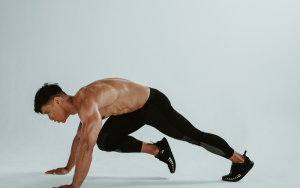
The best cardio workout with just dumbbells is a 25-minute high-intensity circuit featuring six compound movements—thrusters, renegade rows, swings, reverse lunge to press, goblet squats, and burpees—performed in 40-second intervals with 20-second rests for three rounds.
Keep reading to learn exactly how to execute each exercise, choose the right weight, and scale the workout to your fitness level for maximum cardiovascular and strength-building results.
Why Dumbbell Cardio Works Better Than You Think
The magic isn't in the dumbbells themselves—it's in how you use them. Traditional strength training involves lifting heavy weights with long rest periods between sets, giving your heart rate time to recover.
Dumbbell cardio flips this approach: you maintain a quick tempo with incomplete rest periods, which means your heart rate stays elevated from the first exercise to the last.
This sustained cardiovascular demand triggers what exercise scientists call excess post-exercise oxygen consumption, or EPOC. Your metabolism doesn't just shut off when the workout ends.
Instead, it stays elevated for 1-2 hours afterward as your body works to restore oxygen levels, repair muscle tissue, and clear metabolic waste.
The numbers tell a compelling story. High-intensity interval training with dumbbells burns 25-30% more calories than running or cycling during the same timeframe.
But here's where it gets even better: resistance training increases your resting metabolic rate, meaning you burn more calories all day long, even when you're sitting at your desk.
Steady-state cardio like jogging can't deliver this benefit.
Compound movements—exercises that recruit multiple muscle groups simultaneously—create a larger metabolic response than isolation exercises.
When you perform a thruster, for instance, you're engaging your legs, core, shoulders, and arms in one continuous motion.
More muscles working means more energy demanded, which translates to more calories burned and a stronger cardiovascular stimulus.
You're essentially getting two workouts in one. While your heart and lungs work harder to supply oxygen to all those active muscles, those same muscles are getting stronger under the resistance load.
This dual benefit is what separates dumbbell cardio from traditional approaches to either strength or cardiovascular training.
Choose Your Weight Correctly (This Determines Success)
Pick the wrong weight and you'll either struggle through poor form or turn this into a regular strength session.
The goal here isn't to test your maximum lifting capacity—it's to maintain cardiovascular intensity while performing controlled movements.
Start with roughly 50% of what you'd normally use for strength training, or about 35% of your one-rep max if you track that number.
Here's a practical test: grab a dumbbell and perform 15 controlled reps of any exercise in the circuit. If you can complete all 15 with solid form, you're in the right range.
Weight Selection by Experience Level:
| Experience Level | Men | Women |
|---|---|---|
| Beginner (0-6 months) | 10-15 lbs | 5-8 lbs |
| Intermediate (6+ months) | 15-25 lbs | 10-15 lbs |
| Advanced (2+ years) | 25-35 lbs | 15-25 lbs |
The weight should feel challenging during the final seconds of each 40-second interval, but never so heavy that your technique breaks down.
You're looking for muscle fatigue—that burning sensation in your shoulders during thrusters or your legs during goblet squats.
What you don't want is sharp pain in your joints.
If you feel pain in your knees, elbows, or shoulders, you've got one of two problems: the weight is too heavy, or your form needs correction.
Joint pain is your body's warning signal, and you should listen to it immediately.
When you're unsure between two weights, choose the lighter one.
This might feel counterintuitive if you're used to strength training, where progressive overload demands heavier weights over time.
But remember, the cardiovascular training effect comes from the interval structure and minimal rest, not from maxing out your load.
A lighter dumbbell moved quickly with excellent form will deliver better results than a heavy one that forces you to rest mid-interval or compromise your technique.
Your 25-Minute Workout Protocol (Warm-Up Through Cool-Down)
You'll complete this workout in 25-30 minutes total: a 5-minute warm-up, 18 minutes of circuit work, and a 2-minute cool-down.
The circuit itself consists of 6 exercises performed for 40 seconds each with 20 seconds of rest, repeated for 3 complete rounds.
The 40:20 interval format strikes the ideal balance between intensity and sustainability.
You're working hard enough to spike your heart rate and challenge your cardiovascular system, but the 20-second recovery prevents complete exhaustion.
This allows you to maintain quality movement throughout all three rounds rather than burning out halfway through.
Target an RPE (rate of perceived exertion) of 7-8 out of 10 during work intervals.
At this intensity, you can speak if needed, but it's difficult—you're not casually chatting.
If you're tracking heart rate, aim for 80-90% of your maximum during the 40-second work periods, dropping to 60-70% during the 20-second rest.
The 5-Minute Warm-Up:
Skip static stretching before this workout.
Research shows it decreases power output, which is the opposite of what you need.
Instead, prep your body with dynamic movements that gradually increase blood flow and activate the muscles you're about to use.
- Minute 1: Light jog in place or jumping jacks to elevate your heart rate
- Minute 2: Arm circles—30 seconds forward, 30 seconds backward—to open up your shoulders
- Minute 3: Leg swings front-to-back and side-to-side to mobilize your hips
- Minute 4: 10 bodyweight squats followed by hip circles in both directions
- Minute 5: 5 lightweight goblet squats and 5 lightweight shoulder presses using your working dumbbells
That final minute serves as a rehearsal.
You're activating the specific movement patterns you'll use during the circuit while your muscles are still fresh.
Rest Structure:
The 20 seconds between exercises is built into the format—use this time to transition to your next movement and catch your breath.
Between complete rounds, take 60 seconds if you're a beginner or intermediate exerciser.
If your form is deteriorating badly, extend this to 90 seconds. Recovery matters more than speed.
Start with 3 rounds. Beginners can drop to 2 rounds while building capacity.
Advanced exercisers can add a fourth round, but only if form stays consistent throughout round three.
For an advanced progression, reduce rest intervals as the workout progresses: 20 seconds in round one, 15 seconds in round two, and 10 seconds in round three.
This intensifies the cardiovascular demand without adding time or weight.
The Six-Exercise Circuit (Master These Movements)

Perform each exercise for 40 seconds, rest for 20 seconds, then move to the next.
Complete all six exercises, rest for 60-90 seconds, and repeat for 3 total rounds.
Exercise 1: Dumbbell Thruster
This movement spikes your heart rate faster than almost any other dumbbell exercise.
It's a squat and overhead press fused into one continuous motion, demanding coordination between your lower and upper body while keeping your cardiovascular system working overtime.
Hold your dumbbells at shoulder height with palms facing in.
Squat down until your thighs reach parallel with the floor, keeping your chest up and weight distributed through your heels.
Drive up explosively and press the dumbbells overhead in one fluid motion—don't pause at the top of the squat.
As the dumbbells reach full extension, immediately lower them back to your shoulders while beginning the next squat.
Keep your core braced throughout the entire movement.
Your knees shouldn't cave inward during the squat, and the press should be driven primarily by the power from your legs, not your arms.
Reach full hip and knee extension at the top before lowering into the next rep.
Exercise 2: Renegade Row
This combines anti-rotation core work with a pulling movement, forcing your entire body to stabilize while your heart rate stays elevated.
Start in a pushup position with your hands gripping the dumbbells directly beneath your shoulders.
Place your feet wider than hip-width for better stability.
Maintain a rigid plank position and row the right dumbbell up to your ribs while pressing the left dumbbell firmly into the floor.
Lower with control, then repeat on the opposite side.
Continue alternating for the full 40 seconds.
Your hips must stay completely level—no rotating or shifting to the side.
Squeeze your glutes to create a stable base.
Row the dumbbell toward your hip, not up toward your armpit.
If your hips start swaying, widen your stance or reduce the weight.
Exercise 3: Dumbbell Swing (Skier Swing)
Explosive hip-hinge movements are metabolic gold.
This exercise fires up your fast-twitch muscle fibers while demanding cardiovascular output.
Stand with feet shoulder-width apart, holding dumbbells in front of your thighs.
Hinge at your hips and push your glutes back while swinging the dumbbells between your legs.
Drive your hips forward explosively, using that momentum to swing the dumbbells up to chest height.
Your arms stay relatively straight throughout—they're just holding the weight, not lifting it.
Let gravity pull the dumbbells back down as you hinge again into the next rep.
This should be one continuous, rhythmic motion.
The power comes entirely from your hips, not your arms.
This is a hip hinge, not a front raise.
Maintain a flat back throughout the movement.
Your knees will bend slightly, but you're not squatting. Keep your core tight to protect your lower back.
Exercise 4: Reverse Lunge to Press
This exercise alternates between lower and upper body work, maximizing your metabolic response while giving each muscle group brief micro-recoveries.
Hold dumbbells at shoulder height. Step back into a reverse lunge, lowering until both knees reach 90-degree angles.
As you drive back to standing, press the dumbbells overhead.
Lower the dumbbells back to your shoulders and immediately step back with the opposite leg.
Continue alternating legs for the full interval.
Step back far enough that your front knee stays behind your toes.
Keep your torso upright—don't lean forward.
Control the descent, then explode upward.
Time the press so it's coordinated with reaching full standing position.
Exercise 5: Goblet Squat
The front-loaded position demands significant core engagement while targeting your entire lower body.
Hold one dumbbell vertically at chest height, cupping the top end like you're holding a goblet.
Keep your elbows close to your body.
Squat down while keeping your chest up and actively pushing your knees outward.
Descend until your thighs reach at least parallel to the floor, or deeper if your mobility allows.
Drive through your heels to return to standing.
Your elbows should track inside your knees at the bottom position.
Keep your weight distributed across your full foot—don't rise onto your toes.
Maintain a neutral spine and avoid rounding your lower back.
Squeeze your glutes hard at the top of each rep.
Exercise 6: Dumbbell Burpee
This movement uses nearly every muscle in your body and delivers an intense cardiovascular hit while building power and strength.
Stand holding dumbbells at your sides.
Place the dumbbells on the floor, then jump or step your feet back to a plank position.
Perform a pushup with your hands on the dumbbells or on the floor beside them. Jump or step your feet back toward your hands and stand up immediately.
Curl the dumbbells to your shoulders, then press them overhead. Lower and repeat.
Maintain a rigid plank during the pushup—no sagging hips.
Land softly when jumping back to minimize joint impact.
If jumping feels too intense, stepping is a perfectly effective modification.
Control the press at the top rather than using momentum from standing up.
How to Scale This Workout for Your Level (and Progress Over Time)
This circuit adapts to meet you wherever you are right now, and it provides a clear roadmap for getting stronger and fitter over the coming weeks.
For Beginners:
If you're new to high-intensity training, use 30:30 work-to-rest intervals instead of the standard 40:20. This gives you equal work and recovery time, which makes the workout challenging but manageable. Complete just 2 rounds instead of 3.
Simplify the exercises where needed. Step through burpees rather than jumping—you'll still get the cardiovascular benefit without the impact stress. For the reverse lunge to press, drop the overhead press entirely and just perform reverse lunges with the dumbbells at your sides. If your mobility limits squat depth on goblet squats, descend only as far as you can maintain proper form.
For Intermediate Exercisers:
Follow the protocol exactly as written: 40 seconds of work, 20 seconds of rest, 3 complete rounds. Your main focus should be maintaining a consistent pace throughout all intervals. You shouldn't be sprinting through the first round and crawling through the third.
If your form consistently breaks down before the 40-second mark—meaning you're stopping mid-interval or compromising technique repeatedly—reduce your weight. The right load allows you to work hard while maintaining quality movement.
For Advanced Trainees:
Progress to more aggressive intervals like 45:15 or 50:10, which dramatically increases the cardiovascular demand. Add a fourth round if you're completing three rounds with good form and finishing at an RPE of 7 or lower.
Upgrade individual exercises to increase difficulty. Replace the standard burpee with a devil's press, which adds a double dumbbell snatch at the top. Add a jump to your thrusters. Swap renegade rows for full man-makers, which combine a pushup, a row on each side, and a thruster into one brutal movement.
Your 4-6 Week Progression Plan:
Spend weeks 1-2 mastering the form on the base protocol—40:20 intervals for 3 rounds. Don't rush this phase. Building solid movement patterns now prevents injury and creates a foundation for real progress.
In week 3, choose one progression method: either decrease rest between exercises to 15 seconds, or add a fourth round. Never change both simultaneously. Progressive overload works best when you isolate variables.
Week 4 is when you consider adding weight, but only if you've completed all intervals with good form during week 3. Increase by 2-5 pounds, not more. The jump from 15 to 20 pounds might not sound like much, but it compounds across six exercises and three rounds.
Weeks 5-6 introduce more complex exercise variations. This is when advanced exercisers might add jumps to thrusters or upgrade to man-makers.
Track three key metrics: total rounds completed, weight used, and your subjective difficulty rating (RPE). If you're consistently finishing workouts at RPE 6 or lower, you've adapted to the current stimulus and need to progress. Apply only one progression strategy at a time—changing multiple variables makes it impossible to know what's driving your results.
Safety Guidelines and Training Frequency
Do this workout 2-3 times per week, maximum. High-intensity dumbbell circuits create significant metabolic stress and muscle damage, and your body needs time to recover and adapt. Schedule at least 48 hours between sessions—if you train Monday, wait until Wednesday or Thursday before repeating this protocol.
Keep these sessions under 30-35 minutes total. Longer high-intensity workouts trigger excessive cortisol elevation, which can interfere with recovery, disrupt sleep, and eventually lead to overtraining symptoms. The 25-minute structure built into this workout keeps you safely within that window.
During the Workout:
Stop immediately if you experience joint pain. This is distinct from muscle fatigue or the burning sensation in your muscles—joint pain feels sharp and localized in your knees, elbows, or shoulders. Muscle fatigue is normal and expected. Joint pain signals something is wrong with either your weight selection or your form.
If your form deteriorates significantly before an interval ends, rest until the next exercise begins. You're not failing by stopping early. You're making the smart decision to protect yourself from injury. Compromised form under fatigue is how people get hurt.
Watch for the telltale sign of poor form: swinging the dumbbells to generate momentum. If you're jerking weights around or using your whole body to compensate for muscles that are tired, you're cheating those muscles out of the work they need to do. This isn't training—it's just creating injury risk.
Post-Workout Recovery:
Spend 2-3 minutes cooling down with light movement like walking or gentle arm swings. This helps gradually lower your heart rate and prevents blood from pooling in your extremities. Follow this with static stretching, which is appropriate and beneficial after training, unlike before.
The Critical Insight:
Intensity through structured intervals matters more than exercise novelty or heavy weight. A 15-pound dumbbell used correctly through this circuit will produce superior cardiovascular results compared to a 40-pound dumbbell used for traditional strength sets with long rest periods.
Start conservatively with your weight selection. Prioritize form absolutely. Progress through interval manipulation—shorter rests, additional rounds, longer work periods—before adding load. This approach builds cardiovascular capacity and movement quality simultaneously, creating a foundation for long-term progress without injury.
Conclusion
This protocol gives you a complete cardiovascular workout using nothing more than a pair of dumbbells and 25 minutes. The six-exercise circuit delivers the metabolic benefits of traditional cardio while building strength simultaneously—something running or cycling can't match. Start with appropriate weight, master the movement patterns, and progress through interval manipulation rather than immediately adding load.