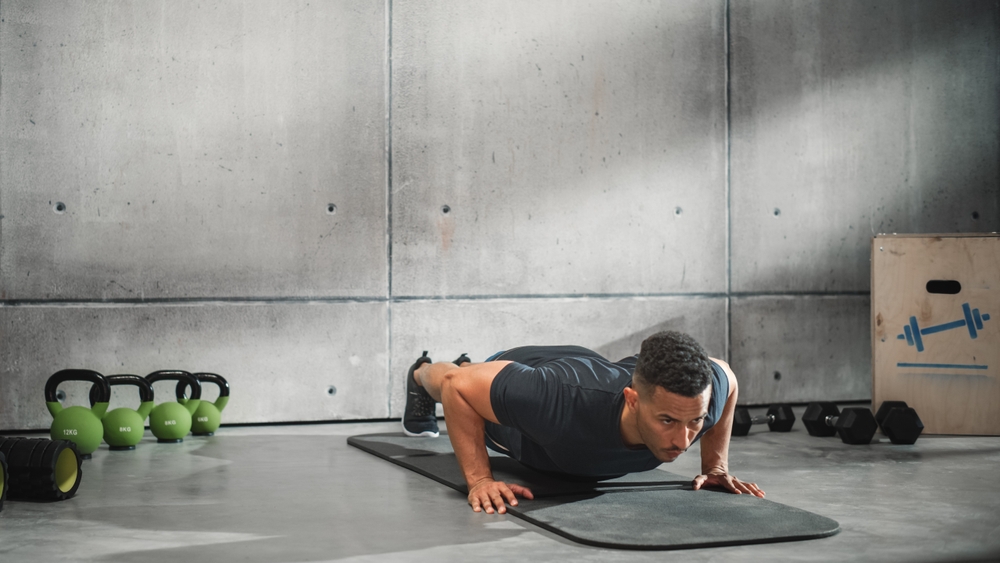
The five most critical pushup mistakes you need to avoid are: flaring your elbows out at 90-degree angles, cutting your range of motion short at the top or bottom, losing body alignment with sagging or elevated hips, shrugging your shoulders toward your ears, and rushing through repetitions without control.
Keep reading to understand exactly why each mistake sabotages your results and how to fix them with simple form adjustments.
Mistake #1 – Flaring Your Elbows Out Too Wide
Most people set up for pushups with their elbows pointed out at 90-degree angles, creating a “T” shape when viewed from above.
This comes from a persistent myth that wider positioning hits the chest harder, but the opposite is true—you're just loading your shoulder joints in a compromised position.
When your elbows flare excessively, you place dangerous stress on the shoulder joint itself rather than the muscles you're trying to work.
This positioning increases your risk of rotator cuff tendon irritation and shoulder impingement, two injuries that can sideline your training for weeks or months.
Research shows that once your elbow angle exceeds 60 degrees from your torso, your shoulder moves into a mechanically disadvantaged position where injury risk climbs sharply.
Here's how to fix it:
Position your elbows at roughly 30-45 degrees from your body as you lower down.
From above, this creates an “arrow” shape instead of that problematic “T” configuration.
Your hands should sit just outside shoulder-width or even slightly narrower—not in that exaggerated wide stance you might see in old training videos.
This adjustment does something important: it aligns your elbow path with your chest muscle fibers, which maximizes muscle activation while protecting your joints.
Think about actively tucking your elbows toward your ribs as you descend.
They can travel slightly backward during the movement, but they shouldn't wing outward.
Pay attention to your hand position too.
Keep your hands neutral with fingers pointing straight ahead or angled slightly outward at about 45 degrees.
Never turn your hands inward—this hand angle actually contributes to elbow flaring and compounds that shoulder impingement risk you're trying to avoid.
Mistake #2 – Cutting Your Range of Motion Short
You're cheating yourself if you stop several inches from the floor or fail to fully extend your elbows at the top.
Both versions of this mistake are incredibly common, and both dramatically reduce what you get from each repetition.
Partial reps cut your time under tension during the hardest parts of the movement—exactly where your muscles need to work most.
This limits muscle development throughout the full range and turns what should be a challenging exercise into something far less effective.
You might knock out more reps, but you're building less strength and muscle than someone doing half as many full-range pushups.
The complete repetition should look like this:
Lower your body until your chest touches the floor or comes within one inch of it.
Don't let yourself completely collapse and disengage muscle tension at the bottom—you should maintain control throughout.
At the top position, fully extend your elbows into complete lockout. No bent-arm finishes.
Control matters just as much as depth.
Aim for at least 2 seconds on the way down and 2 seconds pushing back up.
This tempo ensures you're actually working through the full range rather than just bouncing through the motion.
Here's a key detail most people miss: your entire body should reach the same level at the bottom.
That means your chin, chest, stomach, hips, and thighs all arrive together—not just your nose or forehead touching down while your hips stay elevated.
If only your head is reaching the floor, you're essentially doing a partial rep with poor body alignment.
Keep your head in neutral alignment with your spine throughout the movement.
Don't crane your neck forward into a “gooseneck” position to artificially reduce how far you need to descend.
Looking up excessively creates the same problem and actually reduces your power output, making the pushup harder for the wrong reasons.
Mistake #3 – Losing Body Alignment and Core Tension

Two alignment errors dominate pushup failures: hips sagging toward the floor (creating a “cobra” or “banana” shape) or hips rising too high (forming an inverted “V” or “downward dog” position).
Neither one works.
Sagging hips signal inadequate core engagement.
When your midsection drops, your lower back compensates with hyperextension, which can lead to legitimate pain and injury over time.
The opposite problem—elevated hips—reduces the exercise's effectiveness entirely.
You're essentially taking load off the muscles you're trying to target and turning the pushup into something closer to a pike press.
Your body needs to move as one solid unit, not in segmented pieces where different parts arrive at different times.
Here's what proper alignment requires:
Before you even start your first rep, engage your core by pulling your belly button toward your spine.
Then actively squeeze your glutes.
Think “tight gut, tight butt”—this cue alone fixes most alignment issues.
You need to maintain a rigid plank position from head to heels throughout the entire movement, with your body forming a perfectly straight line.
No bend at the hips, no excessive curve in your lower back.
If you can't hold this position for a full set of pushups, you need to regress temporarily.
There's no shame in building the foundation first:
- Incline pushups: Place your hands on a bench, box, or wall to reduce the resistance
- Knee pushups: Drop to your knees to decrease the load while maintaining proper alignment
Choose the variation where you can execute perfect form for your target rep range.
Build sufficient core strength there before progressing to harder versions.
One detail worth understanding: your shoulder blades should move naturally during pushups.
They'll retract (come together) as you lower and protract (separate) as you push up.
Don't try to lock them in one position throughout the movement—this natural scapular motion is part of healthy shoulder mechanics.
Mistake #4 – Shrugging Your Shoulders and Ignoring Your Lats
When your shoulders creep up toward your ears during pushups, your trapezius muscles hijack work that should go to your chest, shoulders, and triceps.
This compensation pattern reduces your stability, decreases your pushing strength, and shifts tension away from the muscles you're actually trying to develop.
You end up with a less effective exercise and increased strain on your upper traps—exactly what you don't want.
Most people also completely neglect their lats during pushups, which is a bigger oversight than you might think.
Your lats provide a stabilization component that significantly improves both strength output and shoulder health.
When you ignore them, you're essentially performing the exercise with one hand tied behind your back.
The fix requires active engagement before you even begin the movement:
Pull your shoulders down and away from your ears using your lat muscles.
You want to create maximum distance between your ears and shoulders—think about actively depressing your shoulder girdle.
This isn't a passive position; you need to maintain this muscular tension throughout every single repetition.
Here's a powerful cue that activates your lats and fixes your shoulder position simultaneously: imagine you're “screwing your hands into the floor.”
This mental image promotes external rotation at the shoulders, which turns on your lats and locks your shoulders into a stable position.
You're not actually twisting your hands—the floor won't move—but the isometric tension from attempting this rotation creates the stability you need.
Once you establish this shoulder-down, lat-engaged position at the start of your set, don't let it slip as you fatigue.
The moment your shoulders start riding up toward your ears, reset between reps if needed.
This position provides the foundation for both safety and performance, keeping tension exactly where it belongs.
Mistake #5 – Rushing Through Repetitions Without Control
Cranking out pushups as fast as possible might inflate your rep count, but it sabotages everything else.
Rapid, uncontrolled movements increase shear force on your elbow joints, reduce time under tension, and eliminate the benefits of the eccentric (lowering) phase—which happens to be particularly important for muscle growth and strength development.
Speed also makes maintaining proper form essentially impossible.
You can't focus on elbow position, core tension, and shoulder stability when you're just bouncing up and down.
Slow down your tempo significantly:
Take at least 2 seconds to lower your body to the floor with complete control.
If you're more advanced and looking for an extra challenge, extend this to 4-5 seconds on the descent.
Pause briefly at the bottom position without bouncing, then push back up with controlled power.
The ascent can be quicker than the descent, but it should still be deliberate—not explosive or jerky.
The principle here is simple: quality over quantity.
Fewer perfect repetitions with proper tempo will yield far better results than twice as many rushed, sloppy reps.
Ten controlled pushups with 2-second descents build more strength and muscle than twenty fast ones where you're essentially free-falling to the floor and rebounding back up.
Each repetition should look identical whether it's your first or your last.
If your form starts breaking down—elbows flaring, hips sagging, shoulders shrugging—you're done with that set.
Stop there instead of grinding out additional reps with compromised technique.
If you can't perform pushups with proper form and tempo, use easier variations.
Incline pushups or knee pushups allow you to build the necessary strength without sacrificing technique.
Never compromise your form just to complete more repetitions.
Build a solid foundation first, then progress to more difficult variations once you've mastered the fundamentals.
Conclusion
Fixing these five mistakes transforms the pushup from a potentially harmful movement into one of the most effective exercises you can do.
Start with proper elbow positioning, full range of motion, and rigid body alignment, then add lat engagement and controlled tempo.
Master these fundamentals before chasing higher rep counts—your joints and muscles will thank you.