The five best SI joint stretches for low back pain are the single knee-to-chest, figure-4 piriformis stretch, lower trunk rotation, glute bridge, and double knee-to-chest — all of which work by decompressing the joint, releasing tight surrounding muscles, and rebuilding the pelvic stability your SI joint needs to stop hurting.
Keep reading for a full breakdown of how each one works, how to do them correctly, and what to watch out for.
What the SI Joint Is and Why It Causes Pain
The sacroiliac joint is where your sacrum — the triangular bone at the base of your spine — connects to the ilium, the large upper portion of your pelvis.
It's the largest axial joint in the body, yet it barely moves: just 2–4 mm of displacement and about 3 degrees of flexion. Its main job is transferring your upper body's weight into your hips and legs while absorbing shock with every step.
Two things keep it stable:
- Form closure — the sacrum's wedge shape and interlocking joint surfaces, reinforced by some of the body's strongest ligaments
- Force closure — active muscular compression from the glutes, piriformis, and deep core
When either system breaks down through injury, weakness, or degeneration, the joint becomes inflamed or unstable.
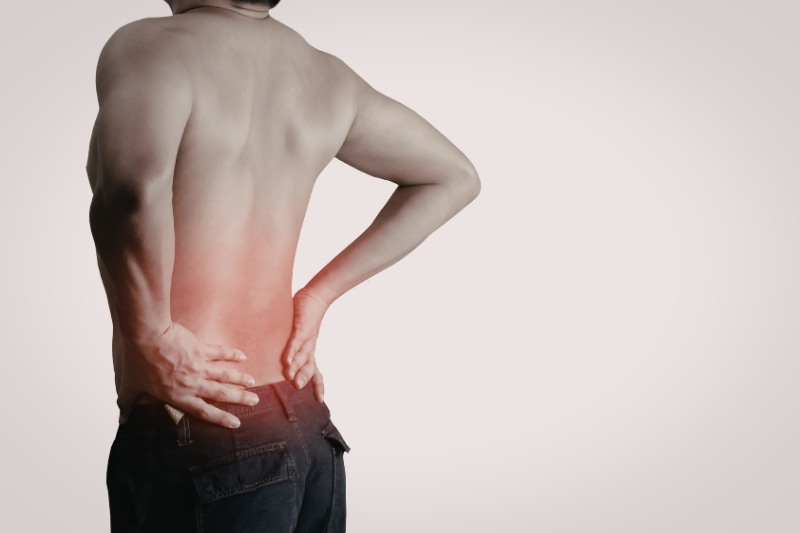
Pain typically appears on one side, just below the beltline, and can radiate into the buttock, hip, groin, or thigh — mimicking sciatica in roughly 28% of cases. Women experience SI joint pain about twice as often as men.
The 5 Best SI Joint Stretches
1. Single Knee-to-Chest
Lie on your back with both knees bent and feet flat on the floor. Clasp both hands around one knee and gently pull it toward your chest until you feel a comfortable stretch through your lower back, buttock, and back of the hip.
Keep your opposite foot flat and your lower back pressed into the mat. If reaching your knee is uncomfortable, loop a towel behind your thigh instead.
Parameters: Hold 15–30 seconds per side, 2–4 reps per leg, once or twice daily.
This is the most universally recommended SI joint stretch for good reason. It directly decompresses the joint by flexing the hip and flattening the lumbar curve, while loosening the erector spinae, glutes, and hip flexors — all of which attach near or across the SI joint.
2. Figure-4 Piriformis Stretch
Lie face-up with knees bent. Place your right ankle just above your left knee and let the right knee fall outward, forming a “4” shape.
Reach both hands behind your left thigh and gently pull it toward your chest until you feel a deep stretch in your right outer hip and buttock. Keep your back flat and shoulders on the ground throughout.
Parameters: Hold 15–30 seconds per side, 2–4 reps, daily.
The piriformis originates directly from the sacrum and crosses over the SI joint. When it's tight, it pulls the sacrum into asymmetric alignment and drives dysfunction. This stretch targets the piriformis and deep external hip rotators, restoring balanced tension across both sides of the joint.
3. Lower Trunk Rotation
Lie on your back with knees bent and feet hip-width apart. Extend your arms out to the sides in a T-shape, palms down.
Draw your belly button toward your spine to engage your core, then slowly let both knees drop together to one side as far as comfortable. Your upper back stays flat on the floor. Hold briefly, return to center using your core, and repeat to the other side.
Parameters: Hold 5–30 seconds per side, 5–10 reps, daily.
This one does double duty — it gently mobilizes the SI joint through controlled rotation while also training the obliques, quadratus lumborum, and lumbar paraspinals that are responsible for dynamic pelvic stability. Engaging your core before rotating is what makes it therapeutic rather than just a passive stretch.
4. Glute Bridge
Lie on your back with knees bent at roughly 90 degrees, feet flat and hip-width apart. Press your lower back into the floor with a posterior pelvic tilt, then push through your heels, squeeze your glutes, and lift your hips until your shoulders, hips, and knees form a straight line. Lower slowly, one vertebra at a time.
Parameters: Hold 5–6 seconds at the top, 8–12 reps, 2–3 sets daily.
This is the only strengthening exercise in the group, and it earns its place. The gluteus maximus attaches directly to the sacrum and ilium — the two bones that form the SI joint.
When it's weak, the joint relies entirely on passive ligaments for stability, which leads to overload and pain. Research supports glute strengthening specifically for persistent SI joint pain, and the bridge is the most accessible way to start rebuilding that force closure mechanism.
5. Double Knee-to-Chest
Lie flat on your back and slowly bring both knees toward your chest simultaneously. Wrap your arms around them and gently hug your knees in, keeping your tailbone on the floor. Breathe deeply and let your lower back soften into the mat with each exhale.
Parameters: Hold 15–30 seconds, 2–4 reps, once or twice daily.
Think of this as the single knee-to-chest stretch scaled up. Pulling both knees in at once decompresses both SI joints symmetrically and releases the erector spinae, bilateral glutes, and hamstrings in one movement.
It's particularly useful when tension is high on both sides or when you need a simple way to close out your routine.
Who Should Be Careful With These Stretches

The most important thing to understand before starting this routine is that SI joint pain often stems from instability, not stiffness. Stretching a joint that's already too loose makes things worse.
If you have known joint hypermobility, Ehlers-Danlos syndrome, or pregnancy-related ligament laxity, your priority should be strengthening — not stretching — and an SI joint support belt may help more than any of the exercises above.
Pregnant women fall into a similar category. SI joint pain during pregnancy is driven by hormonal changes that loosen ligaments, so adding more flexibility work can aggravate rather than relieve symptoms. A physical therapist or OB/GYN can point you toward safer options.
Get medical clearance before starting if you have any of the following:
- Herniated discs
- Osteoporosis
- Ankylosing spondylitis or other inflammatory joint conditions
- Fractures or active infections affecting the spine or pelvis
Stop and seek prompt medical evaluation if you notice any of these red flags:
- Fever alongside joint pain
- Bowel or bladder changes
- Progressive weakness in your legs
- Unexplained weight loss
- Pain that started after significant trauma
These symptoms can point to conditions that need medical treatment, not stretching.
How to Get the Most From Your Routine
Always warm up for 5–10 minutes before stretching — walking, stationary cycling, or gentle marching in place all work. Stretching cold muscles reduces effectiveness and raises your injury risk.
Consistency matters more than effort. Aim for once or twice daily, cycling through three exercises per session and holding each stretch for about 30 seconds across 3–4 sets.
Sporadic practice delivers little benefit; a steady daily routine is what produces results within the 2–6 week window.
Stretching alone only addresses half the problem. Pair it with strengthening work — the glute bridge from this list is a start, but clamshells, bird-dogs, and side-lying hip abduction all build the muscular support system your SI joint depends on.
Clinical guidelines back this up: combining stretching with targeted strengthening consistently outperforms either approach on its own.
A few other things worth adding to your routine:
- Heat or ice for 15–20 minutes to manage soreness and improve tissue mobility
- Low-impact aerobics such as swimming or walking on flat surfaces to keep the joint moving without overloading it
- Manual therapy from a physical therapist, which research shows produces better long-term outcomes when combined with exercise
- Acupuncture, which showed meaningful improvements in pain scores in a 2022 analysis and is endorsed for chronic low back pain
Finally, respect the pain boundary. Mild tension during a stretch is normal — sharp, stabbing, or radiating pain is not. If any exercise reproduces your symptoms or sends pain down your leg, stop and reassess.
Conclusion
These five stretches work because they address SI joint pain from multiple angles — decompressing the joint, releasing the muscles that pull it out of alignment, and rebuilding the stability it needs to function under load.
Do them daily, pair them with strengthening, and most people start feeling a real difference within 2–6 weeks.
If your pain persists or worsens despite consistent effort, see a healthcare provider — SI joint pain can be mistaken for disc problems, piriformis syndrome, or inflammatory conditions that need a different approach entirely.